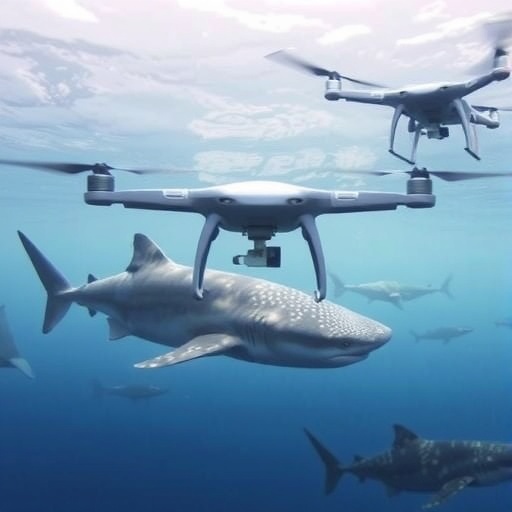
In a groundbreaking study spearheaded by Murdoch University, researchers have revealed that drones flown at varying altitudes above the oceanic environment do not disturb whale sharks, the largest fish species on our planet. This research represents a significant stride in wildlife monitoring technology, providing critical insights into how these gentle giants behave when drones are employed as observational tools in marine settings.
Drones have increasingly become indispensable in ecological and behavioral research, offering unparalleled aerial perspectives in population assessments, behavioral studies, and morphometric analyses of wildlife. Yet, their rising ubiquity in natural habitats brings the essential query of whether these machines inadvertently influence the very subjects they aim to study. The new investigation illuminates the intricacies of drone-wildlife interactions, focusing on ensuring that scientific inquiry remains minimally invasive.
Dr. Samantha Reynolds, lead author and researcher at the Harry Butler Institute within Murdoch University, emphasizes the necessity of scrutinizing the ecological footprint of drones. Although drones have occasionally been noted to trigger behavioral shifts in marine mammals such as whales and dolphins, prior research often relied on observational data without rigorous physiological or biomechanical validation. Such methodologies carry inherent biases and may overlook subtle stress responses.
Breaking new ground, the team employed biotelemetry to collect precise physiological and biomechanical data from 13 whale sharks inhabiting the Ningaloo Reef, a biodiverse marine ecosystem off the coast of Western Australia. Motion-sensing tags affixed to the animals recorded critical parameters including swimming effort, tail beat frequency, and dive profiles. These metrics were carefully chosen for their proven correlation with stress and escape behaviors in pelagic fish species.
During data collection phases, drones were operated directly overhead at controlled altitudes ranging from 10 to 60 meters. This vertical gradient allowed the researchers to assess any altitude-dependent variations in shark responses. The team also monitored behavioral changes during drone ascent and descent phases, which are periods potentially disruptive due to fluctuating noise and visual presence.
Analytical comparisons between tagged shark behavior under drone presence and control periods without aerial vehicles revealed no statistically significant deviations. The whale sharks maintained consistent swimming rhythms and dive patterns irrespective of drone proximity or movement, suggesting a lack of overt disturbance or avoidance behavior.
Such findings carry transformative implications for marine ecology and conservation practices. Drones, when operated responsibly, emerge as potent research tools capable of yielding rich datasets while imposing minimal interference with animal behavior. Dr. Reynolds articulates that these outcomes should bolster confidence among conservationists and policymakers advocating for drone-assisted monitoring in marine environments.
Despite these promising results, the researchers advocate for a precautionary principle in drone deployment. Unmeasured physiological impacts — such as elevated cortisol levels or other stress hormones — could potentially manifest even in the absence of immediate behavioral alterations. Furthermore, the study’s focus on whale sharks does not preclude more sensitive species like seabirds, turtles, or marine mammals from experiencing distress from drone activity.
The legal framework in Western Australia supports such precautionary measures, mandating drone operators, whether commercial or recreational, to maintain a minimum separation of 60 meters from whale sharks and marine mammals. Permits for research drone flights are stringently regulated to ensure wildlife welfare remains paramount.
Published in the reputable journal Ecosphere, this research stands as the first to harness high-resolution biotelemetry alongside drone usage in marine megafauna contexts. The interdisciplinary collaboration involved scientists from diverse institutions including ECOCEAN Inc, Swansea University, James Cook University, and Griffith University, reflecting the global significance and rigorous scientific approach underpinning the study.
The environmental funding for this project was provided by notable organizations such as the Estate of Winifred Violet Scott and The Jock Clough Marine Foundation, alongside operational partners like RAC Parks and Resorts and Three Islands Whale Shark Dive. This multi-stakeholder backing underscores the widespread recognition of drones as a pivotal innovation in wildlife research.
As drone technology continues to evolve with enhanced stealth and quieter operation, future investigations will be poised to expand upon these findings. Integrating physiological biomarkers, long-term ecological monitoring, and multi-species studies will further refine guidelines to harmonize cutting-edge technology with the delicate balance of marine ecosystems.
Subject of Research: Animals
Article Title: Using biotelemetry to assess drone effects on whale sharks
News Publication Date: 1-Apr-2026
Web References: http://dx.doi.org/10.1002/ecs2.70575
Image Credits: Murdoch University
Keywords
Whale Sharks, Biotelemetry, Drone Technology, Marine Ecology, Wildlife Monitoring, Conservation, Ningaloo Reef, Stress Response, Marine Megafauna, Behavioral Ecology, Remote Sensing, Ecological Research
Tags: aerial wildlife population assessmentsbehavioral studies of whale sharksbiotelemetry in marine biologydrone altitude effects on marine animalsdrone impact on whale sharksdrone technology in marine ecologyecological footprint of drones in oceanmarine wildlife monitoring with dronesMurdoch University marine researchnon-invasive marine research methodsstress response in marine species to droneswhale shark behavior under drone observation