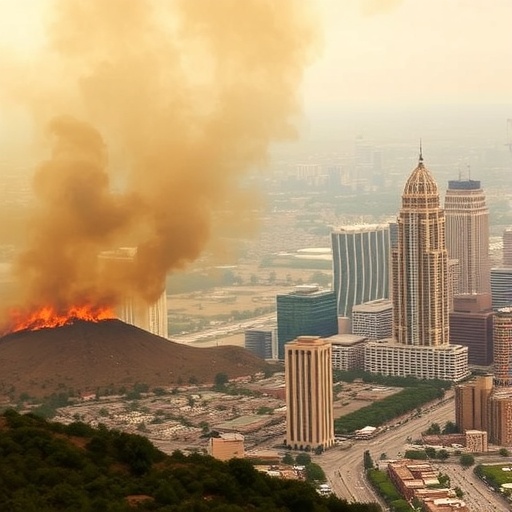
In the autumn of 2025, Los Angeles experienced one of the most devastating urban fire events in modern history, reshaping not only its physical landscape but also its socio-ecological fabric. Recent research led by Norlen, Sharma, and Escobedo, published in Nature Communications, delves deeply into the multifaceted impacts these fires imposed on communities, neighborhoods, and homes. Their work offers unprecedented insight into the intricate dynamics between urban fire disasters and their cascading effects on social structures and ecological networks within one of America’s largest metropolitan areas.
The 2025 fires were not isolated incidents but rather the culmination of evolving climatic pressures, urban sprawl, and changing social dynamics. By integrating environmental science and social analytics, the researchers mapped both the immediate and protracted consequences of the fires. Their approach combined satellite data, high-resolution socio-demographic mapping, and field studies to capture the fire’s imprint on a micro and macro scale. This comprehensive methodology allows for a granular understanding of how the fire altered socioeconomic parameters and ecological equilibria.
Fundamentally, the urban fires disrupted neighborhoods not simply by destroying buildings but by fracturing the community cohesion that underpins resilience. The study highlights how displacement and loss of housing exponentially exacerbated vulnerabilities, especially among low-income populations and marginalized groups. Neighborhoods with preexisting socio-economic stressors were disproportionately affected, further widening regional inequalities. The authors emphasize that fire damage cannot be assessed purely in physical terms – the social aftershocks are equally, if not more, consequential.
From an ecological standpoint, the fires consumed not only built infrastructure but also urban green spaces that play crucial roles in climate regulation and mental health. The researchers document the loss of tree canopies, parks, and open spaces that serve as natural firebreaks. The degradation of such ecological assets intensifies the urban heat island effect, reduces biodiversity, and compromises the city’s ability to absorb future shocks. The domino effect of fire on ecosystem services illustrates the need for integrated urban planning that couples disaster mitigation with ecological restoration.
The multidisciplinary analysis also underscores the complex interactions between fire dynamics and urban design. The spatial distribution of fire damage corresponds significantly with patterns of land use, building materials, and urban density. Older neighborhoods with wooden structures suffered more severe losses, while areas with modern fire-resistant construction experienced comparatively less devastation. This finding propels a critical discourse around urban development policies aimed at increasing resilience through building codes and fire-adaptive architecture.
Social displacement emerged as a key theme with long-lasting repercussions. The disruption of social networks, displacement from established communities, and the psychological trauma associated with loss collectively erode social capital. The study underscores that community recovery goes beyond physical reconstruction – it requires restoring trust, networks, and social support systems to foster holistic resilience. The trauma associated with experiencing an urban wildfire echoes over years, demanding sustained mental health and social services interventions.
Another pivotal insight relates to the fire’s effect on housing affordability and accessibility. The destruction of homes exacerbated an already strained housing market in Los Angeles, driving up rents and displacing renters into more precarious living situations. This socio-economic destabilization contributes to gentrification in areas considered “safer” post-fire, producing complex displacement dynamics that entwine environmental disaster with urban social justice challenges. Policy responses, therefore, must address these intertwined crises to foster equitable recovery.
The researchers bring to light environmental justice concerns that permeate the aftermath of the fires. Historically underserved communities face disproportionate exposure to environmental hazards and receive delayed assistance in recovery, a gap mirrored during the 2025 fires. By corroborating satellite imagery with census data, the study makes a compelling case for prioritizing vulnerable populations in disaster preparedness and response. Such an approach ensures that resilience-building is inclusive and attentive to socio-economic disparities.
Integrated fire risk assessment models developed in this study also predict potential future urban fire scenarios given evolving climate conditions and land use trends. These predictive tools incorporate socio-economic factors alongside ecological and meteorological variables, facilitating targeted policymaking and resource allocation. Such advanced modeling is vital as urban wildland interfaces expand, making cities like Los Angeles increasingly prone to complex fire risks.
The study goes further to explore community-driven coping mechanisms and localized adaptations post-fire. Some neighborhoods demonstrated remarkable agency through grassroots rebuilding efforts, social solidarity, and environmental stewardship. These bottom-up responses highlight the critical role of community engagement in effective disaster recovery, suggesting that resilience is not solely dependent on top-down interventions but also on empowering local actors.
Moreover, the research explores the linkages between urban fire events and public health outcomes, noting an uptick in respiratory illnesses, mental health disorders, and stress-related conditions following the fires. The release of particulate matter and toxic substances from burning urban infrastructure compounds these health threats. These findings advocate for enhanced public health preparedness integrated with environmental disaster management.
In the broader context, this research challenges the traditional siloed perspectives that often treat social and ecological impacts separately. By framing urban fires as socio-ecological phenomena, the authors advocate for holistic strategies that simultaneously address landscape vulnerability, urban inequalities, and community resilience. This paradigm shift aligns with emerging climate adaptation frameworks that call for interconnected solutions to complex urban challenges.
The authors conclude with calls to action, urging policymakers, urban planners, and community leaders to rethink fire management strategies by embedding social equity and ecological sustainability into the core of urban resilience planning. As climate change intensifies wildfire risks, metropolitan areas globally can draw lessons from the Los Angeles case study to avoid repeating catastrophic outcomes and instead build adaptable, inclusive urban futures.
In sum, the 2025 Los Angeles urban fires serve as a stark, transformative event that reshaped the city’s socio-ecological landscape. The novel integration of social vulnerability, ecological degradation, and urban planning dynamics presented by Norlen, Sharma, and Escobedo offers a crucial blueprint for understanding and mitigating the ramifications of urban fire disasters. Their work underscores that the true cost of such fires extends far beyond immediate property loss, rippling through communities and ecosystems in profound and lasting ways.
Subject of Research: Socio-ecological impacts of urban wildfires on communities, neighborhoods, and homes in Los Angeles.
Article Title: Socio-ecological impacts of the 2025 Los Angeles urban fires on communities, neighborhoods, and homes.
Article References:
Norlen, C.A., Sharma, S. & Escobedo, F.J. Socio-ecological impacts of the 2025 Los Angeles urban fires on communities, neighborhoods, and homes. Nat Commun 17, 3941 (2026). https://doi.org/10.1038/s41467-026-71376-1
Image Credits: AI Generated
DOI: https://doi.org/10.1038/s41467-026-71376-1
Tags: 2025 Los Angeles urban firesclimate change and urban firescommunity resilience after firesdisplacement and housing loss in fire eventsecological effects of urban firesenvironmental science of urban firessatellite data in fire analysissocial vulnerability in fire disasterssocio-demographic mapping of fire impactsocio-ecological impacts of urban firesurban fire disaster recoveryurban sprawl and fire risk