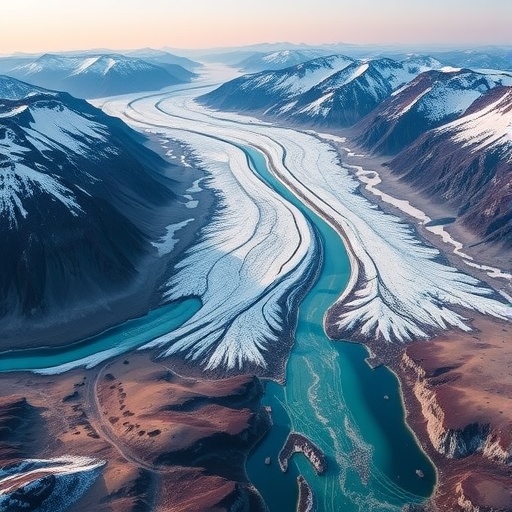
In the quest to uncover hidden reservoirs of water on Mars, scientists are turning to an innovative approach that combines advanced drone technology with ground-penetrating radar (GPR). This pioneering method, developed and tested by researchers at the University of Arizona, promises to revolutionize how we explore icy landscapes on other planets by providing detailed insights into glaciers cloaked by layers of debris. The key to unlocking this potential does not lie in distant labs or spacecraft alone, but in the rugged terrains of Earth’s most challenging environments, where terrestrial glaciers serve as analogs for Martian ice deposits.
Debris-covered glaciers on Earth defy the common perception of glaciers as vast, gleaming ice sheets. Instead, they are dominated by rocky and sediment layers that insulate the ice beneath, preserving it against melting. These glaciers are invaluable models for Martian studies because many of the Red Planet’s mid-latitude glaciers are similarly buried under rocky debris, making remote sensing from orbit insufficient to fully characterize them. The intricate layering and variable thickness of the overlaying debris on Mars directly impact how accessible ice deposits might be for future exploration and in situ resource utilization, a consideration critical to astronaut missions.
The technical heart of this research lies in the integration of lightweight ground-penetrating radar systems onto unmanned aerial vehicles (UAVs), or drones, a novel combination that allows close-range, high-resolution subsurface mapping. UAVs can fly at altitudes just tens of meters above glacier surfaces, granting radar signals the capacity to penetrate thick layers of rubble and sediment, revealing the ice beneath with remarkable clarity. This approach overcomes the current limitations of orbital radars, which are hindered by altitude and resolution constraints, leaving the stratigraphy of Martian glacial deposits largely enigmatic.
Carrying out these drone-based radar surveys required a blend of field expertise, logistical fortitude, and cutting-edge engineering. The research team endured arduous expeditions in Alaska and Wyoming, hauling sensitive radar instruments through mosquito-infested forests and climbing rocky glacier surfaces. Their perseverance paid off, with successful deployments that collected data correlating radar reflections to actual ice thickness measured by traditional excavation and drilling. This validation establishes drone-mounted radar as not only feasible but a precise technique for glacier exploration.
One of the more subtle but profound insights from this technique is the identification of internal ice layers within glaciers. These layers serve as a climatic archive, each layer encapsulating distinct periods marked by environmental shifts over centuries or even millennia. Such internal layering, elusive to orbital radars, might also exist on Mars, holding clues to the planet’s paleoclimate and potentially its habitability history. This capability to discern intra-ice stratigraphy positions drone-borne radar as a transformative tool for planetary geophysics.
Operational parameters for effective drone radar surveys were rigorously tested during these campaigns. Flight altitude, velocity, and radar alignment emerged as critical factors influencing data quality. Flying along the glacier’s flow direction optimized signal penetration and reflection accuracy, while stable flight ensured minimal noise interference. These empirical learnings set the stage for designing future autonomous or crewed missions with tailored airborne radar instruments optimized for extraterrestrial application.
The implications of these findings extend far beyond academic curiosity. Buried water ice on Mars could be the cornerstone of human exploration infrastructure, supplying astronauts not only with essential drinking water but also enabling oxygen generation and supporting agriculture inside habitats. Access to high-fidelity maps of ice thickness and debris layers will allow mission planners to pinpoint ideal drilling sites, reducing mission risks and costs. Furthermore, these ice deposits may harbor biosignatures or organic compounds, making them prime targets for astrobiological investigations.
This research forms a vital bridge between current orbital reconnaissance and the envisioned era of human presence on Mars. By providing a method to “scout” the ground from the air with unprecedented detail, drone radar surveys will help refine landing site choices, robotic mission plans, and sample collection strategies. The synergy of aerial close-up sensing and surface missions stands to accelerate our understanding of Martian glacial dynamics and water accessibility.
Beyond the Martian horizon, the drone radar methodology has promising applications here on Earth, particularly for monitoring glacier health and evolution in response to climate change. As debris-covered glaciers often shield ice from melting, accurately gauging their internal structures can improve predictive models of their response to warming. This dual utility underscores the broader significance of the technology, blending planetary science with practical Earth observation.
The research is a testament to multidisciplinary collaboration, integrating planetary geology, remote sensing technology, and field logistics. It also exemplifies how innovative adaptation of existing technologies—like ground-penetrating radar—can open new frontiers in space exploration. As we stand on the cusp of piloted missions to Mars, such groundwork is critical to ensure that explorers have the tools needed not only to survive but to thrive.
In closing, drone-based ground-penetrating radar offers a powerful window into cryptic ice formations both on Earth and beyond. By peeling back the rocky veneers that hide glaciers from plain sight, this technology brings us closer to turning Martian water ice from a tantalizing mystery into a tangible resource. With continued development and deployment, the skies above hostile icy worlds may soon be patrolled by fleets of high-tech drones, mapping and unlocking the secrets beneath their frozen crusts.
Subject of Research: Not applicable
Article Title: Revealing the Internal Structure of Mars-Analog Glaciers From Drone-Based Radar Sounding
News Publication Date: 24-Mar-2026
Web References:
10.1029/2025JE009208
Image Credits: Jack W. Holt
Keywords
Mars exploration, ground-penetrating radar, drone technology, debris-covered glaciers, ice stratigraphy, planetary geology, in situ resource utilization, Martian glaciers, UAV radar surveys, extraterrestrial water resources
Tags: advanced ice exploration technologyanalogs for Martian glaciersdetecting debris-covered glaciersdrone-based ground-penetrating radarfuture Mars astronaut missionshidden ice reservoirs on Earthice preservation under rocky debrisicy landscape characterization techniquesMartian mid-latitude ice depositsplanetary ice resource utilizationremote sensing limitations on MarsUniversity of Arizona glacier research