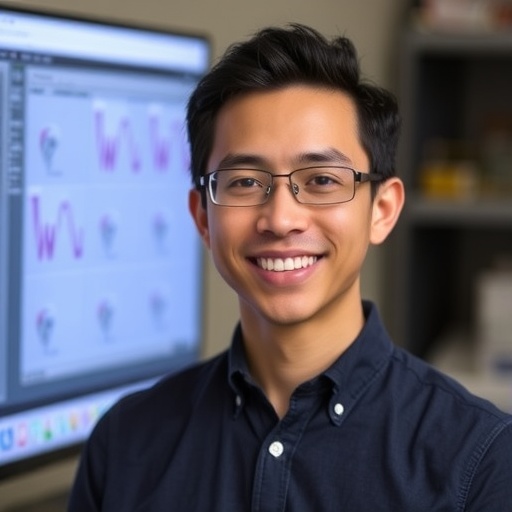
In the intricate realm of polymer science, the fundamental link between molecular architecture and observable mechanical properties often proves elusive. Polymers—long, flexible molecules forming the basis of everything from everyday plastics to complex biological tissues—exhibit behaviors highly dependent on their internal structure. Understanding how polymer chains organize and interact at the microscopic level is vital for predicting and tailoring material performance. At Binghamton University, Assistant Professor Robert Wagner is pioneering research that aims to demystify this relationship by integrating machine learning with both computational simulations and experimental investigations. His recent receipt of the National Science Foundation CAREER Award, a prestigious recognition granted to promising early-career faculty, signifies a transformative step toward unlocking the secrets held within polymer networks.
Wagner’s research confronts a central challenge in materials science: linking molecular-scale phenomena with the macroscopic mechanical characteristics that engineers and scientists observe and utilize. By deploying a novel interdisciplinary approach, his team is bridging the scales from polymer chain structure to bulk material behavior. This involves leveraging machine learning algorithms alongside rigorous experiments on real and simulated polymers, thereby enhancing predictive capabilities for design optimization. The ultimate goal is to untangle the complexity of these networks and enable engineers to tailor polymers with unprecedented precision, tuning properties like stiffness, toughness, and elasticity through controlled synthesis and processing.
Key to Wagner’s investigation is the role of entanglements—physical, knot-like interactions between polymer chains that significantly influence mechanical performance. Unlike chemical cross-links, which form permanent bonds between chains, entanglements are transient physical constraints arising as long polymer chains loop and wind around each other. This distinction is crucial because entangled polymer networks can exhibit dramatic enhancements in toughness, sometimes exceeding three orders of magnitude compared to their chemically cross-linked counterparts. Such increases are attributed to the distribution of stress: when a single chain breaks in a chemically bonded system, stress transfers directly to neighboring chains, exacerbating failure. Conversely, in entangled networks, the vast, interconnected meshwork dissipates stress over a broader region, hindering crack propagation and rendering the material more resistant to fracture.
The implications of entanglement phenomena extend beyond synthetic materials, influencing the design of biomimetic tissues and hydrogels for regenerative medicine. Natural tissues possess intricate polymeric networks with embedded water channels vital for nutrient transport—a characteristic replicated partially by hydrogels. However, current biomaterials often fail to match the mechanical robustness of living tissues, particularly in terms of stiffness, limiting their effectiveness in supporting stem cell differentiation and integration. Wagner’s hypothesis suggests that manipulating entanglements offers an experimental “design knob” to fine-tune hydrogel mechanics without compromising their complex, dynamic nature. By increasing entanglement density, the material could gain stiffness and toughness simultaneously, an outcome difficult to achieve through chemical cross-linking alone.
Studying polymer entanglements directly presents formidable challenges due to their intangible, non-chemical character. Traditional microscopy techniques lack the resolution to visualize these tangles embedded deep within bulk materials. Likewise, molecular dynamics simulations, which model chains at bead-and-spring representations, while informative at the nanoscale, are prohibitively computationally intensive for capturing the time and length scales relevant to real-world polymers. To circumvent these obstacles, Wagner introduces an innovative methodology employing machine learning, specifically graph neural networks, to detect and characterize patterns of entanglement indirectly. By abstracting polymer chains into graphs where entanglements correspond to nodes and their connectivity represents chain interactions, his approach enables rapid prediction of mechanical responses based on network topology.
This graph-based machine learning paradigm draws inspiration from social networking models, where individuals and their interconnections form complex graphs. In the polymer context, each node symbolizes a point of entanglement, and edges represent connections between these entanglements as the chains weave through the material. Such representation empowers algorithms to discern the influence of local and extended network structures, akin to understanding how layers of friends impact social dynamics. The overarching benefit lies in predictive efficiency: instead of simulating every molecular detail, the graph neural network can forecast macroscopic properties, drastically reducing computational costs and accelerating material design workflows.
Complementing computational research, Wagner’s team performs validation experiments using custom-synthesized hydrogel models engineered in-house. These physical tests provide essential benchmarks to verify the accuracy and robustness of machine learning predictions. By iterating between experimental data and algorithm refinement, the group aims to unravel the underpinnings of how synthesis parameters, processing conditions, and polymer chemistries orchestrate the emergence of useful entanglement structures. Such insights promise to establish a comprehensive knowledge base for next-generation polymer engineering, merging theory, computation, and practice.
Beyond advancing fundamental science, Wagner is equally passionate about education and outreach, striving to translate his research into accessible learning experiences. He plans to introduce interactive demonstrations of entangled networks using playful materials for K-12 classrooms, enriching early STEM engagement. Moreover, he is pioneering initiatives to bring computational STEM education into correctional facilities, overcoming logistical hurdles to provide incarcerated learners with meaningful access to advanced scientific tools. By collaborating with MATLAB’s developers to equip computer labs in prisons, Wagner envisions empowering students to explore mathematical and physical concepts through virtual experiments—bridging educational disparities and inspiring new generations of researchers.
Wagner’s journey reflects a profound commitment to continuous learning, embodying the dual role of teacher and student that defines academic research. His own path through graduate studies was sparked by curiosity about materials science’s complexities, a journey he now shares with his mentees. The success of his CAREER award application underscores the collaborative spirit underpinning his efforts, drawing on support from colleagues, students, and strategic institutional programs that facilitated rapid grant acquisition. As his team embarks on this ambitious project, Wagner views their endeavor as a foundational step toward a long-term research portfolio destined to reshape polymer science.
Ultimately, the fusion of machine learning and materials engineering heralded by Wagner’s work could revolutionize how scientists comprehend and manipulate polymer networks. By elucidating the molecular origins of macroscopic behavior, this research will empower engineers to move beyond empirical design toward predictive synthesis, crafting materials precisely calibrated for diverse applications—from robust biomedical implants to resilient industrial polymers. The knowledge generated promises not only to fill longstanding gaps in polymer physics but also to drive transformative innovations across science and technology sectors. As the scientific community anticipates the outcomes of this pioneering research, Wagner and his team stand poised at the forefront of a new era in materials discovery.
Subject of Research: Polymer network mechanics, entanglement phenomena, machine learning applications in materials science
Article Title: Unraveling Polymer Mysteries: Machine Learning Unlocks the Mechanics of Entangled Networks
News Publication Date: 2024
Web References:
National Science Foundation CAREER Award: https://www.nsf.gov/awardsearch/show-award/?AWD_ID=2539455
Binghamton University Mechanical Engineering Faculty: https://www.binghamton.edu/mechanical-engineering/people/profile.html?id=robert.j.wagner
Thomas J. Watson College of Engineering and Applied Science: https://www.binghamton.edu/watson
Image Credits: Binghamton University, State University of New York
Keywords
Polymer science, machine learning, entanglements, polymer networks, hydrogel mechanics, biomimetic materials, graph neural networks, materials engineering, computational materials science, mechanical properties, polymer physics, predictive design
Tags: computational simulations of polymersearly-career materials science researchexperimental polymer investigationsinterdisciplinary materials sciencemachine learning in polymer sciencemechanical properties of polymersNSF CAREER Award polymer researchpolymer chain organizationpolymer molecular architecturepolymer network behaviorpredictive modeling for polymerssoft material design optimization