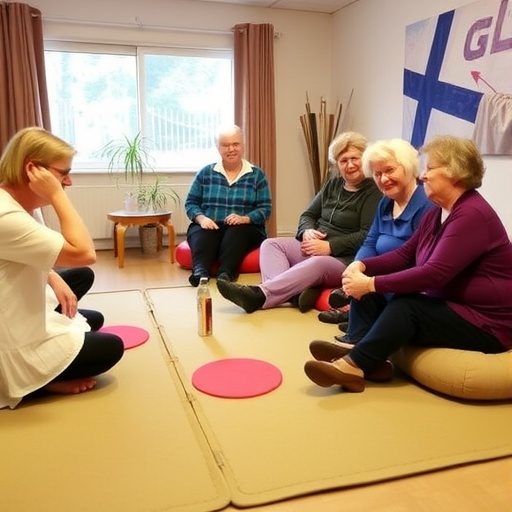
In the ever-evolving landscape of dementia care, one groundbreaking study published in BMC Geriatrics in 2026 has spotlighted a novel communication tool, “Talking Mats,” as a catalyst for enhancing the self-perceived involvement of individuals living with dementia within Swedish home care services. This randomized controlled trial offers fresh insights into how communication strategies can profoundly impact the quality of life for service users, heralding a new era of person-centered care.
Dementia, a progressive neurodegenerative condition, systematically erodes cognitive functions, posing significant challenges to effective communication between care providers and recipients. As the global population ages, the demand for compassionate, effective home care that respects the autonomy and preferences of those affected grows exponentially. However, traditional communication methods often fall short, limiting the ability of care recipients with dementia to express their needs and participate actively in decisions impacting their daily lives.
Enter Talking Mats, a visual communication framework designed to empower individuals with cognitive difficulties by using symbols and images to facilitate expression and engagement. This system transcends conventional verbal communication barriers, enabling users to construct and convey complex thoughts through a structured yet flexible format. The technology fosters dialogue that is not only comprehensible but also deeply participatory, aligning perfectly with contemporary ideals of patient-centered care.
The randomized controlled trial encompassed a diverse cohort of Swedish home care recipients diagnosed with various stages of dementia. Researchers meticulously evaluated the extent to which Talking Mats influenced the participants’ perceptions of involvement in their care planning and daily decisions. This methodological rigor ensured that observed outcomes were attributable to the intervention rather than extraneous variables, fortifying the evidence base underpinning Talking Mats’ efficacy.
A critical dimension of the study delved into the nuances of self-perceived involvement, recognizing that empowering dementia patients extends beyond objective metrics to encompass subjective experiences of autonomy and respect. By employing validated psychometric instruments alongside qualitative interviews, the researchers captured a holistic portrait of the participants’ engagement, revealing that those utilizing Talking Mats reported significantly higher levels of perceived involvement.
Moreover, this study highlighted the reciprocal nature of communication in home care dynamics. Care providers trained in the use of Talking Mats reported enhanced satisfaction and deeper relational connections with service users. This symbiotic improvement underscores the systemic benefits of integrating such tools into care protocols, potentially reducing caregiver burnout and elevating the overall standard of home care services.
The intervention’s visual and tactile modalities were especially impactful for individuals with moderate to severe dementia, who often struggle with verbal articulations. Through repeated sessions employing Talking Mats, participants demonstrated increased confidence and clarity in expressing preferences regarding meals, activities, and personal routines. This outcome suggests that adaptive communication strategies can mitigate some cognitive barriers intrinsic to dementia.
Furthermore, the study addressed potential implementation challenges, including the need for comprehensive caregiver training and the adaptation of Talking Mats to diverse cultural and linguistic contexts within Sweden. Addressing these barriers is crucial for scalable adoption, ensuring that the benefits observed are accessible across the varied spectrum of home care environments.
Quantitative data underscored the statistical significance of improvements, with effect sizes indicating moderate to strong impacts on self-reported involvement scales. These findings not only corroborate prior anecdotal evidence but also position Talking Mats as a scientifically validated tool worthy of integration into national dementia care guidelines.
Notably, the trial design incorporated longitudinal follow-ups, permitting assessment of sustained effects over time. Encouragingly, participants maintained elevated perceptions of involvement weeks after initial interventions, suggesting that the benefits of Talking Mats are not transient but contribute to enduring enhancements in communication and well-being.
The implications of this study reverberate beyond Swedish borders, offering a replicable model for other countries grappling with the challenges of dementia care amidst aging populations. By publishing rigorous data in an open-access format, the authors have paved the way for international discourse and adaptation, fostering global improvements in home care practices.
Looking ahead, the intersection of technology and human-centered care, as exemplified by Talking Mats, heralds promising avenues for multidisciplinary collaboration. Integrating digital enhancements, such as augmented reality or AI-assisted customization, could further refine and personalize communication tools, scaling their impact.
In conclusion, this pioneering randomized controlled trial substantiates the transformative potential of Talking Mats in empowering service recipients with dementia. By elevating self-perceived involvement, this tool exemplifies how innovative communication strategies can restore agency and dignity, fundamentally reshaping the narrative of dementia care. As healthcare systems worldwide grapple with demographic shifts, embracing such validated tools could herald a future where cognitive decline does not equate to diminished voice or choice.
Subject of Research:
Talking Mats as a communication tool and its effect on self-perceived involvement of service recipients with dementia in Swedish home care services.
Article Title:
Talking Mats and self-perceived involvement for service recipients with dementia in Swedish home care services: a randomized controlled trial.
Article References:
Bångsbo, A., Dunér, A. & Olsson, T.M. Talking Mats and self-perceived involvement for service recipients with dementia in Swedish home care services: a randomized controlled trial. BMC Geriatr (2026). https://doi.org/10.1186/s12877-026-07518-3
Image Credits: AI Generated
DOI: 10.1186/s12877-026-07518-3
Keywords:
Dementia care, Talking Mats, communication tools, self-perceived involvement, home care services, randomized controlled trial, cognitive impairment, person-centered care, Sweden
Tags: communication strategies for cognitive impairmentdementia care involvement Swedenempowering dementia patientsenhancing dementia patient autonomyhome care services for dementiaimproving dementia quality of lifeinnovative dementia care methodsnon-verbal communication aidsperson-centered dementia carerandomized controlled trial dementiaTalking Mats communication toolvisual communication in dementia