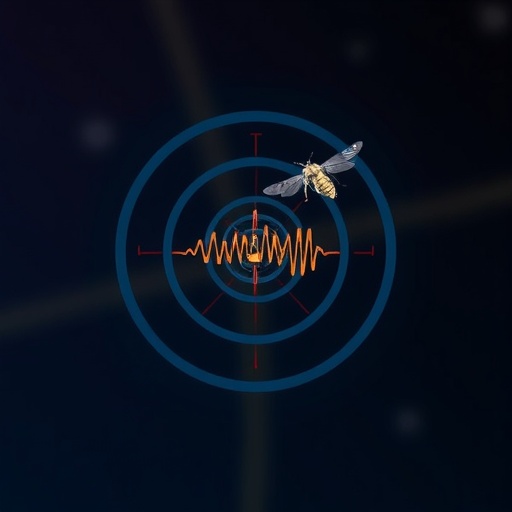
In a groundbreaking advancement poised to revolutionize ecological monitoring, a team of researchers led by Adam Narbudowicz has developed a novel noninvasive method to classify insects using millimeter-wave (mmWave) radar and sophisticated machine learning algorithms. This innovative approach promises to overcome longstanding challenges in monitoring pollinating insects, which are vital to agricultural productivity and biodiversity yet difficult to study due to their delicate nature and complexity.
Traditional techniques for identifying insect species typically involve labor-intensive manual sorting and require physical specimen collection, often resulting in the death of the insects. Such methods are not only ethically problematic but also inefficient and impractical for large-scale environmental monitoring. Addressing these issues, Narbudowicz and colleagues harnessed the unique Doppler signatures generated by insect wingbeats, captured via mmWave radar, to create distinctive taxonomic fingerprints without harming the insects.
The core of this technology involves an advanced radar system that emits high-frequency millimeter-wave signals to detect minute changes in the reflected waves caused by the oscillating wing movements of flying insects. These micro-Doppler effects—rapid variations in frequency resulting from the rhythmic wing flapping—contain rich information that can differentiate species based on their wing beat patterns. Importantly, the method relies not just on fundamental frequencies but on a holistic range of harmonic, spectral, and temporal features to ensure precise classification.
To build and validate their classification model, the team conducted extensive fieldwork on the campus of Trinity College Dublin. Individual insects were gently captured and placed inside small cylindrical plastic containers positioned directly over a mmWave antenna. This setup allowed for accurate recording of radar reflections associated with wingbeat dynamics. Once data was collected, the insects were promptly released back into the environment, ensuring a nonlethal process in respect of insect conservation principles.
From these rich radar signatures, the researchers extracted over seventy features encompassing various statistical and spectral dimensions. These included metrics such as the rate of wing movement changes, harmonic frequency distributions, and temporal modulation patterns—all integral to discriminating between closely-related species or taxonomic groups. Advanced machine learning algorithms were then trained on this multidimensional data, enabling the model to learn the nuanced differences embedded in insect wingbeat signatures.
The performance results of the classification system are remarkable. The model achieved a 96% accuracy rate in distinguishing between bees and wasps, two taxonomic groups often difficult to separate through traditional acoustic or visual methods due to their morphological and behavioral similarities. Furthermore, at the species level, the algorithm classified five different insect species with an impressive accuracy of 85%, showcasing the method’s practical potential for detailed biodiversity assessments.
This technological breakthrough carries significant implications for ecological research and conservation initiatives. Conventional insect monitoring techniques often struggle with scalability and ethical concerns. In contrast, by using mmWave radar sensors potentially installed in fly-through monitoring devices, biologists can acquire continuous, real-time data on insect populations without harming individuals, enabling more sustainable and comprehensive biodiversity monitoring.
Moreover, this approach de-risks the process of monitoring pollinators, whose global decline due to habitat loss, pesticides, and climate change is an urgent environmental concern. Reliable, large-scale data gathered through noninvasive radar monitoring could inform targeted conservation strategies, agricultural management decisions, and ecosystem health assessments, amplifying our ability to safeguard these essential species.
Technically, the success of this research is rooted in the synergy between radar sensing and machine learning. The mmWave radar technology, operating within a spectrum that offers high resolution and sensitivity to micro-motion, is complemented by the power of machine learning techniques that can handle and interpret complex, multidimensional datasets. This combination transforms raw radar waveforms into actionable ecological intelligence.
The research team envisions the evolution of this technology into portable, low-cost sensor arrays that can be deployed across varied habitats, from urban green spaces to remote forests. Such a network could establish continuous insect biodiversity monitoring, producing datasets crucial for tracking shifts caused by environmental change, invasive species, or anthropogenic stressors.
From a broader scientific standpoint, this study underscores the growing potential of applying advanced sensing technologies and artificial intelligence in ecological science. As ecosystems face unprecedented pressures, innovative methodologies like this one open new frontiers for minimally invasive, high-throughput monitoring that can scale across spatial and temporal domains previously inaccessible to researchers.
Lead authorship from Dr. Linta Antony at Trinity College Dublin, along with contributions from international collaborators, highlights the interdisciplinary nature of this work. Combining expertise in entomology, engineering, machine learning, and radar signal processing, the study exemplifies the collaborative approach needed to tackle complex ecological challenges with cutting-edge technology.
In conclusion, leveraging mmWave signals and machine learning for insect classification is not only a scientific milestone but paves the way for sustainable, nonlethal biodiversity monitoring solutions that can aid in preserving biome health globally. This fusion of technological innovation and ecological stewardship offers an inspiring model for future research at the intersection of life sciences and engineering.
Subject of Research: Noninvasive taxonomic classification and monitoring of insects using millimeter-wave radar and machine learning.
Article Title: Harnessing mmWave signals and machine learning for noninvasive taxonomic classification of insects
News Publication Date: 28-Apr-2026
Image Credits: Credit: Sibin Leo
Keywords: Applied ecology, insect monitoring, millimeter-wave radar, machine learning, biodiversity, pollinator conservation, micro-Doppler signatures, noninvasive techniques
Tags: advanced environmental sensing techniquesagricultural pollinator monitoringbiodiversity conservation technologyDoppler signatures of insect wingbeatsecological monitoring of pollinatorsethical insect identification methodsinsect tracking with radarmachine learning in insect classificationmicro-Doppler effect insect detectionmillimeter-wave radar for insectsnoninvasive insect monitoring technologyradar-based species differentiation