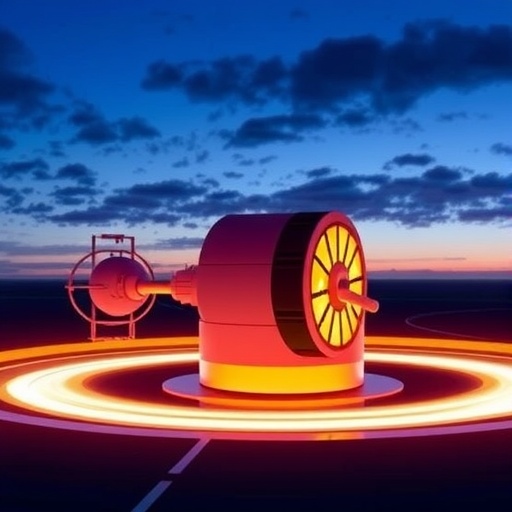
In an ambitious move that promises to accelerate the global pursuit of fusion energy, a landmark 10-year research agreement has been forged to advance work on the Wendelstein 7-X (W7-X) stellarator, a forefront experimental fusion device located in Germany. This pact solidifies the ongoing collaboration between the U.S. Department of Energy (DOE) and the Max Planck Institute for Plasma Physics (IPP), marking a new chapter in international scientific partnership aimed at harnessing the power of plasma—the energetic fourth state of matter.
The Wendelstein 7-X is an engineering marvel designed as a stellarator, a type of magnetic confinement fusion device distinguished by its twisted, non-axisymmetric geometry. Unlike tokamaks, stellarators achieve continuous plasma confinement without the need for plasma currents, which are inherently unstable and challenging to control. Since commencing operations in December 2015, W7-X has produced a series of record-setting plasma experiments, helping to establish the stellarator as a viable pathway toward practical fusion energy production.
Fusion energy represents the ideal of clean, virtually limitless power by replicating the processes that fuel the sun. At its core, fusion requires confining superheated plasma—a highly ionized gas—at extreme temperatures and densities long enough to sustain energy-releasing nuclear reactions. Magnetic confinement devices leverage powerful magnetic fields to cradle this plasma, preventing contact with any material surfaces that would cool or destabilize it. The W7-X stellarator stands out by employing complex superconducting magnet coils to define a meticulously shaped magnetic topology optimized to reduce plasma turbulence and energy losses.
The updated multilateral agreement between DOE and IPP formalizes a collaborative framework unprecedented in its scope, persistence, and legal clarity. It emerges as the first endeavor established under a novel model project framework between the U.S. and the European Commission, promising to streamline administrative complexities that often encumber large-scale scientific projects. This sets a new standard for transatlantic fusion cooperation, facilitating smoother project management, oversight, and expansion.
Integral to this collaboration is the Princeton Plasma Physics Laboratory (PPPL), an acclaimed U.S. fusion research center, whose expertise and resources have been instrumental to W7-X achievements. PPPL physicists contribute cutting-edge diagnostics, novel plasma heating techniques, and valuable modeling insights, offering a critical synergy between experimental data and theoretical understanding. The lab’s active role underscores the importance of broad international participation in solving the intricate physics challenges inherent to stellarator operation.
The Wendelstein 7-X’s unique magnetic field configuration addresses historically persistent hurdles in stellarator research, including neoclassical transport and particle confinement. By refining the geometry of its superconducting coils with unrivaled precision, engineers and scientists have minimized plasma instabilities and improved energy retention. This progress has enabled sustained plasma discharges reaching temperatures of several million degrees Celsius, a critical milestone for moving fusion from experimental curiosity toward practical power generation.
Boosting research efforts on W7-X under the new decade-long agreement expands opportunities for long-term experiments that probe plasma behavior under diverse magnetic configurations and heating regimes. These investigations delve deeply into plasma microturbulence, particle transport mechanisms, and impurity control—phenomena that dictate performance limits of any fusion device. Gaining mastery over these effects is vital not only for stellarators but also for the entire fusion community seeking optimized reactor designs.
The partnership further pioneers a legal and administrative framework that reduces duplicative negotiations and facilitates seamless integration of new collaborators, including potential industry stakeholders. With an eye toward future public-private ventures, this structure represents a forward-thinking approach encouraging fusion energy commercialization. By lowering bureaucratic hurdles, it enables a more agile response to technological advances and evolving research priorities in this rapidly developing field.
The scientific leadership at IPP expressed enthusiasm about the renewed collaboration, emphasizing that continuous synergy with DOE and its national labs serves as a powerful driver behind W7-X’s scientific breakthroughs. Such international cooperation acts as a force multiplier, allowing pooling of expertise, funding, and experimental infrastructure that no single entity could replicate alone. It reflects a shared commitment to overcoming the formidable physics and engineering challenges that remain on the path to fusion power.
Significant intellectual contributions from project managers and physicists on both sides have shaped this new agreement. Their collective vision for efficient, long-lived collaboration will undoubtedly refine best practices in fusion project management, ensuring compliance with regulatory standards while fostering scientific innovation. This holistic approach stands to enhance reproducibility, data sharing, and operational transparency, yielding benefits beyond the immediate scope of the W7-X program.
Meanwhile, PPPL leverages its extensive fusion research experience to cultivate partnerships with private industry through its Fusion Research and Technology Hub. This initiative aims to couple established science with entrepreneurial ambitions by offering state-of-the-art experimental facilities and expert knowledge to fusion startups. Such integration of academia, government, and industry epitomizes a modern innovation ecosystem dedicated to accelerating fusion’s arrival as a viable energy source.
In sum, the renewed and expanded research agreement for Wendelstein 7-X signals a bold and strategic investment into stellarator science that could reshape humanity’s energy future. By deepening transatlantic collaboration, streamlining project frameworks, and bridging public-private domains, this endeavor reinforces fusion research as a thriving international enterprise. The coming decade promises to unlock new levels of plasma control, pushing fusion energy ever closer to commercial reality.
This exciting development resonates well beyond the fusion community, as harnessing the nearly limitless energy potential of W7-X would herald transformative impacts on global energy, climate mitigation, and technological innovation. Through sustained cooperation and innovation on stellarator physics, the world edges nearer to realizing the long-sought dream of clean, abundant, and sustainable energy powered by the stars themselves.
Subject of Research: Fusion energy, magnetic confinement, plasma physics, stellarators
Article Title: Advancing Stellarator Fusion: A Decade-Long Transatlantic Partnership on Wendelstein 7-X
News Publication Date: Not specified
Web References:
Wendelstein 7-X, Max Planck Institute for Plasma Physics: https://www.ipp.mpg.de/w7x
US Department of Energy fusion explanation: https://www.energy.gov/science/doe-explainsstellarators
Princeton Plasma Physics Laboratory: https://www.pppl.gov
Image Credits: Illustration courtesy of the Max Planck Institute for Plasma Physics
Keywords
Fusion energy, stellarators, magnetic confinement, plasma physics, Wendelstein 7-X, superconducting magnets, PPPL, DOE, international collaboration
Tags: advanced fusion reactor designclean limitless fusion powercontinuous plasma confinement methodsfusion energy research collaborationmagnetic confinement fusion devicesMax Planck Institute plasma physicsnuclear fusion energy productionplasma physics experimental devicesstellarator versus tokamak technologytransatlantic fusion energy partnershipU.S. Department of Energy fusion projectsWendelstein 7-X stellarator experiments