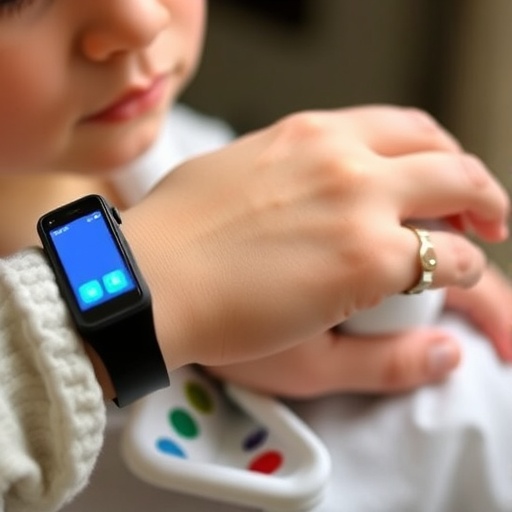
Researchers at UCLA Health are pioneering an innovative approach to identify early signs of autism spectrum disorder and other developmental conditions in infants by leveraging advanced wearable technology. Their new study, supported by a substantial $3.1 million grant from the National Institute of Neurologic Disorders and Stroke, focuses on the critical first year of life—an important window during which subtle motor irregularities may offer the earliest clues to neurodevelopmental differences. This investigation aims to transform the landscape of early diagnosis, enabling interventions that could significantly improve life-long outcomes.
Despite advances in understanding autism’s neurodevelopmental origins, early detection remains a formidable challenge. Autism-related brain changes typically commence prenatally, yet behavioral manifestations often emerge gradually, eluding timely clinical identification. Dr. Rujuta Wilson, the pediatric neurologist leading the project at UCLA Health, emphasizes that early detection and intervention are paramount for maximizing developmental potential in affected individuals. However, traditional evaluations primarily focus on gross motor milestones such as crawling or sitting, often overlooking more nuanced irregularities in movement that precede overt symptoms.
The cornerstone of this research is the deployment of wearable sensors resembling miniature fitness trackers, designed to passively and continuously monitor infant motor activity in naturalistic home environments. These sensors, affixed comfortably to infants’ wrists and ankles within soft arm and leg warmers, will capture rich datasets encompassing movement frequency, variability, and coordination from three to twelve months of age. The design ensures minimal disruption to infants and families while generating high-resolution data rarely accessible through conventional clinical observation.
The choice to study infants at elevated risk—those with an older sibling diagnosed with autism spectrum disorder—is a deliberate strategy to enrich the sample with participants more likely to develop similar conditions, thereby optimizing the predictive power of the metrics derived from movement analysis. Behavioral and developmental assessments will complement sensor data at three-month intervals, with rigorous diagnostic evaluations scheduled at one and two years of age to identify emerging signs of autism or other developmental delays.
Historically, motor impairments in autistic children have been underappreciated and undertreated, partly due to their subtlety and the challenge of quantification in clinical settings. These early motor difficulties—manifesting as impaired coordination or abnormalities in grasping objects—often contribute to cascading developmental challenges. Impaired motor skills can impede environmental exploration, social engagement, and language acquisition, setting back a child’s trajectory across multiple domains. Addressing these challenges early could mitigate long-term functional impairments.
This study builds upon promising preliminary findings from Dr. Wilson’s laboratory, which have demonstrated that specific metrics of infant movement variability serve as robust predictors of later autism diagnosis. By harnessing sophisticated machine learning algorithms, the research team aims to refine these movement biomarkers into a comprehensive battery capable of reliably forecasting developmental risk. Such analytic models could ultimately be integrated into routine pediatric well-child visits to enable scalable, low-cost early screening.
Moreover, the project prioritizes accessibility, with most assessments conducted in the infant’s home environment. This reduces barriers for families and allows for data collection within a naturalistic context, providing more ecologically valid insights into infant motor patterns. Families will receive timely verbal and written reports on their child’s developmental status and can consult directly with the clinicians, fostering an informative feedback loop critical for early engagement.
The implications of this work extend beyond autism alone. Enhanced early detection of motor irregularities could flag a spectrum of developmental conditions, facilitating earlier referrals to targeted therapies designed to bolster functional abilities and independence. Such a paradigm shift in early neurodevelopmental surveillance holds potential to transform clinical practice, shifting the focus from reactive diagnosis to proactive monitoring.
Incorporating wearable sensor technology and data science within pediatric neurology introduces a potent toolset to uncover subtle, previously inaccessible motor signatures. This confluence of technology and developmental science epitomizes precision medicine’s promise to tailor surveillance and intervention strategies according to individual risk profiles. The UCLA team’s longitudinal design ensures capturing developmental trajectories over a crucial period, enriching understanding of how early motor patterns evolve in typical versus atypical development.
Timely identification of autism spectrum disorder remains one of modern neurodevelopmental medicine’s greatest hurdles, with current diagnostic practices typically detecting autism around two or three years of age, well after critical intervention windows. The UCLA-led endeavor seeks to close this gap, implementing innovative sensor-based methodologies that detect early motor perturbations, setting the stage for intervention during the plastic and highly responsive neural periods of infancy.
Set to conclude in December 2030, this five-year research initiative represents a significant commitment to advancing developmental neuroscience and clinical care. By integrating cutting-edge wearable technologies, rigorous behavioral assessment, and machine learning, the investigators aim to establish scalable predictors that will be vital for pediatricians, neurologists, and families alike in the early recognition and treatment of autism and related conditions.
The support granted by the National Institute of Neurologic Disorders and Stroke (grant number 1R01NS142720-01A1) underscores the strategic importance of this work within national research priorities. As this study unfolds, it promises to enrich scientific understanding, offer novel clinical tools, and potentially revolutionize early developmental screening paradigms nationwide.
Subject of Research: Early identification of autism and developmental disorders through wearable sensor technology monitoring infant motor activity.
Article Title: UCLA Health Researchers Harness Wearable Technology for Early Autism Detection
News Publication Date: January 2024
Web References:
UCLA Health Provider – Dr. Rujuta Wilson
Prior Research on Movement Variability and Autism
Study on Child Neurologists’ Role in Autism
Earlier Research Metrics with Predictive Value
References:
National Institute of Neurologic Disorders and Stroke Grant 1R01NS142720-01A1
Keywords
Autism, Neurodevelopment, Wearable Technology, Motor Development, Infant Monitoring, Early Detection, Developmental Disorders, Machine Learning, Pediatric Neurology, Movement Variability, Early Intervention
Tags: autism spectrum disorder early diagnosiscontinuous infant movement trackingearly signs of autism in infantsinfant motor irregularities monitoringmotor milestone evaluation in infantsNational Institute of Neurologic Disorders research grantnaturalistic home environment monitoringneurodevelopmental disorder detectionpediatric neurology researchUCLA Health autism studywearable sensors for developmental screeningwearable technology for early autism detection