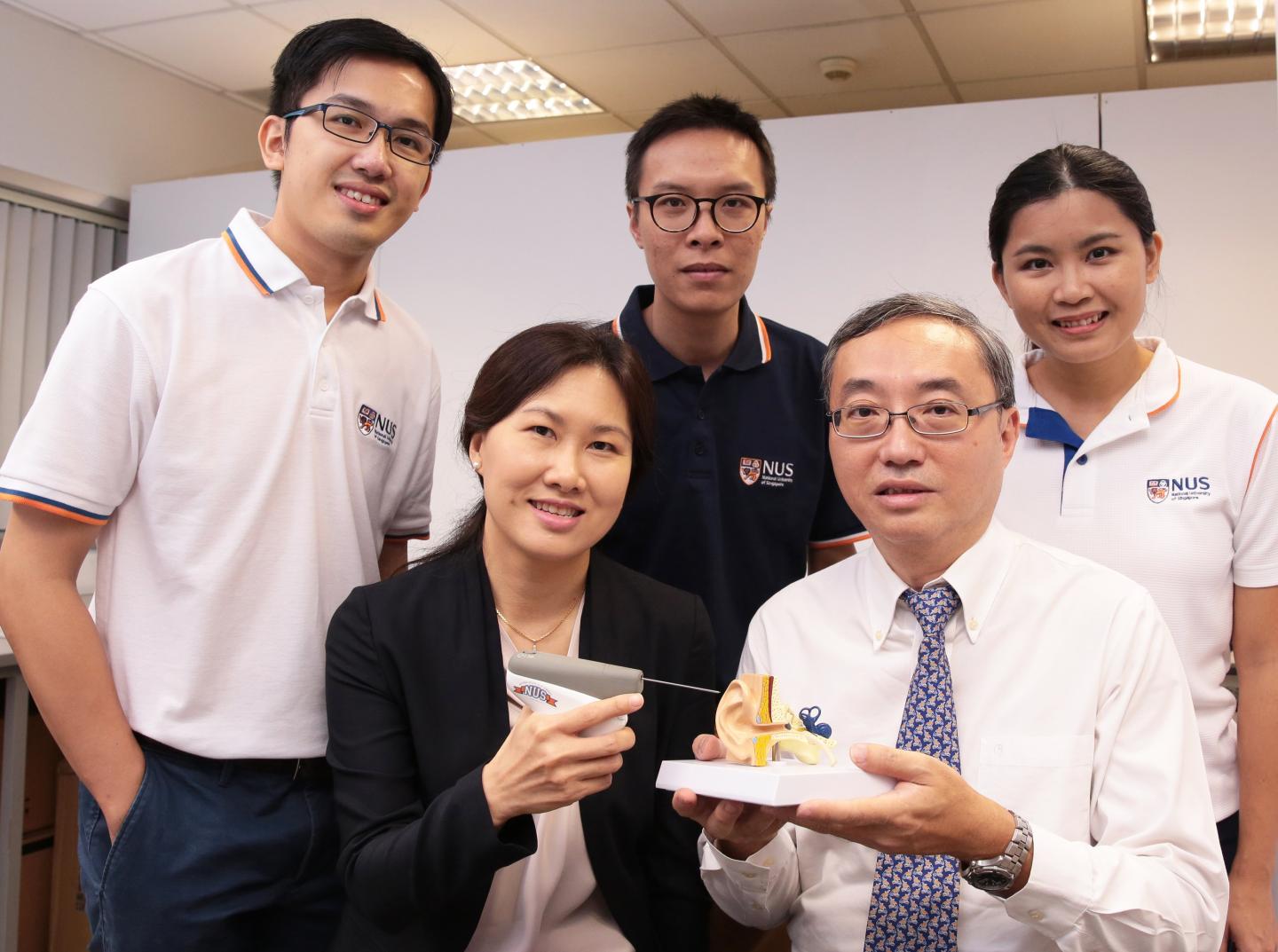
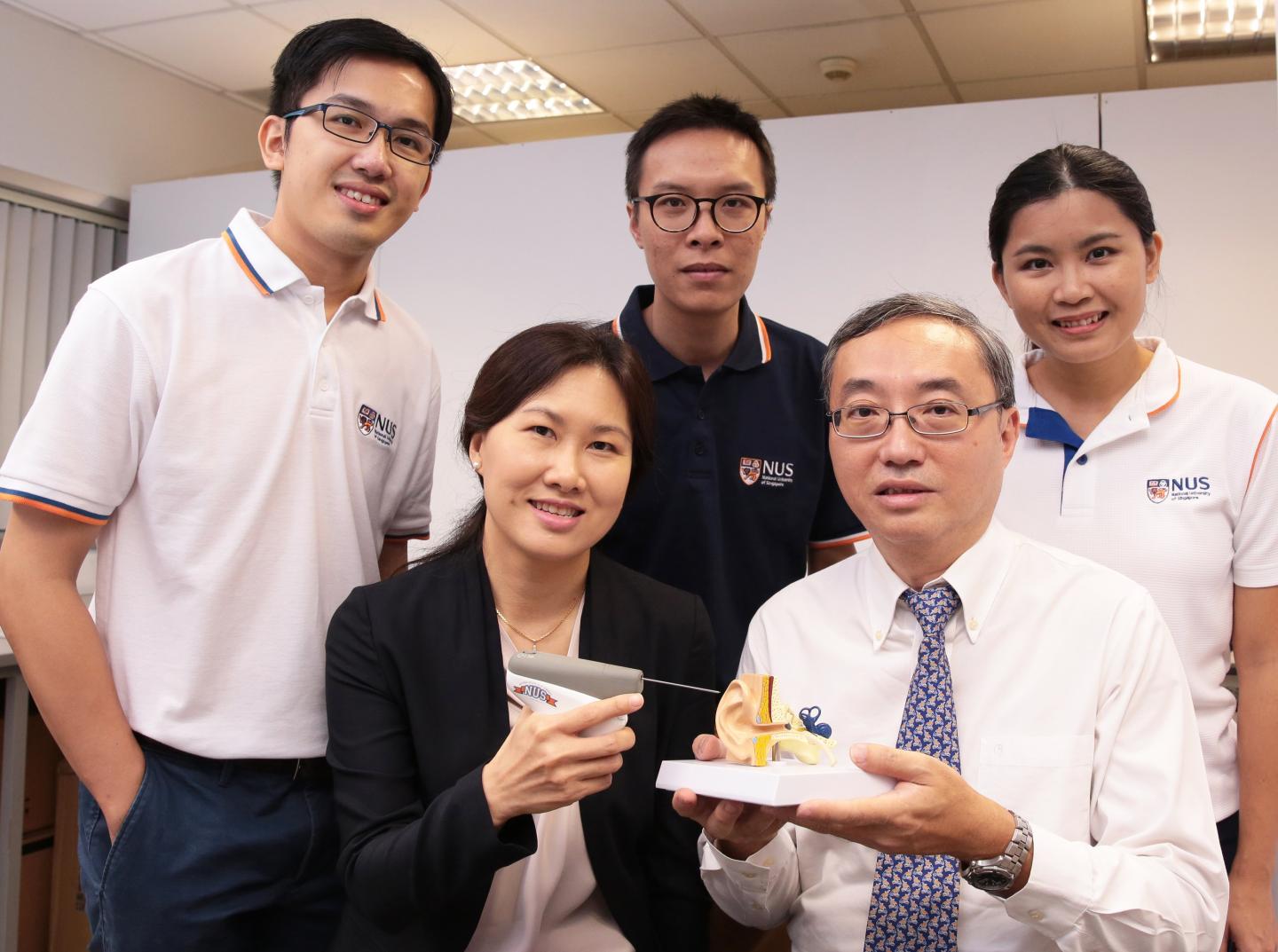
Credit: National University of Singapore
A team of researchers from the National University of Singapore (NUS) has developed a novel handheld device, known as CLiKX, for the treatment of a condition called Otitis Media with Effusion (OME), or 'glue ear', which is the leading cause of hearing loss and visits to the doctors among children worldwide. This NUS invention, which is sensor-guided and easy to use, could significantly improve current surgical treatment of the condition.
OME is a condition where the middle ear becomes filled with fluid instead of air. If left untreated, patients may suffer a series of life-altering complications such as hearing impairment, middle ear bone erosion or tumour, and brain infection. OME has also been shown to cause delays in the speech, language and academic abilities of young children. Around the world, there are about 709 million cases of acute OME annually, of which about 90 per cent occurs in children. In Singapore, it is estimated that about 84,000 children suffer from 'glue ear' yearly. The condition is usually treated using medication first, failing which, ear surgery may be needed.
Specially designed to improve on the surgical treatment of OME, CLiKX is pioneered by a team led by Associate Professor Tan Kok Kiong from the Department of Electrical and Computer Engineering at the NUS Faculty of Engineering, together with Dr Lynne Lim, an Adjunct Associate Professor with the Department of Otolaryngology at the NUS Yong Loo Lin School of Medicine and Senior Ear Nose and Throat (ENT) Consultant at Mount Elizabeth Medical Centre.
"The first line therapy for OME is usually the prescription of antibiotics and treatment of blocked ear tubes. But sometimes, the antibiotics may not be effective against OME. For patients with three or more episodes of OME within a year – especially if there is hearing loss and speech difficulties, some with craniofacial predispositions, or those who are concerned about building resistance to long term use of antibiotics, grommet tube placement surgery is currently the gold standard of care. A grommet is a very small tube that is inserted onto the patient's ear drum during surgery to help drain away fluid in the middle ear. Each procedure usually takes about 30 minutes under general anaesthesia to complete," explained Dr Lim.
Grommet tube placement surgery is carried out in an operating theatre with the use of general anaesthetic, which is a major point of concern for parents who worry about its potential negative impact on brain development in young children.
Assoc Prof Tan elaborated, "CLiKX can potentially shift the current standard surgical procedures for OME. With this pistol-like applicator, the grommet tube can be easily inserted into a patient's ear within a single click. In less than a second, the procedure is done. This simple procedure has the potential to be administered in a doctor's consultation room under local anaesthesia, or out of the operating theatre under intravenous conscious sedation without general anaesthesia. Preoperative preparation and postoperative recovery time for patients are significantly reduced. At the same time, risks of general anaesthesia are avoided. We expect costs, manpower and resources to be lowered substantially, and this in turn, would be welcomed by patients, healthcare institutions, and insurers."
Novel invention benefits patients and healthcare institutions
Grommet tube placement surgery involves making a cut on the eardrum, and placing a tiny ventilation tube, called a grommet, through the hole to drain the ear fluid. The surgery involves a large healthcare team, costly surgical equipment, and set-up in the operating theatre, which is an economic burden not only to patients, but also to hospitals and healthcare insurers.
The palm-sized CLiKX can deliver the grommet tube into a patient's ear quickly and safely using a sensor-controlled automation process. This minimises the overall contact time with the patient's eardrum and prevents over-deformation and excessive pressure, thereby reducing discomfort and trauma for the patients.
To carry out the procedure, surgeons can potentially use a simple eye-loupe that does not require bulky and costly surgical microscopes. The 185-gram CLiKX also works well with a range of commercially available grommets and does not require any custom-made grommet tubes. In addition, the procedure using CLiKX would potentially require only light or moderate sedation or local anaesthetic.
Assoc Prof Tan said, "The motivation behind the development of CLiKX is to significantly reduce the recovery time and treatment cost for patients. By streamlining the manpower and resources required for surgical treatment of OME, healthcare resources could be deployed more efficiently for other treatments and procedures in hospitals."
Dr Lim added, "In many underdeveloped areas where proper healthcare infrastructure and general anaesthesia are not always available, many patients with OME do not have access to treatment in a timely manner. Some of these patients have to live with the condition, its associated hearing loss and complications. CLiKX can make a significant impact by making grommet placement surgeries more accessible to these patients most in need, and it simplifies the procedure for doctors and patients."
First-in-human trial and commercialisation
Building on the promising results from the earlier phases of the project, the NUS team aims to conduct the first-in-man trial in Singapore in 2018. The team is keen to work with partners to further develop and commercialise the device, and they aim to launch the device in the market by 2020.
###
Media Contact
Carolyn Fong
[email protected]
65-651-65399
@NUSingapore
http://www.nus.edu.sg/
############
Story Source: Materials provided by Scienmag