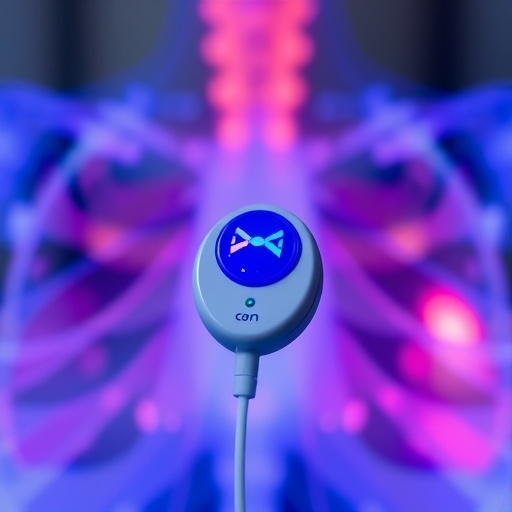
In a pioneering stride toward revolutionizing health monitoring, researchers at The University of Texas at Austin have engineered an extraordinarily compact fiber optic probe capable of simultaneously tracking multiple critical biomarkers within the human body. This breakthrough miniaturized device, with a diameter scarcely exceeding 1.1 millimeters, harbors the potential to transform both clinical diagnostics and personalized wellness by delivering real-time, minimally invasive monitoring of metabolic indicators. The probe targets simultaneous detection of glucose, lactate, and ethanol—molecules that are central to managing diseases, assessing physical performance, and understanding complex metabolic states.
Traditional diagnostic techniques often require separate, cumbersome devices to measure these biomarkers, a process that can be both intrusive and time-consuming. This newly developed probe circumvents such limitations by utilizing advanced mid-infrared spectroscopy delivered via fiber optics to directly interrogate tissue biochemistry with exceptional sensitivity and specificity. The sensor capitalizes on the unique mid-infrared absorption spectra of glucose, lactate, and ethanol, enabling unambiguous identification and quantification without the need for extracted samples or chemical reagents.
The core innovation lies in the probe’s design, which incorporates two silver halide optical fibers encased in a robust polyetheretherketone (PEEK) tube, a polymer renowned for its biocompatibility and durability. One fiber serves as the light delivery conduit with a precision-angled tip, while the other functions as a reflective mirror coated with gold, enhancing signal efficiency. Encapsulated within a semi-permeable membrane, this architecture prevents direct tissue contact, thereby minimizing biofouling and interference from larger biomolecules like proteins, which notoriously complicate spectral measurements.
Mid-infrared light from a quantum cascade laser (QCL) is channeled through the probe to illuminate cellular environments. As molecules within the tissue absorb light at their characteristic wavelengths, they imprint unique spectral signatures upon the returned light. By analyzing these absorption patterns, the system quantifies each biomarker’s concentration dynamically and in situ, thereby capturing metabolic fluxes in real-time. This non-disruptive sensing contrasts sharply with microdialysis techniques—the current clinical standard—which require fluid sampling and offline analysis, introducing delays and reducing temporal resolution.
The clinical implications of this device are profound. For instance, in the management of diabetes, continuous glucose monitoring is imperative yet often limited by sensor size and invasiveness. Similarly, lactate concentrations furnish critical insights into sepsis progression and hypoxia in critical illness, while ethanol monitoring serves underestimated but vital roles in addiction treatment and alcohol-related organ damage. The ability to concurrently track these markers opens unprecedented avenues for integrated metabolic profiling, enhancing decision-making agility in intensive care units where every second counts.
Beyond immediate clinical applications, this technology harmonizes with burgeoning trends in personalized medicine and wearable health monitoring. Its small form factor hints at future integration into consumer devices capable of non-invasive or minimally invasive metabolic tracking during daily activities or athletic performance. This adaptability could democratize health data acquisition, promoting proactive disease management and holistic wellness optimization on a population scale.
The genesis of this innovation traces back over a decade to Professor Tanya Hutter’s doctoral research at the University of Cambridge, where the urgent need for real-time biomarker monitoring in traumatic brain injury (TBI) care was first recognized. Traditional neurochemical monitoring techniques in TBI rely heavily on microdialysis, which, although informative, is labor-intensive and temporally lagged, posing challenges to optimized patient management. This probe provides a continuous chemical snapshot of the cerebral microenvironment without perturbing tissue integrity, a critical advantage for managing dynamically evolving neurological crises.
Technically, the use of silver halide fibers is strategic given their wide transmission window in the mid-infrared range, essential for capturing the vibrational modes of organic molecules. The probe’s semi-permeable membrane further enhances measurement reliability by excluding large interfering molecules while enabling the diffusion of target analytes. Integrating the system with a quantum cascade laser amplifies spectral resolution and detection sensitivity, allowing the probing of subtle metabolic shifts previously inaccessible in real time.
The research, funded by the National Institute on Alcohol Abuse and Alcoholism (NIAAA), illuminates the feasibility of continuous ethanol measurement in vivo, a significant advancement for alcohol-related disorder management. However, the technology’s modular and scalable design positions it for broad deployment across various biomarker targets beyond the initial three compounds. This foresight underscores the probe’s potential as a platform technology with applications spanning critical care, sports medicine, metabolic research, and beyond.
Looking forward, the University of Texas is actively seeking industry partners to bring this promising innovation from bench to bedside. Patent protections are in place to enable tailored commercialization pathways, ensuring both academic rigor and practical deployment. As this fiber optic sensing technology evolves, its impact promises to redefine biomarker monitoring’s temporal and spatial resolution limits, ultimately reshaping the clinical paradigm and empowering precision health management globally.
Subject of Research: Development of a compact mid-infrared fiber optic probe for simultaneous in vivo monitoring of multiple biomarkers
Article Title: Compact mid-infrared fiber probe for in vivo multi-compound monitoring demonstrated using ex vivo human skin
Web References: http://dx.doi.org/10.1038/s41467-026-70300-x
Image Credits: Credit to Tzu-Chin Hsu
Keywords: Biomarkers, mid-infrared spectroscopy, fiber optic probe, glucose monitoring, lactate measurement, ethanol detection, metabolic health, real-time sensing, minimally invasive diagnostics, critical care, traumatic brain injury, quantum cascade laser
Tags: advanced tissue biochemistry analysisbiocompatible PEEK probe designfiber optic sensors for clinical diagnosticsglucose lactate ethanol sensingmetabolic biomarker monitoring technologymid-infrared spectroscopy in medicineminiature fiber optic health probeminimally invasive diagnostic devicepersonalized wellness monitoring toolsreal-time metabolic monitoringsilver halide optical fibers in healthcaresimultaneous biomarker detection