• HOME
  • NEWS
  • EXPLORE
    • CAREER
      • Companies
      • Jobs
    • EVENTS
    • iGEM
      • News
      • Team
    • PHOTOS
    • VIDEO
    • WIKI
  • BLOG
  • COMMUNITY
    • FACEBOOK
    • INSTAGRAM
    • TWITTER
Wednesday, April 1, 2026
BIOENGINEER.ORG
No Result
View All Result
  • Login
  • HOME
  • NEWS
  • EXPLORE
    • CAREER
      • Companies
      • Jobs
        • Lecturer
        • PhD Studentship
        • Postdoc
        • Research Assistant
    • EVENTS
    • iGEM
      • News
      • Team
    • PHOTOS
    • VIDEO
    • WIKI
  • BLOG
  • COMMUNITY
    • FACEBOOK
    • INSTAGRAM
    • TWITTER
  • HOME
  • NEWS
  • EXPLORE
    • CAREER
      • Companies
      • Jobs
        • Lecturer
        • PhD Studentship
        • Postdoc
        • Research Assistant
    • EVENTS
    • iGEM
      • News
      • Team
    • PHOTOS
    • VIDEO
    • WIKI
  • BLOG
  • COMMUNITY
    • FACEBOOK
    • INSTAGRAM
    • TWITTER
No Result
View All Result
Bioengineer.org
No Result
View All Result
Home NEWS Science News

Three-dimensional graphene: Experiment at BESSY II shows that optical properties are tuneable

Bioengineer by Bioengineer
May 24, 2017
in Science News
Reading Time: 2 mins read
0
Share on FacebookShare on TwitterShare on LinkedinShare on RedditShare on Telegram
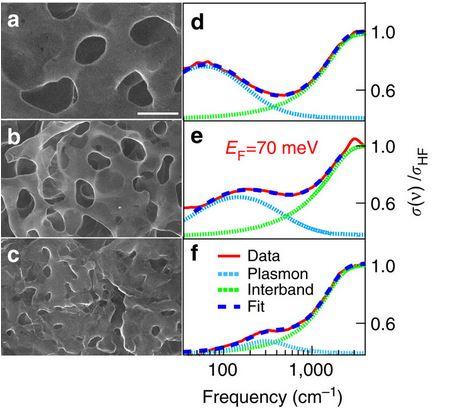
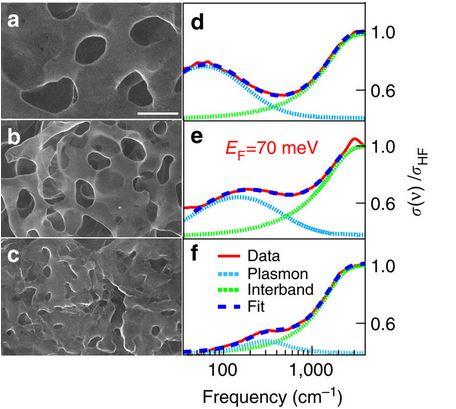
IMAGE

Credit: Nature Communications: 10.1038/ncomms14885

Carbon is a very versatile element. It not only forms diamonds, graphite, and coal, but can also take a planar form as a hexagonal matrix – graphene. This material, consisting of only a single atomic layer, possesses many extreme properties. It is highly conductive, optically transparent, and is mechanically flexible as well as able to withstand loads. André Geim and Konstantin Novoselov received the 2010 Nobel Prize in Physics for the discovery of this exotic form of carbon. And just recently, a Japanese team has been successful in stacking two-dimensional graphene layers in a three-dimensional architecture with nanometre-sized pores.

Tuneable plasmons

A research team operated by a group at Sapienza University in Rome has now for the first time made a detailed investigation of the optical properties of 3D graphene at BESSY II. The team was able to ascertain from the data how charge density oscillations, known as plasmons, propagate in three-dimensional graphene. In doing so, they determined that these plasmons follow the same physical laws as 2D graphene. However, the frequency of the plasmons in 3D graphene can be very precisely controlled, either by introducing atomic impurities (doping), by the size of the nanopores, or by attaching specific molecules in certain ways to the graphene. In this way, the novel material might also lend itself to manufacturing specific chemical sensors, as the authors write in Nature Communications. In addition, the new material is interesting as an electrode material for employment in solar cells.

Advantages provided by the IRIS beamline

The researchers used the IRIS beamline at the BESSY II synchrotron source in Berlin to their advantage for their investigations. Broad-band infrared is available there, which especially facilitates spectroscopic analysis of novel materials using terahertz radiation. "A special operating mode of the BESSY II storage ring called low-alpha allowed us to measure the optical conductivity of three-dimensional graphene with a particularly high signal-to-noise ratio. This is hardly possible with standard methods, especially in the terahertz region. However, it is exactly this region that is important for observing critical physical properties", says Dr. Ulrich Schade, head of the group at the infrared beamline.

###

Published in Nature Communications (2017): „Terahertz and mid-infrared plasmons in three-dimensional nanoporous graphene"; Fausto D'Apuzzo, Alba R. Piacenti, Flavio Giorgianni, Marta Autore, Mariangela Cestelli Guidi,Augusto Marcelli, Ulrich Schade, Yoshikazu Ito, Mingwei Chen & Stefano Lupi

DOI: 10.1038/ncomms1488

Media Contact

Dr. Antonia Roetger
[email protected]
49-308-062-43733
@HZBde

http://www.helmholtz-berlin.de

############

Story Source: Materials provided by Scienmag

Share12Tweet8Share2ShareShareShare2

Related Posts

KIST-IAE Collaborative Team Surpasses Performance Limits in Lithium-Air Batteries with Innovative Two-Dimensional Catalyst

KIST-IAE Collaborative Team Surpasses Performance Limits in Lithium-Air Batteries with Innovative Two-Dimensional Catalyst

April 1, 2026

Brain Metastases Show Unique Macrophage Spatial Patterns

April 1, 2026

PRSS56 Drives and Treats Human High Myopia

April 1, 2026

Early cfEBV DNA Guides Nasopharyngeal Cancer Treatment

April 1, 2026
Please login to join discussion

POPULAR NEWS

  • blank

    Revolutionary AI Model Enhances Precision in Detecting Food Contamination

    96 shares
    Share 38 Tweet 24
  • Imagine a Social Media Feed That Challenges Your Views Instead of Reinforcing Them

    1006 shares
    Share 398 Tweet 249
  • Promising Outcomes from First Clinical Trials of Gene Regulation in Epilepsy

    51 shares
    Share 20 Tweet 13
  • Popular Anti-Aging Compound Linked to Damage in Corpus Callosum, Study Finds

    43 shares
    Share 17 Tweet 11

About

We bring you the latest biotechnology news from best research centers and universities around the world. Check our website.

Follow us

Recent News

KIST-IAE Collaborative Team Surpasses Performance Limits in Lithium-Air Batteries with Innovative Two-Dimensional Catalyst

Brain Metastases Show Unique Macrophage Spatial Patterns

PRSS56 Drives and Treats Human High Myopia

Subscribe to Blog via Email

Enter your email address to subscribe to this blog and receive notifications of new posts by email.

Join 78 other subscribers
  • Contact Us

Bioengineer.org © Copyright 2023 All Rights Reserved.

Welcome Back!

Login to your account below

Forgotten Password?

Retrieve your password

Please enter your username or email address to reset your password.

Log In
No Result
View All Result
  • Homepages
    • Home Page 1
    • Home Page 2
  • News
  • National
  • Business
  • Health
  • Lifestyle
  • Science

Bioengineer.org © Copyright 2023 All Rights Reserved.