In a groundbreaking study published in the journal Obesity, researchers at Penn State led by Harold Lee, an assistant professor of biobehavioral health, have uncovered how genetic predisposition distinctly influences long-term weight maintenance in postmenopausal women—revealing a complex interplay between genetics, race, and environment. By meticulously analyzing extensive longitudinal data from the National Institutes of Health’s Women’s Health Initiative Dietary Modification trial, the research team focused on genetic risk influences and their impact on weight regain after modest weight loss among women aged 50 to 79.
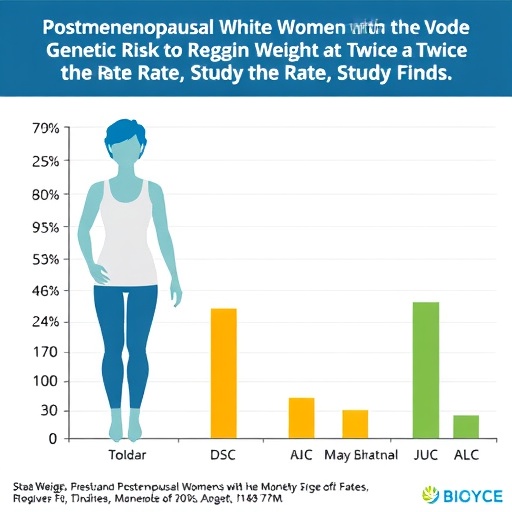
The study’s core finding reveals that white women with a high polygenic risk score for obesity—indicating a significant genetic predisposition—regained weight at approximately twice the rate of their counterparts whose genetic risk was lower. Intriguingly, this relationship did not hold for Black women participants, whose weight regain patterns remained consistent regardless of their genetic risk profile. This finding challenges existing assumptions about obesity’s genetic factors and underscores the nuanced variability across different populations.
The polygenic risk score, a cutting-edge genetic tool, was instrumental in this investigation. Unlike single-gene assessments, this methodology aggregates the effects of millions of gene variants and weights them by their statistical association with obesity, offering a comprehensive quantification of genetic susceptibility. The team defined high genetic risk as those scoring in the top 5% of the risk distribution, providing a focused lens through which to analyze weight trajectory after weight loss interventions in an aging female cohort.
During the initial phase of the trial, all participants adhered to a low-fat diet regimen, along with frequent consultations with dieticians, resulting in an average weight reduction near four pounds across the diverse sample. However, in the subsequent years of follow-up, the majority of participants gradually regained the lost weight, a common challenge in weight management research. The divergence emerged when genetically stratified data highlighted that white women with elevated genetic risk experienced significantly faster weight regain, at a rate approximating two pounds per year compared to roughly one pound for those with lower genetic risks.
This disparity in genetic impact provokes deeper inquiry into the biological mechanisms underpinning obesity and weight maintenance. Lee emphasizes that while genetics play a substantial role in how quickly weight is regained, it does not necessarily influence the initial ability to lose weight. In fact, the study observed that all women, irrespective of genetic background or race, were equally successful at losing weight initially under the structured diet and behavioral support, a finding that sheds optimism on the potential to mitigate genetic predispositions through environmental and lifestyle modifications.
The research underscores the critical importance of environmental contexts, particularly as the modern obesogenic environment overwhelms innate physiological regulators with readily accessible, calorie-dense, yet nutritionally poor foods. This “toxic” environment, shaped by urban design favoring sedentary lifestyles and omnipresent unhealthy food options, has been a driving force behind the obesity epidemic—not shifts in human DNA, as Lee notes. Such insights underline how altering environmental and behavioral factors can temporarily override genetic risks, pointing to the need for systemic changes in public health strategies.
Although the polygenic risk score provided robust predictive power for weight regain among white women, its limited utility in the Black female cohort highlights ongoing challenges in genetic research equity. The genetic datasets predominantly comprise white individuals, resulting in less predictive accuracy for minority populations. This disparity illustrates the critical need for more inclusive and representative genetic sampling to ensure equitable application and interpretation of genetic risk assessments across diverse demographics.
Smaller sample sizes of Black women within the study further constricted the ability to detect genetic effects in this group, emphasizing the statistical power issues when generalizing across heterogeneous populations. It raises a pivotal point about the intersection of genetics, race, and study design, and how improvements in recruitment diversity are essential to unravel the complex etiologies of obesity for all racial groups.
Lee stresses that genetics undeniably influences obesity risk across populations, but current limitations in data representation prevent a full understanding of these dynamics in underrepresented groups. The study advocates for prioritizing racial and ethnic inclusivity in large-scale genetic studies to rectify these gaps and harness genetics for universally applicable health advances, thereby avoiding inadvertent exclusion and health disparities.
The study also contributes to a broader understanding that maintaining weight loss is an intricate and formidable challenge. Genetic predisposition accelerates weight regain, particularly in genetically susceptible white women, complicating long-term management efforts. This knowledge is crucial for guiding personalized medicine approaches, suggesting that individuals at higher genetic risk may need more intensive, tailored interventions to sustain weight loss.
Despite the weight regain patterns revealed, the initial uniform success in losing weight regardless of genetic risk or race offers a hopeful narrative. It suggests that interventions—such as low-fat diet adherence combined with dietitian support—can effectively counteract genetic predispositions in the short term. These findings advocate for environmental modifications and personalized behavioral strategies as powerful tools that can offset the shadow of genetic risk, at least episodically.
Ultimately, this research enriches the discourse on how genetics and environment conjointly sculpt obesity trajectories. As Lee articulates, understanding the multifaceted factors influencing weight loss and regain—including gene-environment interactions—is vital to designing better health interventions. The study’s insights call for a balanced perspective that appreciates genetic influence without succumbing to determinism, recognizing the modifiable nature of environmental contributors.
The research was supported by the National Institutes of Health’s National Heart, Lung, and Blood Institute, underscoring the critical role of federal funding in advancing genetic and epidemiological research. Given recent threats to such funding, the investigators emphasize the importance of sustained investment to enable ongoing innovation in public health and personalized medicine.
Collaborators in this study span several premier institutions, including the University of North Carolina at Chapel Hill, the National Cancer Institute, Northwestern University, and Fred Hutchinson Cancer Center. Their combined expertise in epidemiology, genetics, and behavioral health adds multidisciplinary depth to the investigation, fostering a comprehensive approach to understanding obesity’s complex etiology in aging female populations.
This work heralds an important step forward in elucidating how genetic risk modulates not just the onset of obesity but the durability of weight loss—especially in specific demographic segments. The insights gleaned have the potential to inform both clinical practice and public health policy, advancing precision health strategies aimed at mitigating obesity’s burden across diverse communities.
Subject of Research: People
Article Title: Impact of Genetic Predisposition to Obesity on Long-Term Maintenance of Modest Weight Loss in Postmenopausal Women
News Publication Date: 6-Mar-2026
Web References:
Obesity journal article
Women’s Health Initiative
WHI Dietary Modification trial
References:
Lee, H., Avery, C., Graff, M., et al. (2026). Impact of Genetic Predisposition to Obesity on Long-Term Maintenance of Modest Weight Loss in Postmenopausal Women. Obesity. DOI: 10.1002/oby.70175
Keywords: Obesity, Weight Loss, Weight Gain, Body Weight, Genetics, Postmenopausal Women, Polygenic Risk Score, Epidemiology
Tags: genetic risk and obesitygenetics and environment interaction obesitylong-term weight regain studyobesity genetics in Black womenobesity genetics in white womenpolygenic risk score obesitypostmenopausal weight managementpostmenopausal women weight regainracial differences in obesity geneticsracial variability in genetic obesity riskweight maintenance after weight lossWomen’s Health Initiative Dietary Modification trial