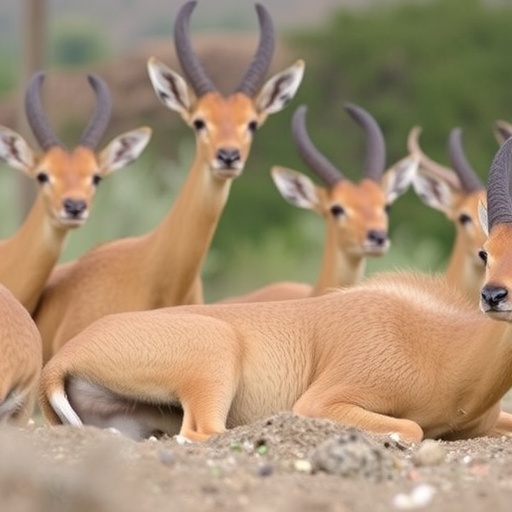
In the dynamic field of conservation biology, new research from Ben-Gurion University of the Negev presents a transformative approach that leverages habitat management to bolster genetic diversity in wild populations. This breakthrough study highlights how strategic alterations in resource distribution can significantly affect mating structures and reproductive success, ultimately enhancing the genetic resilience of species in natural ecosystems without the need for invasive interventions such as breeding programs or animal translocations.
A team led by Dr. Shirli Bar-David and Prof. Amos Bouskila, with critical contributions from PhD candidate Noa Yaffa Kan-Lingwood, investigated the Asiatic wild ass (Equus hemionus) inhabiting the arid Negev Desert in Israel. This species exhibits a resource-defense polygyny mating system, where dominant males establish territories strategically positioned around sparse water sources to maximize access to breeding females. Recognizing the immense influence of these water points on mating opportunities, the researchers hypothesized that modifying their quantity and distribution could reshape social dynamics and genetic patterns within the population.
The experimental design involved increasing the number of available watering holes from a singular point to three distinct locations scattered throughout the habitat. This seemingly straightforward change unleashed profound ecological consequences. The proportion of territorial, reproductively active males surged dramatically, nearly doubling from previous levels of approximately 16-18% to an impressive 42-48%. Such a shift indicates that territorial establishment is tightly linked to resource availability, confirming the critical role of water distribution in driving male reproductive strategies.
Importantly, these demographic changes corresponded with significant shifts in genetic parameters. The variance effective population size (N_ev), a robust indicator of genetic variability within a population, increased from 34.9 to 38.4 following habitat modification. N_ev reflects the number of individuals contributing genetically to subsequent generations and is essential for maintaining population adaptability in the face of environmental stresses and stochastic events. This increment suggests that by diversifying resource access points, the mating opportunities become more evenly shared among males, mitigating the monopolization effects often seen in resource-defense polygynous systems.
Observations confirmed that new territorial males predominantly occupied areas near the newly introduced water sources, illustrating how resource redistribution can swiftly alter social structure and mating patterns. Such rapid ecological responses underline the malleability of wildlife populations and demonstrate how relatively simple conservation actions can produce measurable genetic benefits. This insight is particularly consequential when addressing species that face threats from habitat fragmentation, climate change, and declining population sizes, conditions increasingly common in the Anthropocene.
The implications of this research stretch beyond the Asiatic wild ass and could inform conservation practices for other species characterized by social hierarchies dependent on critical resources. Many threatened mammals, birds, and reptiles exhibit territorial behaviors linked to essential food, water, or nesting sites. Adjusting resource distribution within their habitats might serve as a non-invasive management tool to enhance reproductive equity and, thus, genetic heterogeneity, which is vital for long-term population survival.
Furthermore, the study champions a paradigm shift in conservation, emphasizing environmental manipulations that reinforce natural behaviors and evolutionary processes rather than relying extensively on direct genetic interventions. Breeding programs, while valuable, can be resource-intensive and sometimes ineffective, particularly when reintroduced individuals fail to adapt or integrate socially. Similarly, translocation efforts carry risks including disease transmission and disruption of local gene pools. Habitat management sidesteps these issues by working with the species’ intrinsic mating systems and resource preferences.
Dr. Bar-David remarks that the findings offer a hopeful prospect amidst global biodiversity declines and climate-induced habitat stressors. By optimizing landscape features in favor of natural mating patterns, conservation managers can sustain and recover genetic diversity, potentially stabilizing populations before genetic impoverishment or demographic collapse occurs. This approach complements traditional methods by providing a proactive strategy rooted in ecological understanding.
The significance of this research is amplified by its robust methodology, integrating behavioral ecology, population genetics, and landscape management within an experimental framework. This multifaceted approach lends credibility and applicability, allowing conservationists worldwide to draw lessons tailored to their ecosystem-specific challenges. Moreover, it stresses the pivotal role that hydrological features play in arid environments, a factor crucial to regional conservation planning.
Co-authors, including Dr. Liran Sagi, Prof. Alan R. Templeton, and others, contributed to an expansive interdisciplinary effort that enhanced the scientific rigor and relevance of the study. Their collaboration encapsulates the modern ethos of integrative conservation science, in which genetics, ecology, and practical habitat management converge to propose scalable solutions.
This research was generously supported by the United States-Israel Binational Science Foundation and the Mohamed bin Zayed Species Conservation Fund, underscoring the importance of international cooperation in safeguarding global biodiversity. The findings were published in the esteemed journal Ecological Applications in April 2026, and the detailed study is accessible through the digital object identifier 10.1002/eap.70226.
In conclusion, this pioneering study demonstrates that tailored habitat management targeting resource distribution can serve as a powerful, non-invasive conservation tool. By harnessing natural mating systems and ecological behaviors, it offers a sustainable pathway to enhance genetic diversity and population resilience in endangered species, promising a significant leap forward in conservation strategy amid a rapidly changing world.
Subject of Research: Animals
Article Title: Resource management as a conservation tool to impact genetic diversity through mating patterns in wild populations
News Publication Date: April 21, 2026
Web References: https://doi.org/10.1002/eap.70226
References: Bar-David, S., Bouskila, A., Kan-Lingwood, N. Y., et al. (2026). Resource management as a conservation tool to impact genetic diversity through mating patterns in wild populations. Ecological Applications. DOI: 10.1002/eap.70226
Image Credits: Naama Shahar
Keywords: ecosystem management, conservation priorities, ecological restoration, conservation biology, genetic diversity, conservation ecology
Tags: animal territoriality and reproductionAsiatic wild ass mating behaviorBen-Gurion University conservation researchconservation biology strategieseffects of watering hole distributionenhancing reproductive success in wild speciesgenetic resilience in wild populationshabitat management for genetic diversityimpact of water distribution on animal geneticsNegev Desert wildlife studynon-invasive wildlife conservationresource-defense polygyny systems