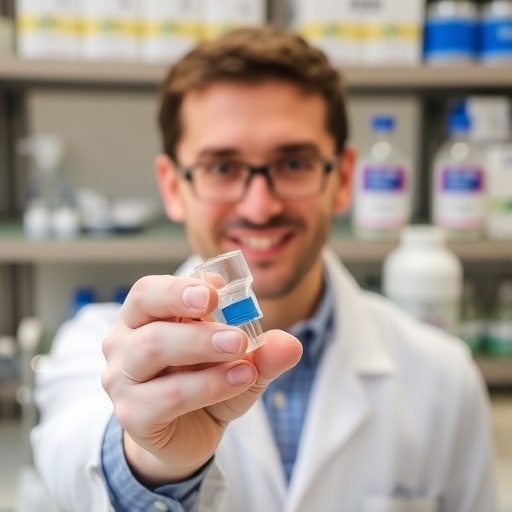
Antimicrobial resistance has emerged as a dire global challenge, threatening both human health and food security with escalating urgency. In response to this critical issue, an innovative research collaboration spearheaded by Flinders University alongside UK experts has unveiled a groundbreaking sulfur-rich polymer with potent antimicrobial and antifungal properties. This novel polymer represents a significant advancement towards developing affordable, effective, and safe materials, capable of combating resistant pathogens without damaging human or plant cells.
The World Health Organization has repeatedly emphasized that antimicrobial resistance, particularly involving lethal pathogens such as Staphylococcus aureus, Klebsiella pneumoniae, non-typhoidal Salmonella, and Mycobacterium tuberculosis, constitutes one of the most pressing health threats of the 21st century. Existing antimicrobial agents are increasingly rendered ineffective, necessitating the discovery of new chemical strategies that avoid fostering resistance mechanisms. Within this landscape, sulfur-based chemistry offers a promising avenue but has historically been limited by practical challenges including unpleasant odor and poor solubility, restricting their broad application.
Professor Justin Chalker, leading the Flinders University team, has pioneered innovative photochemical synthesis techniques that overcome many traditional barriers associated with sulfur polymers. Through a carefully controlled reaction known as inverse vulcanization, his lab has created stable poly(trisulfide) oligomers that are rich in sulfur content but free from the characteristic drawbacks of elemental sulfur. This approach enables the formation of novel polymer architectures with high antimicrobial efficacy and favorable physicochemical properties.
The research, recently published in the prestigious journal Chemical Science, details how these sulfur-based polymers exhibit broad-spectrum activity against a range of fungal and bacterial pathogens. Unlike conventional treatments, the molecular design of these poly(trisulfide) oligomers allows them to selectively target microbial cells while sparing human and plant cells, a vital breakthrough for both medical and agricultural applications. This selectivity is hypothesized to stem from the unique sulfur-sulfur linkages that disrupt microbial membranes and metabolic pathways.
Dr. Jasmine Pople, lead author and a visiting researcher at the University of Liverpool at the time of discovery, highlights that antimicrobial resistance among fungal pathogens poses an underestimated yet rapidly growing threat. Her work demonstrates that sulfur polymers can be formulated into low-cost medicines and agrichemicals with scalable production potential. This is particularly relevant for regions with limited healthcare infrastructure and intensive agricultural demand, where affordable antimicrobial solutions can save countless lives and crops.
To validate their findings, the multidisciplinary team integrated advanced chemical synthesis with rigorous biological assays conducted across multiple pathogenic strains. Contributions from virologist Professor Jillian Carr and microbiologist Associate Professor Bart Eijkelkamp enriched the study, ensuring comprehensive evaluation of antimicrobial activity and cytotoxicity. Their results confirmed that the polymers not only abate microbial growth but also reduce the likelihood of resistance development due to their novel mode of action.
Beyond antimicrobial applications, Professor Chalker’s lab positions this technology within a broader context of sustainable chemistry innovations that valorize surplus elemental sulfur from industrial processes. Traditionally considered a waste product, elemental sulfur is now being repurposed into high-value materials including recyclable plastics, gold recovery agents for electronic waste, and even thermal imaging lenses. The poly(trisulfide) oligomer adds a powerful antimicrobial function to this expanding portfolio of sulfur-derived materials.
The team’s photochemical approach employs ultraviolet light to initiate polymerization, resulting in well-defined oligomers with trisulfide linkages. This mechanism contrasts with conventional thermal methods and affords superior control over polymer chain length and sulfur content. Such precision synthesis directly influences the antimicrobial potency and stability of the final product, enabling customization for specific clinical or agricultural needs.
Importantly, the new polymer avoids common pitfalls associated with sulfur-containing antimicrobials, such as volatility and odor, making them far more acceptable for widespread use. Preliminary toxicological assessments indicate minimal adverse effects on mammalian cells, suggesting a promising safety profile. These characteristics open pathways for translation into topical formulations, coatings, or even integration into food packaging to inhibit microbial contamination.
Funding and support for this transformative research came from several Australian Research Council grants in addition to a Flinders Foundation Health Seed Grant, underscoring strong institutional commitment to tackling antimicrobial resistance through chemical innovation. Looking ahead, the team plans to explore diverse polymer architectures, optimize synthesis scalability, and conduct in vivo efficacy studies that will pave the way towards clinical and commercial deployment.
This landmark study represents a paradigm shift in antimicrobial material development, merging sophisticated phosphorus chemistry with biological function to address one of the most urgent global health challenges. As multidrug-resistant infections continue to rise, next-generation sulfur-rich polymers may provide a vital new arsenal, safeguarding human health and agricultural productivity in an increasingly resistant microbial world.
Subject of Research: Cells
Article Title: A poly(trisulfide) oligomer with antimicrobial activity
News Publication Date: 16-Apr-2026
Web References:
– https://www.who.int/news-room/fact-sheets/detail/antimicrobial-resistance
– https://pubs.rsc.org/en/content/articlepdf/2026/sc/d5sc09816e
References: DOI: 10.1039/D5SC09816E, Chalker et al., Chemical Science (2026)
Image Credits: Flinders University
Keywords: Antimicrobial resistance, Sulfur-rich polymers, Poly(trisulfide) oligomer, Photochemical synthesis, Antifungal agents, Multidisciplinary research, Elemental sulfur valorization, Sustainable chemistry, Pathogen inhibition, Inverse vulcanization, Chemical Science journal, Emerging health threats
Tags: agricultural pathogen controlantifungal materials innovationantimicrobial polymers for healthcareantimicrobial resistance solutionscombating resistant pathogensFlinders University antimicrobial researchinverse vulcanization in polymersnovel antimicrobial chemical strategiesphotochemical synthesis techniquessafe antimicrobial materialsStaphylococcus aureus resistancesulfur-rich polymer development