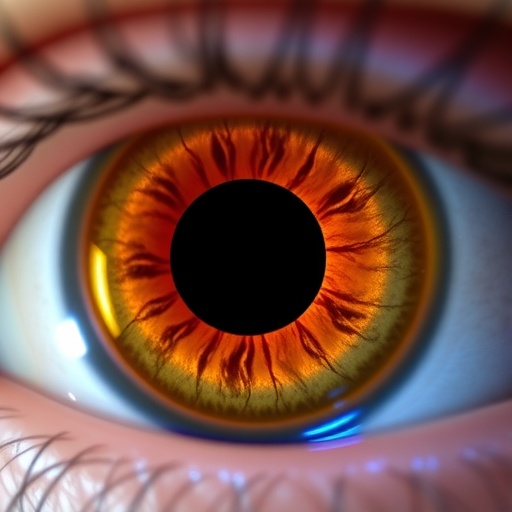
In a groundbreaking advancement that promises to revolutionize retinal imaging and clinical diagnostics, researchers have unveiled a novel method that overcomes a fundamental optical limitation by combining adaptive optics with cutting-edge computational techniques. This breakthrough allows for full-thickness retinal imaging at cellular resolution without the need for repeated focusing adjustments, marking a significant stride in both biomedical engineering and ophthalmology.
Retinal imaging has long been constrained by the delicate interplay between resolution and depth of focus. The human retina, a multi-layered neural tissue about 300 micrometers thick, demands extraordinarily precise visualization to reveal structures at the single-cell level. Conventional high-resolution methods, especially those involving adaptive optics optical coherence tomography (AO-OCT), have offered unprecedented clarity but only within extremely thin focal planes. As a result, clinicians have historically faced the daunting task of sequentially refocusing and acquiring numerous scans across different retinal layers to capture a full picture—an approach that inevitably elongates examination times, complicates procedures, and increases susceptibility to motion artifacts induced by involuntary eye movements.
Led by the collaborative efforts of Dawid Borycki and Maciej Wojtkowski from the Institute of Physical Chemistry of the Polish Academy of Sciences’ International Centre for Translational Eye Research (ICTER), alongside Zhuolin Liu and Daniel X. Hammer from the U.S. Food and Drug Administration’s Center for Devices and Radiological Health (CDRH), the new study presents a paradigm shift. Rather than pursuing hardware complexity to gain extended depth of focus, the team has innovatively employed Computational Aberration Correction (CAC) to computationally extend the depth of field from a single, optimally positioned focus setting, enhancing retinal images across layers with no sacrifice in resolution.
At the heart of this work lies AO-OCT, a sophisticated hybrid imaging technology that fuses optical coherence tomography’s infrared imaging capabilities with adaptive optics’ real-time correction of ocular aberrations. AO-OCT can visualize intricate retinal structures such as photoreceptors, retinal ganglion cells, and capillaries at unparalleled resolutions. Despite its potential, the inherent limitation of a narrow depth of focus—often only tens of micrometers—has been a major obstacle to its broader clinical application. The retina’s rich layering necessitates viewing beyond these narrow planes, traditionally achievable only through laborious focus stacking.
The CAC algorithm ingeniously harnesses the rich phase and amplitude information contained in AO-OCT’s high-quality input data. Unlike superficial digital enhancements that merely smooth or sharpen images, CAC reconstructs sharpness for out-of-focus layers by computationally reassigning wavefront distortions, essentially “stitching” the depth of field in the computational domain. This method requires an optimal signal-to-noise ratio—the researchers identified a critical threshold of approximately 25 dB—to ensure the phase retrieval and correction are reliable and effective.
Through carefully designed experiments, the team determined the ideal focal plane for simultaneous multi-layer visualization lies at the inner plexiform layer (IPL), situated roughly midway through the retina. Focusing here capitalizes on relatively strong imaging signals from both deeper photoreceptor layers and more superficial ganglion cell layers. This strategic choice enables CAC to fully exploit the high signal quality, delivering a comprehensive, high-resolution image of the entire retinal thickness from a single acquisition, reducing scanning time significantly.
Testing their method on data from two human volunteers—a healthy 39-year-old and a 53-year-old patient with multiple sclerosis (MS) and a history of optic neuritis—offered meaningful insights into clinical applicability. MS-related neurodegeneration primarily affects retinal ganglion cells and the optic nerve head; however, effects on photoreceptors remain poorly understood due to difficulty in visualizing these layers simultaneously. The ability to image both inner and outer retinal layers concurrently using CAC-enhanced AO-OCT provides a new window into assessing disease impact with precision.
Another advantage stems from improved patient experience and diagnostic reliability. Reducing examination times by up to fivefold minimizes the effects of fatigue and involuntary eye movements, common sources of image degradation. Consequently, the new imaging protocol fosters not only faster clinical workflows but also enhanced image quality, enabling earlier detection of subtle pathological changes. This is particularly relevant for diseases such as age-related macular degeneration and diabetic retinopathy, where early intervention can dramatically alter patient outcomes.
Furthermore, the compatibility of the CAC algorithm with existing AO-OCT systems underscores the technique’s potential for seamless integration into clinical practice. While current computational reconstruction requires approximately 3.4 seconds per scan, the authors highlight that leveraging graphics processing unit (GPU) acceleration could reduce this to milliseconds, making near-real-time full-thickness retinal imaging a practical possibility.
The implications of this research extend beyond ophthalmology. Because the retina serves as a readily accessible part of the central nervous system, detailed cellular-resolution imaging can yield biomarkers relevant to a wide range of neurological disorders. Diseases like Alzheimer’s and Parkinson’s manifest early changes in retinal microstructures, opening avenues for non-invasive diagnosis and monitoring through retinal imaging—a prospect greatly enhanced by the newly extended depth-of-focus technique.
This innovative fusion of adaptive optics and computational aberration correction not only elevates the capabilities of retinal imaging but also exemplifies a formidable synergy between hardware and software in overcoming fundamental physical constraints. It illustrates a broader trend in biomedical optics: leveraging computational power to circumvent hardware limitations, ultimately delivering higher performance with streamlined instrumentation.
As the research community and clinical practitioners move forward, the focus will likely shift toward refining the CAC algorithm’s robustness, automating the selection of optimal focal planes, and integrating the technology into commercial imaging systems. This promises to democratize access to cellular-resolution retinal imaging, transforming the landscape of eye care diagnostics and research.
In summary, the advent of computational aberration correction enabling full-thickness AO-OCT represents a leap forward in how we visualize the retina. By attaining simultaneous clarity across retinal layers from a single focus, it paves the way for faster, more informed, and more patient-friendly ocular examinations. Such innovation holds the promise of earlier diagnoses, improved disease monitoring, and potentially, better prognostic outcomes for millions affected by eye and neurodegenerative diseases worldwide.
Subject of Research: Adaptive optics optical coherence tomography and computational aberration correction for enhanced retinal imaging
Article Title: Computational aberration correction enables full-thickness retinal imaging with adaptive optics optical coherence tomography
News Publication Date: February 2026
Web References: DOI: 10.1016/j.bbe.2026.02.002
References:
Borycki, D., Liu, Z., Hammer, D. X., & Wojtkowski, M. (2025). Computational aberration correction enables full-thickness retinal imaging with adaptive optics optical coherence tomography. Biocybernetics and Biomedical Engineering.
Image Credits: Photo by Karol Karnowski, ICTER
Tags: adaptive optics optical coherence tomographyadaptive optics retinal imagingbiomedical engineering in ophthalmologycellular resolution eye imagingcomputational retinal imaging techniquesfull-thickness retina imaginghigh-resolution retinal diagnosticsmulti-layer retinal visualizationreducing eye imaging motion artifactsretinal imaging depth of focus solutionssingle-exam retinal scan technologytranslational eye research advancements