In a groundbreaking study published in the Journal of Perinatology, researchers have unveiled striking findings on the incidence and risk factors of post-operative tracheitis in infants admitted to neonatal intensive care units (NICUs) following tracheostomy placement. Tracheostomy, a surgical procedure that creates an opening through the neck into the trachea, is commonly performed to assist infants with prolonged respiratory distress. While lifesaving, this intervention carries inherent risks, chief among them being tracheitis, a potentially severe inflammation of the tracheal lining with serious complications if not promptly diagnosed and managed.
The team led by Forget et al. conducted a comprehensive analysis involving a large cohort of infants who underwent tracheostomy in the NICU setting. Their objective was to provide a detailed epidemiological outlook on how frequently post-operative tracheitis occurs and to identify contributing factors that predispose certain patients to this condition. Given that respiratory complications in this vulnerable population can escalate rapidly, elucidating these risk factors holds significant promise for improving clinical outcomes and guiding preventive strategies.
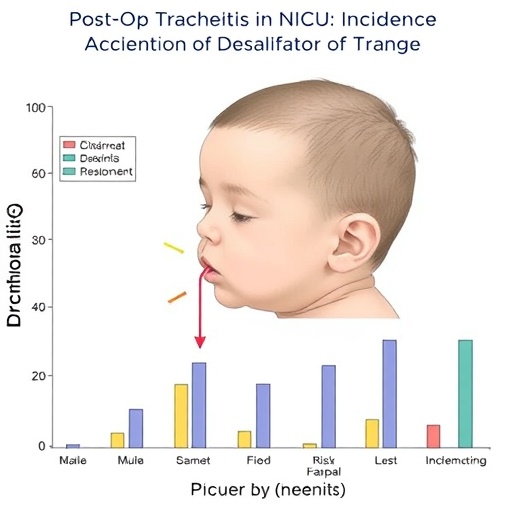
One of the central revelations of the study was the observed incidence rate of post-tracheostomy tracheitis, marked in the figure as increasing sharply over days post-procedure. The authors meticulously mapped out how the risk evolves within the first several weeks after surgery. This temporal pattern highlights the critical window during which heightened vigilance and targeted prophylactic interventions could be most beneficial, a finding that could recalibrate NICU protocols worldwide.
Diving deeper into the pathophysiology, tracheitis after tracheostomy stems from a combination of factors including mechanical irritation, colonization by pathogenic bacteria, compromised mucosal barriers, and sometimes immune system immaturity. Infants, particularly those born prematurely, possess inherently delicate airway structures and immature immune defenses, rendering them exceptionally vulnerable to infections that exacerbate inflammatory responses in the trachea. The study’s data provide empirical support for these clinical observations, confirming that these predispositions translate into measurable increased risk.
Interestingly, the researchers identified several modifiable and non-modifiable risk factors associated with post-operative tracheitis. Prematurity emerged as a prominent non-modifiable risk factor, aligning with prior understanding of neonatal immunological immaturity. Additionally, extended duration of mechanical ventilation prior to tracheostomy correlated with higher incidence rates, indicating that prolonged airway manipulation might exacerbate vulnerability. The use of certain ventilator settings and the duration of tracheostomy tube placement also surfaced as significant contributors.
Another key facet of the study was its exploration of microbiological profiles related to tracheitis episodes. The team documented predominant bacterial strains implicated in tracheal infections, which include both common respiratory pathogens and opportunistic organisms often problematic in NICU environments. Such detailed microbial data underscore the need for tailored antimicrobial stewardship in neonatology, ensuring that antibiotic therapy is both effective and minimizes resistance development.
Furthermore, the study raises critical questions about the inflammatory cascade initiated in the trachea post-tracheostomy. Prolonged inflammation can lead to complications such as tracheal stenosis, granulation tissue formation, and increased respiratory morbidity. Understanding the molecular underpinnings of these processes could pave the way for innovative therapies that target inflammation at the cellular level, beyond conventional antimicrobial approaches.
Clinical implications of these findings extend to vigilant post-operative monitoring protocols. The study advocates for routine surveillance bronchoscopy and microbial cultures within the first few weeks following tracheostomy, especially in high-risk infants. Early identification and treatment of tracheitis could prevent downstream complications and improve ventilator weaning success rates, reducing NICU length of stay and healthcare costs.
Moreover, the findings underscore the importance of multidisciplinary collaboration in managing NICU patients with tracheostomies. Neonatologists, otolaryngologists, infectious disease specialists, and respiratory therapists must coordinate to optimize care pathways, encompassing preoperative assessments, surgical techniques, and postoperative care plans that mitigate infection risks.
Innovations in tracheostomy tube design may also evolve in response to such research. Materials that resist biofilm formation, improved cuff designs to minimize mucosal trauma, and enhanced humidification systems could collectively reduce irritation and bacterial colonization, helping to decrease tracheitis rates.
Perhaps the most urgent message from this landmark study is the need for individualized care. Recognizing which infants are at highest risk enables clinicians to tailor preventative and therapeutic interventions more precisely, embodying the principles of precision medicine in neonatology. This approach may ultimately confer better health trajectories for these fragile patients.
In conclusion, the detailed epidemiology and risk profiling of post-operative tracheitis elucidated by Forget et al. provide a pivotal resource for NICU practitioners worldwide. Their research not only delineates the scale of the problem but also charts a clear path towards more effective prevention and management strategies. As the NICU community digests these insights, enhanced survival and quality of life for infants undergoing tracheostomy may become a definitive reality.
Future studies building on this foundation could focus on novel anti-inflammatory agents or biomaterials science to develop next-generation tracheostomy care that minimizes inflammation and infection. Integrating this knowledge with genetic and immunological profiling of neonates could further refine risk stratification models.
The repercussions of this study resonate far beyond the NICU, touching on fundamental challenges in pediatric airway management and postoperative care. It exemplifies how rigorous clinical research coupled with multidisciplinary efforts can yield transformative advances in neonatal healthcare, a testament to the future of medicine focused on vulnerable populations.
As neonatal survival rates continue to improve worldwide, addressing complications such as post-operative tracheitis becomes increasingly paramount. Studies such as this provide the empirical backbone necessary to drive policy changes, educational initiatives, and clinical guidelines that will enhance care quality for the tiniest, most fragile patients among us.
Subject of Research: Incidence and risk factors of post-operative tracheitis following tracheostomy placement in infants within the NICU.
Article Title: Post-operative tracheitis in the NICU: incidence and risk factors.
Article References:
Forget, A., Armstrong, A., Dewitt, E. et al. Post-operative tracheitis in the NICU: incidence and risk factors. J Perinatol (2026). https://doi.org/10.1038/s41372-026-02669-y
Image Credits: AI Generated
DOI: 17 April 2026
Tags: clinical strategies for post-tracheostomyepidemiology of post-op tracheitisincidence of tracheitis after tracheostomymanagement of tracheitis in infantsneonatal intensive care respiratory infectionsoutcomes of tracheostomy in NICUpost-operative tracheitis in neonatesprevention of neonatal airway infectionsrespiratory distress interventions in neonatesrisk factors for neonatal tracheitistracheostomy care in newbornstracheostomy complications in NICU