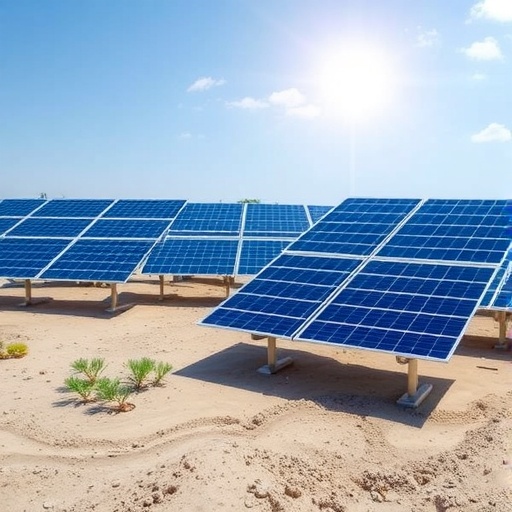
In the relentless pursuit of sustainable energy solutions, solar hydrogen production has emerged as a beacon of hope, promising a future where clean fuel is generated directly from sunlight and water. Recent breakthroughs by a team of researchers, including Sun, YE., Lin, WC., Huang, HN., and their colleagues, have unveiled a revolutionary approach to enhance solar hydrogen generation efficiency while optimizing land use. Their study, poised to be published in Nature Communications in 2026, introduces vertically stacked immobilized photocatalyst devices, an innovation that could redefine the landscape of renewable energy production.
Traditionally, photocatalytic water splitting systems have relied on planar configurations, which often require expansive surface areas to achieve meaningful hydrogen yields. This spatial demand poses a significant challenge, especially in densely populated or geographically constrained regions where land is scarce. Addressing this bottleneck, the team’s vertically stacked photocatalyst architecture ingeniously multiplies catalytic surface area per unit land footprint without compromising device performance.
At the core of this technology is the immobilization of photocatalysts onto vertically oriented substrates, which allows consecutive layers to harness sunlight sequentially. By meticulously engineering the optical path and catalyst orientation, these devices efficiently capture incident photons across multiple strata, thereby increasing overall light absorption and reactive surface exposure. This method sidesteps the limitations of conventional, flat-panel designs that face diminishing returns as they scale in size.
A critical aspect of the researchers’ approach lies in the selection and synthesis of photocatalytic materials. They employed semiconductors with tailored bandgaps optimized to absorb a broad spectrum of sunlight, from ultraviolet through visible wavelengths. This spectral matching enhances the generation of electron-hole pairs crucial for driving the water-splitting reactions. Moreover, surface modifications introduced to the catalysts improve charge separation efficiencies, mitigating recombination losses that have historically plagued photocatalytic systems.
The immobilized design facilitates robust catalytic activity by anchoring nanoparticles securely on substrates, which prevents agglomeration and catalyst degradation over prolonged cycles. This structural stability is vital for practical deployment, ensuring that the devices maintain consistent hydrogen output across extended operational periods. Additionally, the vertical stacking configuration promotes effective mass transport of reactants and products, alleviating diffusion limitations that commonly arise in denser catalytic assemblies.
To characterize the performance of their vertically stacked devices, the team conducted comprehensive photoelectrochemical analyses under simulated solar illumination. The results demonstrated a substantial increase in hydrogen evolution rates compared to planar counterparts normalized by land area. Notably, their setup achieved higher solar-to-hydrogen conversion efficiencies, signaling promise for scalable and economically viable hydrogen production.
Beyond efficiency gains, this architecture offers compelling advantages in modularity and integration. The thin, layered structure can be adapted to a variety of substrates and scaled vertically, facilitating compact reactor designs suitable for urban settings or existing infrastructure rooftops. This versatility supports decentralized hydrogen generation, potentially reducing reliance on long-distance fuel transportation and associated carbon emissions.
Environmental durability was another pivotal consideration during device development. The immobilized catalysts exhibited resilience against photocorrosion and fouling under prolonged aqueous exposure, thanks to protective passivation layers and inherently stable material compositions. These traits underscore the system’s potential for real-world applications, where harsh operational environments often diminish photocatalytic longevity.
In contemplating the broader implications, vertically stacked immobilized photocatalyst devices represent a transformative step toward sustainable energy ecosystems. By dramatically improving land-use efficiency in solar hydrogen production, this innovation aligns with global strategies to mitigate climate change and transition away from fossil fuels. The capability to generate clean fuel with minimal spatial constraints addresses a key hurdle in deploying renewable technologies at scale.
Moreover, the scalability and adaptability of this design invite interdisciplinary collaboration across materials science, chemical engineering, and environmental policy domains. Future iterations may incorporate emerging nanomaterials and advanced fabrication techniques to further enhance catalytic activity, light management, and device robustness. Integration with smart energy grids and storage solutions could optimize hydrogen utilization, catalyzing a hydrogen-based economy.
While commercialization efforts remain in their infancy, the team’s findings provide a compelling blueprint for next-generation solar hydrogen reactors. By combining innovative device architecture with rigorous material science, the research paves the way for sustainable molecular fuel production that harmonizes with urban planning and land conservation priorities.
This breakthrough also stimulates inquiry into potential synergies with other renewable technologies such as photovoltaic cells, enabling hybrid systems that maximize solar energy conversion pathways. Coupling photocatalytic reactors with water-splitting electrodes or co-catalysts might further elevate production rates, advancing the frontier of artificial photosynthesis.
In summary, Sun, YE., Lin, WC., Huang, HN., and collaborators have charted a visionary route to amplify solar hydrogen production through vertically stacked immobilized photocatalyst devices. Their pioneering work not only tackles spatial limitations intrinsic to traditional designs but also enhances catalytic efficiency and durability. As society urgently seeks clean energy alternatives, innovations like these bring the hydrogen economy closer to widespread realization, heralding a sustainable and land-efficient future fueled by sunlight.
Subject of Research: Solar hydrogen production using vertically stacked immobilized photocatalyst devices.
Article Title: Vertically stacked immobilized photocatalyst devices towards land-efficient solar hydrogen production.
Article References:
Sun, YE., Lin, WC., Huang, HN. et al. Vertically stacked immobilized photocatalyst devices towards land-efficient solar hydrogen production. Nat Commun (2026). https://doi.org/10.1038/s41467-026-71947-2
Image Credits: AI Generated
Tags: enhanced solar hydrogen generationimmobilized photocatalyst technologyland-efficient renewable energymultilayer photocatalyst architectureoptimizing catalytic surface areaphotocatalytic water splittingrenewable energy in constrained spacessolar hydrogen productionstacked photocatalyst devicessunlight-driven hydrogen fuelsustainable energy innovationsvertically oriented photocatalysts