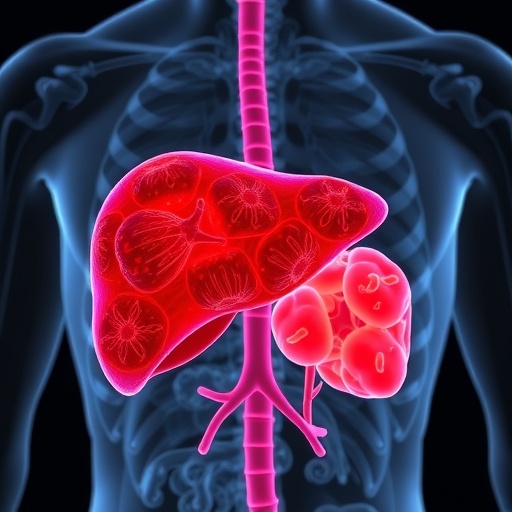
In the realm of regenerative medicine, a persistent obstacle has been the inability to scale engineered liver tissues to sizes sufficient for therapeutic application. Patients afflicted with end-stage liver disease face a dire prognosis, with liver transplants remaining the only curative option after intrinsic regenerative mechanisms fail. The scarcity of donor organs and the lengthy waitlists exacerbate mortality rates, highlighting the urgency for innovative therapeutic strategies. A groundbreaking study from the Wyss Institute at Harvard University, in collaboration with Boston University and MIT, introduces a synthetic biology-based approach to circumvent these limitations by enabling controlled, on-demand growth of implanted engineered liver tissues.
This novel approach, termed “BOOST” (bioengineered on-demand outgrowth via synthetic biology triggering), deftly integrates synthetic biology with tissue engineering to genetically program primary human liver cells and supportive fibroblasts. By reconfiguring the expression of specific growth regulators within these cells, the engineered liver constructs can be remotely stimulated to proliferate upon administration of an externally controlled inducer molecule, doxycycline (DOX). This advancement strategically bypasses the traditional constraints imposed by tissue scale and vascular integration, allowing the implanted tissues to expand volumetrically within the host’s body to therapeutically relevant sizes without necessitating pre-growth ex vivo.
The cornerstone of BOOST’s strategy lies in the nuanced manipulation of signaling pathways that govern hepatocyte proliferation. Initial investigations identified four potent growth factors — hepatocyte growth factor (HGF), transforming growth factor alpha (TGFa), WNT2, and R-spondin 3 (RSPO3) — that individually induced hepatocyte expansion in low-density cultures. However, their inability to stimulate proliferation within densely packed three-dimensional constructs pointed to additional inhibitory mechanisms. The researchers elucidated the role of Yes-associated protein (YAP), a mechanosensitive transcriptional effector, which under high cellular density is sequestered and degraded in the cytoplasm, thus acting as a proliferation checkpoint. By engineering hepatocytes to express a constitutively active, non-degradable form of YAP capable of nuclear translocation even under crowded conditions, they effectively overcame this barrier, synergizing YAP activity with growth factor signaling to fulfill the proliferative requirements in dense liver tissues.
To translate this mechanistic insight into a controllable therapeutic modality, the team employed synthetic biology to engineer genetic circuits within hepatocytes and fibroblasts. The fibroblasts were modified to secrete the aforementioned induction cocktail of growth factors, while the hepatocytes were engineered to express the stabilized YAP variant, all under the control of a doxycycline-inducible promoter system. This inducibility confers precision temporal control over liver tissue growth: administering DOX triggers protein expression and induces proliferation, while withdrawal ceases growth and maintains tissue stability. Time-course experiments demonstrated significant expansion of the engineered liver constructs in vitro under continuous induction, affirming the system’s dynamic responsiveness.
Extending the model to an in vivo context, small-scale engineered liver tissues were implanted subcutaneously into immunocompetent mice. Upon systemic doxycycline administration for one week, the implants exhibited a remarkable 500% increase in tissue size, correlated with a doubling of hepatocyte populations. Notably, the proliferated tissues became vascularized, effectively accommodating their metabolic demands without eliciting fibrotic response or tumorigenesis, which are common complications associated with uncontrolled cell growth. This finding underscores the strategy’s safety profile and its potential for clinical translation.
A striking aspect of BOOST is its capacity to provoke liver tissue growth independent of host liver injury, a departure from existing paradigms that require hepatic damage to create a proliferative niche. The ability to non-invasively regulate tissue expansion in a healthy environment opens new avenues for therapeutic interventions, especially as a bridge for patients awaiting transplantation or as a means to restore metabolic function in chronic liver disease. The research also sheds light on the complexity of human liver regeneration pathways, diverging from rodent models by revealing additional proliferative checkpoints necessitating combined modulation of growth factors and mechanotransduction signals.
Despite the promising outcomes, the study candidly acknowledges a trade-off between proliferation and hepatocyte functionality. High proliferative states coincide with a transient reduction in liver-specific functions, a biological compromise well-documented across tissue types. Future investigations are poised to explore strategies that either mitigate this effect or harness endogenous re-differentiation pathways to restore full hepatic competency post-expansion. Such efforts will be pivotal to maximize the clinical efficacy of BOOST-engineered tissues.
The implications of BOOST extend beyond liver regeneration. The modularity of this synthetic biology platform suggests its potential adaptation to other organ systems where engineering scalable tissue implants remains challenging. For instance, analogous approaches might be engineered to control the growth of cardiac or pancreatic tissues, addressing diseases such as heart failure or diabetes with unprecedented precision. The underlying principle of inducible, controlled outgrowth could revolutionize how regenerative therapies are designed and administered.
This breakthrough was achieved through a unique interdisciplinary collaboration that combined expertise in nanotechnologies, bioengineering, cellular engineering, and vascular biology. Leadership by Drs. Christopher Chen and Sangeeta Bhatia, both pioneers in their respective fields, facilitated the seamless integration of complex synthetic circuits with robust tissue engineering frameworks. Their collective vision propels the Wyss Institute’s mission of delivering bioinspired engineering solutions to pressing medical challenges.
Supported by prominent funding bodies—including the National Institutes of Health, Howard Hughes Medical Institute, and National Science Foundation—the study exemplifies the power of sustained investment in cutting-edge biomedical research. The involvement of early-career scientists like Amy Stoddard, who spearheaded the development of BOOST, highlights the essential role of nurturing scientific talent in fostering transformative innovation.
The ability to synthetically direct the proliferation of human liver tissue in vivo represents a foundational advance with broad ramifications. By breaking the constraints of pre-implantation growth, this method presents a versatile and clinically viable path toward alleviating organ shortages. As the field progresses, integrating this technology with existing transplant protocols or developing entirely new cell-based therapies promises to redefine standard care for liver disease and possibly other degenerative conditions.
This study’s publication in Science Advances invites the scientific community to engage deeply with the methodological advancements and encourages collaborative endeavors aimed at refining and scaling BOOST. The meticulous engineering of gene circuits, thorough in vitro and in vivo validation, and comprehensive safety assessments set a robust precedent for future synthetic biology applications in regenerative medicine.
In conclusion, the BOOST strategy marks a pivotal leap in regenerative therapeutics, allowing engineered liver tissues to be expanded on demand post-implantation with external molecular cues. Its innovative synthesis of synthetic biology, mechanotransductive insights, and tissue engineering strategies may fundamentally transform the treatment landscape for liver diseases and beyond, heralding a new era where organ shortages and associated mortalities could be mitigated through precise and controllable bioengineered solutions.
Subject of Research: Cells
Article Title: Synthetic Control of Implanted Engineered Liver Tissue Growth
News Publication Date: 17-Apr-2026
Web References:
DOI: 10.1126/sciadv.adz8362
Image Credits: Wyss Institute at Harvard University
Keywords: Organ transplantation, Hepatocytes, Liver damage, Inflammation, Synthetic biology, Genetic engineering, Tissue engineering, Signal transduction, Growth factor pathways, Mechanotransduction pathways, Differentiation pathway, Signaling cascades
Tags: bioengineered liver constructsBOOST synthetic biology approachdoxycycline-inducible tissue proliferationend-stage liver disease treatment innovationengineered liver tissue scalingfibroblast role in tissue engineeringin vivo liver tissue regenerationliver tissue vascular integrationon-demand liver tissue growthprimary human liver cell programmingsynthetic biology in regenerative medicinetherapeutic liver tissue expansion