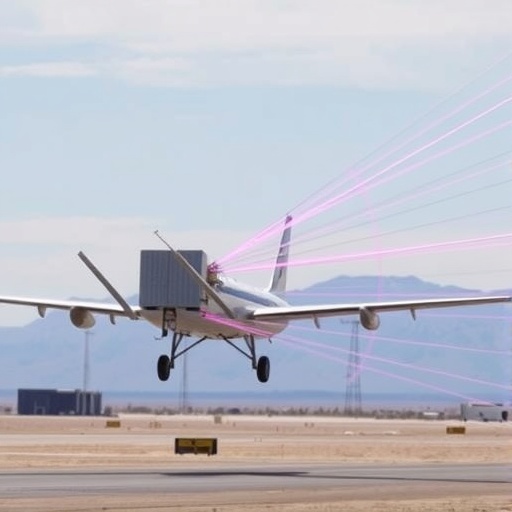
In a groundbreaking deployment at a Nevada airfield, researchers have demonstrated the extraordinary capabilities of fiber optic technology combined with seismic sensing to capture detailed data on aircraft flight dynamics. Originally installed to monitor the re-entry signals of NASA’s OSIRIS-REx Sample Return Capsule, a T-shaped fiber optic cable strategically laid out on the airfield’s surface unexpectedly recorded intricate details of a Cessna 172’s speed and maneuvering patterns. This innovative approach highlights the potential of Distributed Acoustic Sensing (DAS) as a rapid-deployment tool for monitoring acoustic and seismic signatures in environments where traditional subsurface installations are impractical.
Distributed Acoustic Sensing technology leverages the inherent microstructural imperfections within standard optical fibers to serve as thousands of quasi-distributed seismic sensors along the length of the cable. A laser interrogator sends pulses down the fiber, and light reflects back from scattering sites induced by these tiny flaws. When the fiber encounters environmental vibrations—whether acoustic signals in the air or seismic waves traversing the ground—minute alterations in the fiber’s length occur. These perturbations translate to strain measurements in the order of nanometers, providing researchers with a rich dataset to analyze ambient and transient wavefields with remarkable spatial and temporal resolution.
In the Nevada airfield experiment, the fiber optic cable was arrayed both on the ground’s surface and buried shallowly at a depth of about seven centimeters, running parallel to the taxiway used by the aircraft. Complementing the fiber array, researchers installed conventional seismic sensors nearby, creating a multi-modal sensing network capable of capturing the complex interaction between aircraft-generated acoustic waves and ground vibrations. This setup allowed for a novel examination of aircraft behavior through the lens of coupled acoustic-seismic phenomena, correlating fiber-derived strain signals with traditional seismic recordings and visual observations from video footage.
On September 22, 2023, just days before the OSIRIS-REx capsule’s highly anticipated return, the team recorded video footage of a Cessna 172 as it performed takeoffs, fly-bys, and proficiency flight patterns. The dual use of fiber optic sensing and visual documentation enabled the researchers to link specific aircraft maneuvers to their corresponding seismo-acoustic signatures. Their analyses revealed that changes in the aircraft’s speed, turning actions, and propeller revolutions per minute (RPM) produced distinct, time-varying spectral features in the DAS and seismic datasets. These variations offered an unprecedented dynamic portrayal of flight operations, surpassing the steady-state characterizations typically achievable in overflight studies.
Crucially, the researchers demonstrated that surface-draped fiber could effectively capture aircraft-induced vibrations without necessitating complex trenching or permanent installations, a significant advancement in field-deployable monitoring technology. This capability opens new avenues for quickly establishing sensor networks in otherwise inaccessible or environmentally sensitive locations where traditional seismic instrumentation would be impractical. The shallowly buried fiber, meanwhile, offered enhanced coupling with ground motions, facilitating precise estimations of taxi speeds and permitting reconstruction of the plane’s traffic pattern—a rectangular circuit typically flown during pilot proficiency exercises.
The spectral analysis of seismic signals further allowed the team to infer variations in the Cessna’s propeller RPM as it altered power settings during its flight path. By generating seismic spectrograms, they observed the dynamic frequency shifts that accompany changes in engine speed and aerodynamic maneuvers. This level of real-time detail provides a nuanced understanding of how aircraft influence localized vibrational environments, information that holds promise not only for aviation monitoring but also for broader geophysical and security applications.
These findings build on a growing body of research into the utility of DAS for detecting and tracking aircraft. While prior studies have largely focused on the relatively constant vibrations produced during steady overflight, this investigation brings to light the rich, temporally resolved dynamics associated with flight maneuvers. The capacity to discern such fine-scale variations in real-world conditions represents a leap forward in applying fiber optic sensing technology to aeronautical engineering and traffic surveillance.
Looking forward, the research team plans to continue investigating the complex seismic responses captured by surface-draped fibers. Understanding the influence of environmental factors such as soil composition, surface conditions, and cable deployment configurations will be key to optimizing data quality and interpretability. The insights gleaned from this Nevada deployment are expected to inform design strategies for future DAS installations aimed at multi-modal sensing—from ground transportation corridors to aerospace test fields.
Beyond terrestrial applications, the team’s work has sparked interest in the potential for DAS technology in extraterrestrial environments. At the same conference, co-author Carly Donahue from Los Alamos National Laboratory discussed the feasibility of deploying surface-draped fiber optic systems on the Moon. Such a setup could revolutionize lunar seismo-acoustic studies, enabling sensitive detection of micro-vibrations caused by lander operations, meteorite impacts, or seismic events, without the logistical challenges of burying instrumentation in the harsh lunar regolith.
The convergence of optical fiber technology, seismic sensing, and aerospace monitoring encapsulates a vibrant interdisciplinary frontier. As the data from the Cessna 172 flights demonstrate, DAS provides a powerful means of remotely acquiring high-fidelity, distributed measurements of mechanical disturbances across complex environments. This capability promises transformational advances in aviation safety oversight, earthquake science, and planetary exploration, affirming the profound value of pushing the boundaries of sensor technology integration.
In summary, this innovative study reports the first known utilization of surface-draped and shallow-buried fiber optic cables to capture the detailed seismo-acoustic fingerprints of a propeller-driven aircraft in flight. The capacity for rapid deployment and rich data acquisition inherent in DAS systems signals a new era of geophysical sensing versatility. As fiber optic networks proliferate and interrogation technologies evolve, the possibilities for monitoring dynamic phenomena—from terrestrial transportation hubs to the surfaces of other worlds—expand exponentially.
Subject of Research: Distributed Acoustic Sensing of Aircraft Maneuvers Using Fiber Optic Cables
Article Title: Fiber Optic Seismo-Acoustic Sensing Captures Real-Time Dynamics of Aircraft Flight at Nevada Airfield
News Publication Date: Information not explicitly provided in the source material
Web References:
2026 SSA Annual Meeting: https://meetings.seismosoc.org/
OSIRIS-REx Related Publication: https://pubs.geoscienceworld.org/srl/issue/96/5
Recent Aircraft Seismic Classification Studies: https://pubs.geoscienceworld.org/ssa/tsr/article/5/4/330/688104/Classification-of-Aircraft-Types-Using-Seismic
Potential Lunar DAS Applications: https://seismosoc.secure-platform.com/a/gallery/rounds/47/details/13982
Image Credits: E. A. McGhee
Keywords
Distributed Acoustic Sensing, Fiber Optic Cable, Seismic Sensing, Aircraft Detection, Cessna 172, OSIRIS-REx, Seismo-Acoustic Data, Aviation Monitoring, Fiber Optic Sensors, Seismic Spectrogram, Aircraft RPM, Lunar Seismic Sensing
Tags: aircraft maneuver monitoring with DASCessna 172 flight data analysisDAS technology for flight dynamicsdistributed acoustic sensing in aviationfiber optic cable aircraft speed detectionfiber optic flight data sensorsfiber optic seismic sensing applicationshigh-resolution flight data acquisitionNASA OSIRIS-REx fiber optic sensoroptical fiber seismic wave measurementrapid-deployment acoustic sensorsseismic sensing for aircraft monitoring