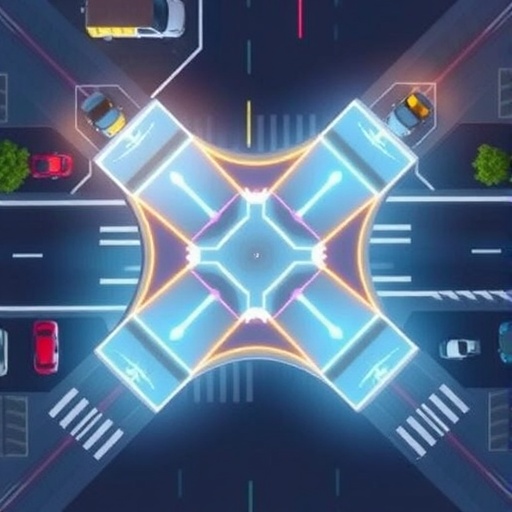
A groundbreaking development in autonomous vehicle technology promises to revolutionize traffic management at signalized intersections, especially in mixed traffic environments where human-driven cars and connected autonomous vehicles (CAVs) coexist. Addressing the long-standing problem of mandatory lane changes—where vehicles must navigate mid-block to align correctly with turning lanes—researchers have unveiled a novel artificial intelligence framework known as SS-MA-PPO (Simulation-Supervised Multi-Agent Proximal Policy Optimization). This innovative system goes beyond traditional isolated decision-making processes by integrating acceleration and lane-switching tasks into a unified, multi-agent cooperative strategy, offering a substantial leap forward in traffic flow optimization and safety.
Mandatory lane changes at intersections notoriously contribute to traffic congestion, increased fuel consumption, and unsafe driving conditions due to the abrupt maneuvers required. The complexity intensifies in mixed traffic scenarios, where autonomous vehicles must interact seamlessly with unpredictable human drivers. SS-MA-PPO addresses this challenge head-on by conceptualizing lane change control as a coordinated effort among multiple agents—the vehicles themselves—working collaboratively rather than independently. This collective viewpoint fundamentally shifts how trajectory planning is approached, focusing on harmonizing movements across several vehicles instead of optimizing isolated actions.
Central to the SS-MA-PPO framework is the Simulation-Guided Supervisory Module (SGSM), which acts as an intelligent safety net during the autonomous learning process. Employing sophisticated human-driver behavioral models, the SGSM pre-evaluates potential maneuvers before they are executed, thereby safeguarding against risky or unstable decisions, particularly in the early stages of AI training. This preemptive evaluation ensures the system maintains robust reliability and smooth driving behavior, making learning processes both efficient and safe.
The innovative framework also leverages comprehensive situational awareness by incorporating detailed surrounding vehicle data into its algorithms. Rather than optimizing for the speed of a single autonomous vehicle, SS-MA-PPO emphasizes collective traffic efficiency. CAVs dynamically cooperate to create strategic gaps and synchronize lane changes, effectively reducing stop-and-go events and smoothing the overall traffic progression. This holistic strategy promises to significantly lessen delays and fuel waste, while enhancing driving stability.
Field validation of SS-MA-PPO utilized an extensive real-world traffic dataset from Langfang, China, which provided a rigorous test bed under varying conditions of CAV penetration ranging from 20% to full 100% integration. Across all conditions, the multi-agent framework consistently outperformed traditional rule-based methods and competing multi-agent reinforcement learning approaches, demonstrating marked improvements in critical performance metrics such as delay reduction, waiting time minimized, fuel consumption cutbacks, and decrease in stop-and-go frequencies. These results underscore the practical efficacy and scalability of this advanced approach.
Of particular note is SS-MA-PPO’s ability to manage both longitudinal (acceleration, deceleration) and lateral (lane switching) vehicle dynamics through unified, cooperative decision-making. This integration allows autonomous vehicles to prepare coordinated maneuvers well in advance, minimizing sudden braking or abrupt lane changes that typically degrade traffic flow quality. Such foresight is vital in mixed traffic, where human drivers’ behaviors introduce uncertainties that must be surmounted with predictability and caution.
The researchers emphasize the transformative power of blending simulation supervision with multi-agent cooperation. By creating an AI framework that not only learns safely but also communicates and collaborates among vehicles, SS-MA-PPO stands out as a pioneering solution that bridges the gap between theoretical reinforcement learning models and practical on-road deployments. The implementation offers a promising pathway to mitigate urban traffic challenges that have long stifled mobility and sustainability efforts worldwide.
Looking ahead, the research team envisions expanding the framework to integrate adaptive traffic signal control systems. By synchronizing vehicle decision-making with dynamic signal timing, the potential exists to further streamline intersection throughput and minimize congestion. Moreover, the application scope is planned to extend beyond isolated intersections to entire corridors and urban networks, which would amplify the benefits of coordinated multi-agent control at city-wide scales.
Another exciting frontier identified is the refinement of human-driver models within the system. Enhancing these models with richer, data-driven behavioral insights will elevate the realism and robustness of simulations, thereby fostering safer and more efficient AI behaviors when deployed in the chaotic variability of real human traffic. Constant improvements to these behavioral analogues will ensure that SS-MA-PPO adapts gracefully to evolving human driving patterns.
The work is published in the prestigious journal Communications in Transportation Research, reflecting a significant endorsement by the academic community. Its publication underlines the growing importance of interdisciplinary approaches combining machine learning, human factors, and transportation engineering to tackle modern mobility challenges. As CAVs inch closer to widespread adoption, frameworks like SS-MA-PPO are poised to accelerate this transition while mitigating potential disruptions.
To summarize, the SS-MA-PPO framework introduced by this team marks a major milestone in the quest to harmonize autonomous vehicle control within mixed traffic environments. By innovatively combining simulation-based safety supervision with cooperative multi-agent learning, it offers a technically sophisticated yet practical solution to longstanding intersection traffic problems. This breakthrough signals a new era of collaborative intelligence on the road, promising smoother, safer, and more sustainable urban transportation networks.
Subject of Research: Multi-agent AI framework for trajectory planning of connected autonomous vehicles in mixed traffic at signalized intersections.
Article Title: Joint Longitudinal-Lateral Trajectory Planning for CAVs in Mixed Traffic at Signalized Intersections.
News Publication Date: 31-Mar-2026.
Web References: https://doi.org/10.26599/COMMTR.2026.9640011
References: Not specified.
Image Credits: Communications in Transportation Research.
Keywords
Connected autonomous vehicles, multi-agent reinforcement learning, trajectory planning, lane change control, mixed traffic, signalized intersections, roadway safety, traffic efficiency, simulation-supervision, human-driver models, cooperative AI, transportation research.
Tags: AI in autonomous driving safetyautonomous and human driver interactionautonomous vehicle lane changing strategiesconnected autonomous vehicles coordinationcooperative trajectory planning for CAVsintelligent traffic management systemsmixed traffic management solutionsmulti-agent reinforcement learning for trafficreducing congestion with AIsimulation-supervised multi-agent systemsSS-MA-PPO frameworktraffic flow optimization at intersections