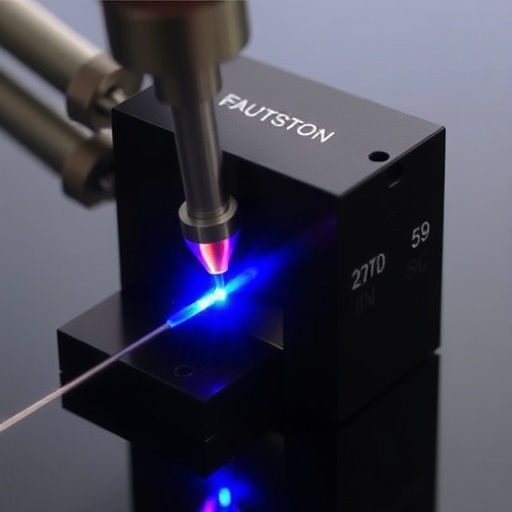
In a groundbreaking advancement set to redefine the capabilities of ultra-precision manufacturing, researchers at The Hong Kong Polytechnic University (PolyU) have developed an innovative diamond cutting technology that integrates multi-energy fields to enhance process efficiency and material performance. This novel technique leverages the synergy of multiple external energy fields to assist the diamond cutting tool, enabling unprecedented accuracy and surface quality improvements when machining high-performance materials. This development promises to revolutionize sectors reliant on extreme precision, including aerospace, biomedical engineering, and microelectronics.
The core challenge in ultra-precision manufacturing of advanced materials has historically been achieving superior surface finish and dimensional accuracy without compromising the integrity of the workpiece. Traditional diamond cutting methods offer a high level of precision, but they often encounter limitations in processing hard, brittle, or heat-sensitive materials. The PolyU team addressed these challenges by pioneering a multi-energy field-assisted diamond cutting process that applies carefully calibrated electromagnetic, thermal, and vibrational energies simultaneously. These combined fields modify the cutting zone dynamics, resulting in reduced tool wear, minimized cutting forces, and enhanced material removal rates.
Technically, the multi-energy field-assisted method creates a synergistic environment where electromagnetic fields induce localized heating and softening at the cutting interface. This controlled thermal effect reduces the cutting resistance faced by the diamond tool. Concurrently, ultrasonic vibrations superimposed on the cutting tool generate micro-impacts and intermittent contact conditions, which help to alleviate built-up edge formation on the tool and reduce friction during machining. The precise modulation of these energy inputs is accomplished through an integrated control system capable of adapting to variations in material properties and cutting conditions in real-time.
One of the remarkable engineering feats in this technology is the comprehensive characterization of energy field interactions at the cutting zone. PolyU researchers employed high-speed infrared thermography, laser Doppler vibrometry, and electromagnetic field mapping to quantify temperature distributions, vibrational amplitudes, and magnetic flux density during the machining process. The data acquired facilitated advanced modeling and simulation of the coupled physical phenomena, enabling optimization of parameters to balance energy input with mechanical cutting action for maximum performance.
The new diamond cutting setup features a modified ultra-precision lathe equipped with an electromagnetic coil assembly and ultrasonic transducers precisely positioned around the diamond tool holder. This configuration allows simultaneous application of electromagnetic, thermal, and ultrasonic fields in a controlled manner. A unique aspect of the system design is its ability to dynamically adjust the frequency, amplitude, and phase of the energy fields during cutting operations. Such adaptability ensures consistent cutting conditions when faced with material heterogeneity or complex machining paths, which are common in high-performance alloys and composites.
Experimental trials conducted by the team on various high-hardness materials—such as tungsten carbide, silicon carbide, and advanced composites—demonstrated significant improvements in surface integrity. Surface roughness measurements revealed reductions by over 40% compared to conventional diamond cutting techniques. Moreover, subsurface damage typically associated with brittle fracture and thermal degradation was drastically minimized, confirmed through scanning electron microscopy and X-ray diffraction analyses. These improvements translate directly into longer component lifespans and enhanced reliability in end-use applications requiring high dimensional stability.
An additional advantage of the multi-energy field approach is the marked decrease in tool wear rates. Diamond tool longevity is often a limiting factor in precision manufacturing due to its exposure to abrasive and thermal stresses. By harnessing electromagnetic heating to soften the work material locally and ultrasonic vibrations to reduce cutting resistance, the PolyU method effectively mitigates cumulative wear mechanisms. Long-term operational tests have shown that tool life can be extended by as much as 60%, reducing manufacturing costs and downtime associated with tool replacement.
Importantly, the research team has also addressed concerns related to energy consumption and system complexity. The multi-energy fields are applied in an optimized, low-power regime that carefully balances process enhancements with minimal additional energy input. Sophisticated control algorithms ensure that only the necessary magnitude of each energy field is activated adaptively, allowing an eco-friendly manufacturing process. The engineers believe that with further development, this technology has high potential for scalable integration into existing precision machining infrastructures.
This diamond cutting innovation promises transformative impacts across diverse industries. In aerospace engineering, where components often require micron-level tolerances and intricate geometries, this method provides a powerful tool for machining advanced superalloys and ceramics critical for engine and structural applications. Similarly, in the biomedical sector, ultra-smooth surfaces free of microcracks are essential for implants and surgical instruments. The ability to machine such components with minimal thermal and mechanical damage opens new frontiers in patient safety and device performance.
Beyond tool and component manufacturing, the new approach holds promise for microelectromechanical systems (MEMS) fabrication, where nano- to microscale precision machining is fundamental. The control enabled by the multi-energy fields can meet stringent surface finish requirements and minimize deformation in delicate microstructures. This capability can facilitate the production of next-generation sensors, actuators, and microfluidic devices with enhanced functionality. The convergence of multi-disciplinary energy fields in diamond cutting offers new paradigms for material-process interactions at ultra-small scales.
As the PolyU research team continues to refine and commercialize this cutting-edge technology, collaborative efforts with industry partners and international research institutions are underway to expand its applicability. Future research includes exploring the integration of laser-assisted heating, flexible robotic control for complex tool trajectories, and real-time sensor feedback systems for closed-loop process control. The aim is to establish comprehensive knowledge-driven manufacturing platforms where multi-energy field-assisted diamond cutting is a pivotal enabler of smart, high-performance materials fabrication.
This breakthrough reflects a profound advancement in precision engineering, harnessing physics beyond mechanical cutting alone. The fusion of electromagnetic, thermal, and vibrational energy fields into a unified machining process embodies a paradigm shift, offering capabilities previously unattainable with conventional methods. As industries continue to push the boundaries of material properties and component miniaturization, innovations like the PolyU multi-energy field-assisted diamond cutting technology will be instrumental in meeting future manufacturing demands with unmatched precision and sustainability.
Subject of Research: Development of multi-energy field-assisted diamond cutting technology for ultra-precision manufacturing of high-performance materials
Article Title: PolyU researchers pioneer novel multi-energy field-assisted diamond cutting technology, enabling ultra-precision manufacturing for high-performance materials
News Publication Date: Not provided
Web References: Not provided
References: Not provided
Image Credits: Media service of EurekAlert.org
Tags: advanced diamond cutting technologyaerospace material processing innovationsbiomedical engineering microfabricationelectromagnetic thermal vibrational energy synergyenhanced surface finish in precision machininghigh-performance material machiningimproved dimensional accuracy manufacturingmaterial removal rate enhancement methodsmicroelectronics ultra-precision cuttingmulti-energy field-assisted diamond cuttingreduced tool wear in diamond cuttingultra-precision manufacturing techniques