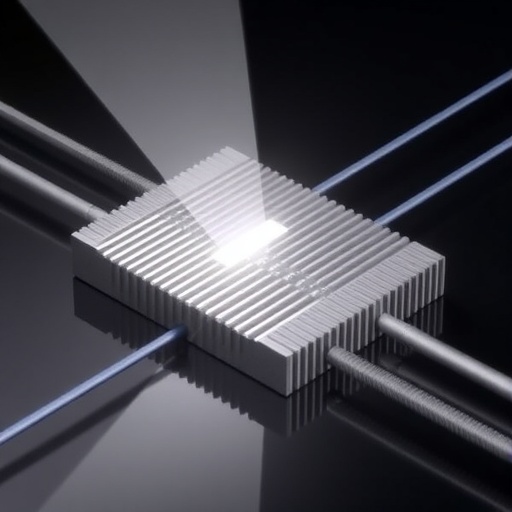
In a groundbreaking advancement poised to redefine the limits of infrared technology, researchers have engineered a revolutionary large-area metal-integrated grating electrode that achieves unprecedented near 100% infrared transmission. This pioneering development, detailed in a recent publication in Light: Science & Applications, signals a paradigm shift in the way infrared light can be manipulated and utilized across a spectrum of scientific, industrial, and technological applications. The project exemplifies how cutting-edge material science, coupled with precise nanofabrication techniques, can overcome inherent optical challenges that have long impeded the efficiency of devices operating within the infrared domain.
Infrared technology underpins many critical fields ranging from telecommunications to medical diagnostics and environmental monitoring. Despite its widespread importance, enhancing infrared transmission efficiency across large surfaces has remained a formidable challenge. Traditional electrodes, especially those integrating metallic components, often suffer from significant optical losses due to reflection, scattering, and absorption. These losses curtail device performance, limiting sensitivity and resolution. The team’s achievement in devising a metal-integrated grating structure capable of nearly immaculate transmission thus represents a monumental leap forward. This innovation paves the way for the development of devices that can harness infrared radiation with previously unattainable precision and power.
At the heart of this advance lies the meticulous design and fabrication of a grating electrode whose physical and optical properties are optimized to facilitate seamless passage of infrared waves. Grating structures traditionally modulate light by diffraction and interference, phenomena heavily dependent on the grating geometry and material composition. By integrating metallic elements, the researchers not only enhanced the electrode’s electrical conductivity but also strategically manipulated the interaction between the grating and incident infrared light. The resulting structure exhibits extraordinary control over light propagation, steering energies in a manner that minimizes reflection and enhances transmission.
One cannot understate the technical sophistication required to achieve this feat. The fabrication process employs state-of-the-art lithographic patterning techniques capable of producing highly uniform gratings over expansive areas. Such precision ensures consistent optical behavior across the electrode’s surface, a critical requirement for practical device integration. Moreover, the selected metals exhibit optimal intrinsic properties — including low plasmonic losses and high reflectivity thresholds — finely tuned to resonate with the infrared spectrum. The delicate balance struck between material choice, structural intricacy, and processing fidelity underscores the intricate engineering underpinning this high-transparency electrode.
The implications of near-perfect infrared transmission electrodes are vast and multifaceted. In optoelectronic devices, where electrodes commonly serve as both electric contacts and optical interfaces, the newfound capability means reduced energy losses and enhanced device efficiency. For instance, in photodetectors and sensors, higher transmission equates to heightened sensitivity and faster response times, potentially transforming applications in environmental sensing, spectroscopy, and medical imaging. The optimized interface will allow devices to function at lower power levels, extending battery life in portable systems and reducing thermal noise.
Another cornerstone application affected by this technology is in the realm of telecommunications. Infrared wavelengths are essential for fiber-optic communication networks, serving as carriers of vast quantities of data over long distances. The integration of electrodes that do not impede infrared signals enhances signal integrity and reduces attenuation. By embedding such gratings into photonic devices, it is anticipated that system bandwidths can be expanded while maintaining low error rates, a crucial factor in meeting the burgeoning global demand for data transmission.
From a fundamental research perspective, this innovation serves as a platform for exploring light-matter interactions at the nanoscale. The metal-integrated gratings act as both optical and electrical conduits, enabling complex experiments where the interplay between incident infrared radiation and electronic responses can be thoroughly investigated. This dual functionality catalyzes new experimental designs in plasmonics, nonlinear optics, and quantum photonics, where manipulating infrared photons with finesse is pivotal. As a result, the device is not only an engineering marvel but also an enabler of scientific discovery.
Furthermore, the large-area aspect of the electrode presents a notable advantage over previous designs that were often limited to microscale or localized regions. Scaling such technology to macroscopic dimensions without sacrificing performance is critical for real-world applicability. Whether deployed in large-panel sensors or integrated into expansive infrared imaging systems, the uniform high transmission ensures that device performance is consistent and reliable, fostering robustness essential for commercial viability and industrial deployment.
Durability and stability under operational conditions add another layer of merit to this electrode’s design. The metal integration is crafted to withstand thermal cycling and environmental exposure without degradation of optical properties. This resilience is vital as devices leveraging infrared transmission typically operate in diverse and sometimes harsh conditions. Longevity combined with performance integrity ensures the technology’s adaptability across a gamut of industries, from aerospace to consumer electronics.
The team’s systematic approach, combining theoretical modeling with empirical optimization, validated the electrode’s performance under various test scenarios. Optical measurements demonstrate the near-total transmission of infrared light through the electrode, a result confirmed by spectroscopic analysis and corroborated through numerical simulations. Such comprehensive characterization provides confidence in the replicability and scalability of the technology.
Looking ahead, this breakthrough ushers in a new era for infrared technology development. The electrode design principles could be adapted and expanded to other spectral regions, potentially transforming visible and ultraviolet photonics. It also stimulates innovation in multi-functional materials where selective optical transmission is paired with electrical control and sensing capabilities. This aligns with the increasingly interdisciplinary nature of photonic research where materials science, physics, and engineering converge.
Moreover, the research opens fertile ground for industrial collaboration and commercialization. The scalable fabrication methods harmonize with existing semiconductor manufacturing processes, smoothing the path from laboratory prototype to market-ready components. Industries focused on energy harvesting, night vision systems, and advanced imaging stand to benefit immensely, accelerating the translation of scientific insight into tangible technological products.
The profound impact of this metal-integrated grating electrode cannot be overstated. By resolving a long-standing bottleneck in infrared transparency associated with metal electrodes, the researchers have unlocked a new level of performance. This breakthrough not only enhances existing technologies but fundamentally transforms the design space for future infrared devices, inviting innovation in fields as diverse as quantum computing, autonomous vehicles, and environmental sensing.
In summary, the creation of a large-area, metal-integrated grating electrode with near-perfect infrared transmission represents a landmark achievement in photonic engineering. It challenges existing paradigms about the trade-off between electrical functionality and optical transparency in electrodes, offering an elegant solution that marries the two seamlessly. The innovation sets a foundation upon which the next generation of high-performance infrared technologies will undoubtedly be built, promising advances that resonate across science, industry, and everyday life.
Subject of Research: Experimental development of high-transparency, metal-integrated grating electrodes for infrared applications
Article Title: Large-area metal-integrated grating electrode achieving near 100% infrared transmission
Article References: Bogdanowicz, K., Głowadzka, W., Smołka, T. et al. Large-area metal-integrated grating electrode achieving near 100% infrared transmission. Light Sci Appl 15, 195 (2026). https://doi.org/10.1038/s41377-026-02270-0
Image Credits: AI Generated
DOI: 10.1038/s41377-026-02270-0
Tags: environmental monitoring infrared sensorshigh-efficiency IR electrodesinfrared light manipulationinfrared technology advancementsinfrared telecommunications technologylarge-area infrared devicesmaterial science in infrared opticsmedical diagnostics infrared applicationsmetal-integrated grating electrodenanofabrication techniques for IRnear-perfect infrared transmissionoptical losses in infrared electrodes