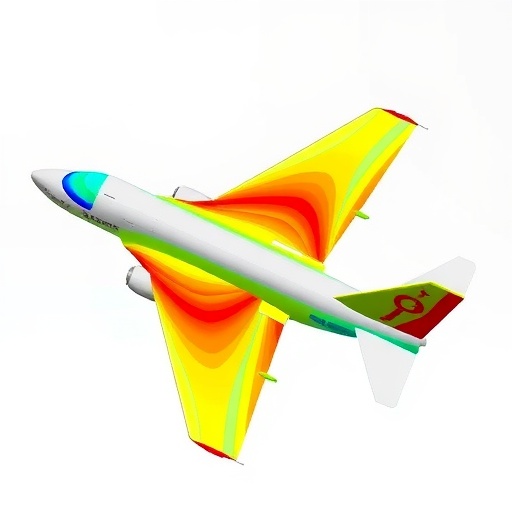
In the constantly evolving field of aerospace engineering, safety and efficiency remain paramount priorities. Among the numerous components that contribute to an aircraft’s overall performance and stability, the vertical tail plays a crucial role, particularly during emergency conditions. Recent advances in computational fluid dynamics (CFD) have unlocked new opportunities for in-depth analysis of aerodynamic behaviors that were previously difficult to measure or simulate with precision. A groundbreaking study by Zhou, Zhao, and Yan offers fresh insights into the aerodynamic characteristics of an aircraft’s emergency vertical tail, employing high-fidelity CFD techniques that promise to enhance future aircraft design and emergency response strategies.
The vertical tail of an aircraft, often overlooked in discussions concerning emergency systems, proves to be integral in maintaining directional stability and control. During scenarios such as asymmetric thrust conditions or system failures, the emergency vertical tail acts as a critical control surface that helps pilots regain command and ensure safe landing protocols. Zhou and colleagues embarked on an ambitious project that delves deeply into the fluid dynamic phenomena around this vital component using state-of-the-art CFD models, aiming to demystify its manipulation in emergency maneuvers.
Traditional wind tunnel testing and empirical data collection, while invaluable, inherently limit the range of conditions and scale over which aerodynamic forces can be detailed. CFD, on the other hand, leverages numerical methods and simulations on supercomputers to replicate airflow characteristics around complex geometries with unprecedented accuracy. The researchers utilized a series of computational grids, refined dynamically to capture vortex shedding, boundary layer effects, and flow separations that critically influence tail performance under duress.
By running these simulations across varying angles of attack and sideslip angles, Zhou et al. were able to characterize the stability derivatives and control effectiveness of the emergency vertical tail in a comprehensive manner. Their results highlight subtle nonlinearities in aerodynamic response, pointing to phenomena that could either enhance or degrade control authority depending on the state of the aircraft and external disturbances such as turbulence or sudden attitude changes.
One of the most fascinating outcomes of the study relates to the role of vortex dynamics along the trailing edge of the vertical tail. The researchers observed that under emergency conditions where the rudder deflection is significant, complex vortical structures form, which can either enhance lift generation or induce adverse yaw moments. This insight challenges prior assumptions, suggesting potential redesigns that harness these vortices beneficially rather than merely mitigating their deleterious effects.
Moreover, the pressure distribution maps generated from the simulations revealed localized zones of high and low pressure that directly impact the stress distribution on the vertical tail’s structural components. Such detailed aerodynamic load maps could direct future materials engineering efforts towards reinforcing critical areas prone to fatigue or failure during emergency operations, thus augmenting the robustness of vertical tail assemblies.
In addition to steady-state analyses, the study explored transient aerodynamic responses induced by sudden changes in control inputs. This temporal dimension is critical because many emergencies demand rapid correction maneuvers that elicit dynamic loadings quite different from steady cruising scenarios. The transient CFD results showcased how the flow regime transitions during these moments, elucidating the tail’s behavior that pilots experience instinctively but rarely quantify explicitly.
The findings reported by Zhou and colleagues carry substantial implications beyond the mere academic sphere. Aircraft manufacturers could incorporate these aerodynamic nuances into their design workflows, optimizing vertical tail shapes and control surface mechanics to maximize emergency handling capabilities. Enhanced computational models derived from this research could also be integrated into flight simulators, preparing pilots better for emergency contingencies by simulating more realistic flight dynamics.
Furthermore, regulatory agencies may find the study’s outcomes valuable when revisiting certification criteria related to aircraft stability and control under abnormal conditions. Certification processes have traditionally depended heavily on conservative safety margins derived from empirical data. With more precise CFD-informed knowledge, certification standards could evolve to reflect actual aerodynamic behavior more faithfully, possibly enabling lighter, more fuel-efficient designs that do not compromise safety.
The study also paves the way for interdisciplinary collaborations bridging aerodynamics, structural mechanics, and control systems engineering. The detailed aerodynamic load characterizations could guide the development of adaptive control algorithms that dynamically adjust rudder deflections or incorporate active flow control technologies to mitigate sudden aerodynamic instabilities, elevating aviation safety standards.
Beyond commercial and military aviation, the principles illuminated through this research extend into the realm of emerging aerospace domains such as urban air mobility and unmanned aerial vehicles (UAVs). These platforms often operate in constrained environments where emergency maneuvers may be required frequently, thus benefiting significantly from vertical tail designs optimized with cutting-edge CFD insights.
The methodological rigor in this research deserves particular mention. The authors employed turbulence models and numerical schemes verified by benchmarking against known experimental data, enhancing confidence in their simulations. Grid independence studies ensured that the results did not suffer from numerical artifacts, while sensitivity analyses around boundary conditions underscored the robustness of their conclusions under realistic operational envelopes.
Technological advancements in high-performance computing have been indispensable enablers for this study, allowing simulations that previously might have taken weeks to complete in mere days or hours. The computational resources employed allowed for fine temporal and spatial resolution, capturing shear layers and wake structures critical to understanding the aerodynamic intricacies of the emergency vertical tail.
Future directions inspired by this study might include coupling the CFD findings with full aircraft flight dynamics models to simulate pilot response and automated control systems’ interaction with aerodynamic forces during emergencies in a holistic manner. Such integrated models promise a transformative leap in aircraft safety simulation and certification processes.
In conclusion, the comprehensive CFD-based investigation by Zhou, Zhao, and Yan represents a milestone in aerodynamics research with tangible impacts on aircraft safety and performance. By elucidating the complex flow physics surrounding the emergency vertical tail, the study provides a scientifically grounded pathway towards more resilient, efficient, and controllable aircraft capable of navigating crises with greater certainty. The aerospace community eagerly awaits the translation of these findings into practical engineering solutions that enhance the next generation of aircraft safety.
Subject of Research: Aerodynamic analysis of aircraft emergency vertical tail using computational fluid dynamics
Article Title: CFD-based investigation of the aerodynamic characteristics of an aircraft emergency vertical tail
Article References:
Zhou, Z., Zhao, Z. & Yan, D. CFD-based investigation of the aerodynamic characteristics of an aircraft emergency vertical tail. Sci Rep (2026). https://doi.org/10.1038/s41598-026-47446-1
Image Credits: AI Generated
DOI: 10.1038/s41598-026-47446-1
Keywords: Aircraft emergency vertical tail, computational fluid dynamics, aerodynamic characteristics, vortex dynamics, transient aerodynamic loads, aerospace safety
Tags: advanced CFD techniques for aircraftaerodynamic simulation for aircraft designaircraft directional stability controlaircraft emergency control surfacesasymmetric thrust aerodynamic effectsCFD analysis of aircraft vertical tailComputational Fluid Dynamics in aerospaceemergency vertical tail aerodynamicsfluid dynamics in aviation safetyhigh-fidelity CFD modeling aircraftvertical tail aerodynamic performancevertical tail response in system failures