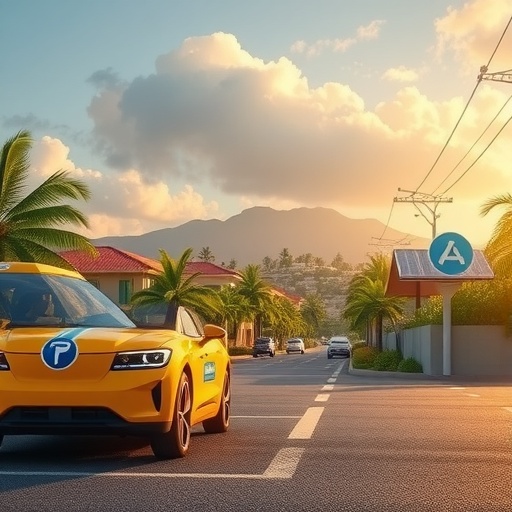
In tropical metropolises around the globe, the unpredictable and fleeting nature of afternoon thunderstorms presents a formidable challenge to the stability and reliability of power grids, particularly for urban areas aggressively transitioning to solar energy. The swiftly shifting weather patterns, which briefly eclipse sunshine, result in sudden drops in solar photovoltaic (PV) output, creating momentary blackouts in entire neighborhoods. Markus Schläpfer, a civil engineer now assistant professor at Columbia Engineering, identified this as an emerging issue upon his move to Singapore nearly ten years ago, a dense urban environment with a burgeoning solar infrastructure.
Tackling the challenge of solar intermittency traditionally relies on augmenting grid infrastructure—building new transmission lines or bolstering storage capabilities. However, in densely populated tropical cities like Singapore, such expansions come at a prohibitively high cost and are logistically complex, often requiring expensive underground cabling. At nearly 60 million Singapore dollars per kilometer, these upgrades strain municipal budgets and delay sustainable energy adoption. Thus, innovative, cost-effective solutions that leverage existing resources are of paramount importance.
In groundbreaking research published recently in Nature Communications, Schläpfer and his colleagues propose an elegantly pragmatic approach: harnessing the latent energy capacity of electric vehicles (EVs) to stabilize urban solar energy supply during transient disruptions caused by thunderstorms. This concept reframes EVs not merely as transport means but as dynamic, distributed energy storage units integrated within the broader urban electricity grid. When solar generation dips, these parked EVs can discharge stored power, replenishing the local grid and mitigating supply shortfalls.
Fundamentally, solar power’s variability imposes strain when neighborhoods relying heavily on PV suddenly lose sunlight during storms. Existing infrastructure compensates by importing electricity from adjacent areas still generating power—an approach that, while effective in the short term, burdens the transmission system with surges that can exceed its design capacity. This additional load risks equipment damage, outages, and increased maintenance costs. Deploying EVs as mobile batteries at the local scale circumvents these issues by providing on-demand power where it is most needed without overtaxing transmission lines.
The research elucidates a crucial insight: the scale at which EV battery utilization is optimized directly impacts grid resilience. Previously, city-wide optimization attempted to evenly balance energy demand and supply but inadvertently exacerbated local imbalances by shifting burdens across longer distances. Schläpfer’s team demonstrated that a more granular approach—managing battery charging and discharging at the neighborhood level—enhances system stability. In Singapore’s 55 distinct urban planning areas, this localized strategy effectively reduces maximum line loads on stormy days by nearly 18 percent while contemporaneously smoothing daily electricity demand curves.
An important facet of this methodology is its reliance on detailed urban mobility and parking data. Since the battery energy available depends heavily on where vehicles are physically located, the team incorporated anonymized, aggregated mobile phone datasets to map car parking patterns with exceptional precision. This data-driven perspective revealed distinct diurnal variations: residential districts tend to empty during the day while commercial zones fill, directly influencing where and when EVs can contribute power to the local grid. The interplay of these patterns allows for a sophisticated, adaptive charging strategy that anticipates energy needs in real-time.
This strategy also holds promise for environments with relatively low car ownership rates. Singapore, notably, has approximately one vehicle per eight residents, a figure that might preclude large-scale battery storage in less densely motorized cities. Yet, the research found that even with such limited EV penetration, the approach remains effective. The system leverages the temporal and spatial diversity of vehicle presence effectively enough to provide meaningful grid support, a critical discovery with broad implications for other urban centers worldwide.
At the technological core, the integration depends on bi-directional charging systems capable of both replenishing EV batteries from the grid and feeding stored electricity back into it. This vehicular-to-grid (V2G) technology enables cars to act as temporary power stations, discharging energy during peak demand or generation shortfalls and refilling when solar irradiance resumes post-storm. The bidirectional flow necessitates sophisticated communication protocols and real-time control algorithms to synchronize battery usage without impairing vehicle function or owner convenience.
While the promise of EVs as decentralized storage pivots on V2G technical feasibility, the research also highlights policy and infrastructure considerations. Supporting such systems requires building regulatory frameworks that reward users for grid participation, protect battery life, and ensure data privacy. Smart meters, grid communication standards, and incentives for EV owners to participate during storms will be essential for widespread adoption. Moreover, city planners and utilities must work collaboratively to integrate these decentralized storage networks seamlessly into urban energy ecosystems.
The systemic benefits extend beyond weather-induced solar fluctuations. Incorporating EV batteries as grid assets can reduce dependence on fossil-fuel-based peaker plants, mitigate infrastructure upgrade costs, and enable higher penetration of renewables. On a broader climate scale, leveraging existing transportation assets ensures more economical use of embedded carbon investments, maximizing the sustainability dividends of both EVs and solar PV installations. The approach exemplifies innovation at the nexus of technology, urban planning, and environmental stewardship.
Yet, challenges remain. Battery degradation due to frequent charge-discharge cycles is a contentious topic, with implications for EV owners’ financial incentives and vehicle lifespans. Comprehensive lifecycle assessments and market mechanisms must balance grid integration benefits with costs to consumers. Additionally, integrating vast numbers of EVs into complex urban grids demands cybersecurity safeguards to protect critical infrastructure from cyber threats.
In sum, the study by Schläpfer and colleagues crystallizes a vision of tropical cities where electric vehicles and solar energy are interwoven not just in concept but operationally harmonized to deliver resilient, sustainable, and economically viable power systems. As half the global population increasingly gravitates towards urban life in the tropics, such innovations are imperative to surmount the dual challenges of climate change and urban energy access. Transforming EVs from isolated transport devices into active grid components could mark a paradigm shift in urban energy management worldwide.
Subject of Research: Integration of electric vehicles and solar photovoltaics to enhance grid stability in tropical urban environments.
Article Title: How Electric Cars Could Help Tropical Cities Run on Solar
News Publication Date: 7-Apr-2026
Web References:
https://www.nature.com/articles/s41467-026-71123-6
Image Credits: Urban Systems Engineering Lab
Keywords
Sustainable energy, electric vehicles, solar photovoltaics, tropical cities, grid stability, vehicle-to-grid technology, urban energy management, renewable energy integration, grid optimization, energy storage, Singapore, storm resilience
Tags: cost-effective urban renewable energy solutionselectric car battery energy sharingelectric vehicles for solar energy storageEVs as distributed energy resourcesintegrating EVs into power gridsmanaging solar power fluctuations with EVsSingapore solar energy infrastructuresolar energy challenges in tropical metropolisessolar intermittency solutions in tropical citiessolar power blackout mitigation strategiessustainable energy transition in dense citiesurban solar power grid stability