A Snowflake Mutation Sheds New Light on the Genetic Architecture Underpinning Color Pattern Formation in Clownfish
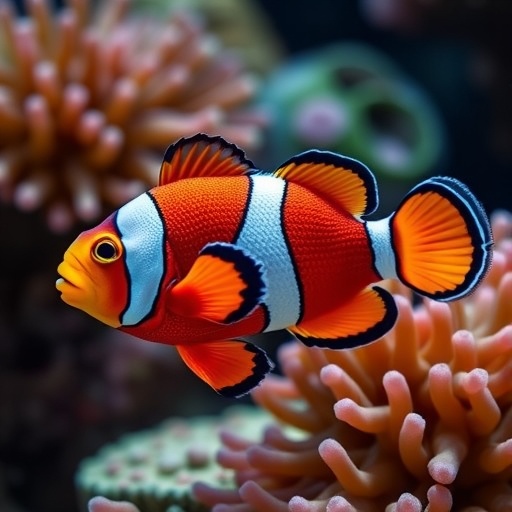
In the realm of tropical marine biodiversity, the clownfish (Amphiprion ocellaris) stands out not just for its vibrant orange hue but for the distinctive patterning of three bold, white bars edged with thin black lines that adorn its body. Since 1999, a remarkable individual hatched in a UK hobbyist’s aquarium has captivated scientists and aquarists alike. This clownfish bore a unique “Snowflake” mutation, characterized by wavy, irregular white bars replacing the typical straight lines. Intriguingly, these distorted patterns were symmetrically mirrored on both sides and heritable over generations, raising compelling questions about the genetic mechanisms orchestrating such pigmentation.
For decades, the precise molecular underpinnings behind this atypical pigmentation anomaly remained elusive. However, an interdisciplinary team comprising researchers from the Okinawa Institute of Science and Technology (OIST), Academia Sinica in Taiwan, Kyoto University, and the University of Virginia has recently elucidated the genetic basis of this mutation. Published in the renowned journal Nature Communications, their work uncovers that a single amino acid substitution within a gap junction protein gene is responsible for the altered snowflake patterning, illuminating broader principles governing how cells coordinate to create complex pigmentation motifs across teleost fishes.
Typically, clownfish exhibit a well-organized color scheme governed by strict spatial cues that ensure the iconic straight white bars form consistently throughout the fish’s life. The Snowflake lineage’s deviation from this norm provided a unique opportunity to interrogate the molecular crosstalk directing these pigmentation boundaries. To dissect these mechanisms, researchers leveraged comparative genomic approaches, drawing parallels between Snowflake clownfish and zebrafish (Danio rerio), a freshwater species long-established as a developmental biology model due to their characteristic horizontal stripes.
Previous investigations into zebrafish pigmentation had identified a mutant variant dubbed “Leopard,” which replaces stripes with spots. Crucially, Leopard harbors mutations in a gene encoding a specific gap junction protein—a channel-forming protein facilitating direct intercellular communication through electrical and chemical signals. By analyzing the Snowflake and wild-type clownfish genomes, the OIST-led team discovered that Snowflake also harbored a mutation in this very same gap junction gene, homologous to the one implicated in zebrafish patterning anomalies. This remarkable conservation over 200 million years of evolutionary divergence between freshwater and saltwater teleosts underscores the fundamental role of this protein in pigment cell coordination.
But the story becomes more intricate upon considering the functional implications of this gap junction mutation. In zebrafish, the gap junction protein modulates a self-organizing “Turing pattern” mechanism, which balances short-range inhibitory and long-range activatory interactions between pigment cells to generate evenly spaced stripes. However, clownfish patterns do not rely on dynamic stripe rearrangements but instead maintain fixed stripe positions throughout development and adulthood. Thus, the classical Turing model inadequately accounts for their pigmentation architecture, suggesting that gap junction-mediated communication functions beyond mere stripe morphogenesis.
The study’s lead author, Dr. Marleen Klann, elaborates that the gap junction protein in clownfish predominantly ensures robust and precise cell-to-cell signaling that specifies the timing and positioning of pigmentation bars. This communication is fundamental in orchestrating the formation of sharp pigmentation boundaries and maintaining the fidelity of pattern inheritance. Their findings necessitate revising canonical pattern formation theories to encompass a more general framework of intercellular signaling informing cellular differentiation and spatial delineation.
To better characterize the physical forces shaping these pigmentation interfaces, the interdisciplinary team integrated principles from membrane physics, applying mathematical modeling frameworks traditionally used to describe fluctuating biological membranes. They found that the Edwards-Wilkinson model—a mathematical construct balancing surface tension forces with intrinsic noise—provides the most parsimonious explanation for the observed corrugated pattern borders in Snowflake clownfish. Surface tension acts to smooth cellular interfaces, while stochastic noise introduces irregularities; the interplay between these forces determines how straight or wavy the pigmentation boundaries become.
Professor Simone Pigolotti, co-author and mathematician at OIST, highlights the model’s versatility: “It offers a universal language connecting biological observations with theoretical physics, granting us predictive insight into cellular pattern formation. Its implications extend far beyond clownfish to diverse organisms exhibiting patterned pigmentation.” This conceptual synthesis between biology, genetics, and physics establishes an exciting paradigm wherein cellular communication and physical constraints coalesce to produce stable, species-specific pigment patterns.
Furthermore, the research utilized transgenic anemonefish engineered through collaborations with Professor Masato Kinoshita at Kyoto University. These genetically modified fish allowed functional testing of the gap junction gene’s role, enabling dissection of how specific mutations alter pigment cell communication and organization in vivo. Such experimental advances bring the scientific community closer to resolving long-standing puzzles about cellular decision-making during tissue patterning.
Professor Vincent Laudet reflects on the broader significance: “Understanding cellular organization — a process seemingly mundane — is foundational to grasping how nature crafts biological diversity and complexity. Snowflake’s elegant mutation grants us a window into the universal rules underpinning biological design, uniting empirical observations with theoretical rigor.” The findings not only deepen comprehension of teleost patterning but also potentially inform regenerative medicine, developmental biology, and evolutionary theory by revealing genetic and physical principles steering multicellular spatial organization.
Taken together, this multidisciplinary investigation exemplifies how long-standing biological enigmas can be unraveled through integrated genetic, experimental, and theoretical approaches. It showcases the power of model organisms — from clownfish to zebrafish — as platforms for dissecting conserved molecular pathways and inspires future research probing the myriad ways cells communicate and cooperate to shape life’s vivid tapestries. As scientists continue to decode the language of cells, the Snowflake clownfish mutation stands as a testament to nature’s subtle complexity and the elegant genetic choreography that paints the world in color.
Subject of Research: Animals
Article Title: Cell-cell communication as underlying principle governing color pattern formation in teleost fishes
News Publication Date: 18-Feb-2026
Web References: https://www.nature.com/articles/s41467-026-69524-8
References: DOI 10.1038/s41467-026-69524-8
Image Credits: Andrew Scott / OIST (Okinawa Institute of Science and Technology Graduate University)
Keywords: Clownfish, Snowflake mutation, pigmentation, gap junctions, pattern formation, teleost fishes, cell-cell communication, Edwards-Wilkinson model, Turing pattern, genetics, zebrafish, evolutionary biology
Tags: Amphiprion ocellaris color patterninggap junction protein gene mutationgenetic architecture of color patternsgenetic coordination in pigmentationheritable clownfish color variationinterdisciplinary marine biology researchmolecular basis of pigmentation anomaliesmutant clownfish pigmentation geneticsNature Communications clownfish studysnowflake mutation clownfish patternsymmetrical color mutation inheritancetropical marine biodiversity genetics