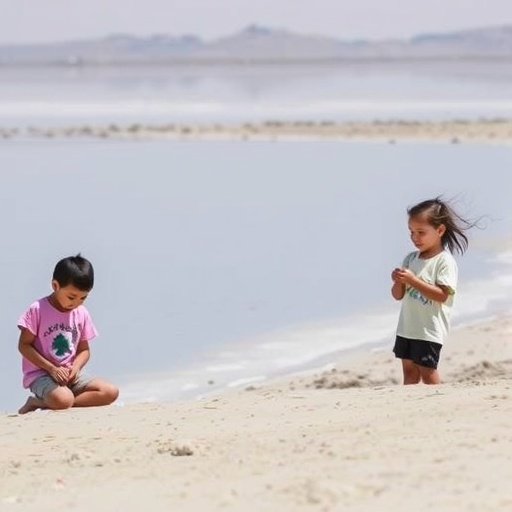
Children residing within an 11-kilometer radius of the Salton Sea—a vast, drying saline lake in California’s Imperial Valley—are exhibiting significantly slower growth in lung function between the ages of 10 and 12 compared to their peers living farther away. This concerning trend in pulmonary development mirrors the health impact commonly observed in children living within 500 meters of major freeways, highlighting the severity of environmental exposure in this region. The findings, recently published in JAMA Network Open and partly funded by the National Institutes of Health, suggest that the respiratory consequences of such environmental factors may extend well into adulthood.
The Salton Sea was created unexpectedly in 1905 when the Colorado River breached an irrigation canal, leading to the formation of this large, salty lake near the United States-Mexico border. Over time, a combination of drought conditions, increasing temperatures, and diversions of water resources have drastically reduced the lake’s surface area. As the Salton Sea recedes, extensive stretches of dry, exposed lakebed become sources of airborne dust. This dust is laden with fine particulate matter—microscopic pollutants known to exacerbate respiratory challenges and linked to adverse cardiovascular, immune, and neurological effects on human health.
While local surveillance has documented an uptick in respiratory ailments such as asthma within communities near the Salton Sea, the research group led by the Keck School of Medicine of USC represents the first attempt to quantitatively assess changes in lung capacity over time in these children. This kind of longitudinal lung function data is pivotal in understanding how environmental factors might disrupt normal respiratory development during critical windows, and potentially contribute to chronic health problems worldwide. The study’s implications resonate beyond California, calling attention to shrinking saline lakes worldwide—such as the Great Salt Lake in Utah and the Aral Sea in Central Asia—where similar ecological shifts may be imperiling vulnerable populations.
Fangqi Guo, PhD, a postdoctoral research associate specializing in population and public health sciences at the Keck School of Medicine and the study’s first author, emphasizes the gravity of these findings. Guo explains that adolescence marks an essential period in lung development characterized by a growth spurt leading to maximal lung function in early adulthood. Interruption of this trajectory could raise susceptibility to respiratory, cardiovascular, and metabolic diseases later in life, creating a public health concern that demands urgent attention and intervention.
Lung function growth was evaluated through two primary measures: forced vital capacity (FVC) and forced expiratory volume in one second (FEV1). FVC quantifies the maximum volume of air expelled from the lungs following a deep inhalation, while FEV1 assesses the speed of air exhalation within the first second. These metrics collectively provide detailed insights into airway function and respiratory health, enabling researchers to detect subtle impairments linked to environmental exposure.
The cohort comprised 369 children, averaging 10 years of age at the study’s onset, who were closely tracked for approximately two years. The investigators leveraged geographic data to calculate the precise distance of each child’s residence from the Salton Sea. Concurrently, they incorporated air quality data reflecting fine particulate matter concentrations and episodic dust level spikes measured by local monitors. Crucially, the analysis controlled for confounding variables including age, sex, ethnicity, socioeconomic status, height, body mass index, and baseline respiratory condition to isolate the influence attributable to proximity and dust exposure.
Results indicated a stark disparity in lung function growth rates depending on residential distance. Children living within the 11-kilometer boundary exhibited an annual reduction in FVC growth of approximately 52 milliliters and a decrease in FEV1 growth of nearly 39 milliliters, compared to peers residing farther away. Notably, increased hours of exposure to elevated dust concentrations compounded these effects, especially in those residing closest to the Salton Sea, thereby underscoring the direct relationship between airborne particulate pollution and impaired lung development.
This research adds to a growing body of evidence pointing to the heightened prevalence of asthma in the region, with previous studies by the same group showing that over 20% of children near the Salton Sea suffer from this chronic lung condition—almost three times the national average. Persistent breathing difficulties in childhood set a precedent for long-term respiratory, cardiovascular, and metabolic health complications if environmental remediation efforts remain insufficient.
Shohreh F. Farzan, PhD, associate professor of population and public health sciences and co-senior author of the study, highlights the uncertainty regarding the permanence of these pulmonary impairments. Given the lung’s ongoing development throughout childhood and adolescence, there is potential for mitigation of damage through reductions in environmental exposures, emphasizing the urgent need for effective public health measures to safeguard vulnerable populations.
In response to the deteriorating conditions of the Salton Sea, California state authorities have implemented a comprehensive 10-year restoration and management plan aiming to curb the environmental and health crises posed by the lake’s shrinkage and dust emissions. However, researchers caution that such initiatives must be intensified and broadened in scope, considering the escalating challenges posed by climate change, escalating drought, and desertification that affect similar communities on a global scale.
Looking ahead, the interdisciplinary team will extend their longitudinal monitoring of the affected cohort to ascertain whether diminished lung function growth persists into adolescence and young adulthood. Their ongoing work also seeks to dissect which specific dust components inflict the greatest pulmonary harm, as part of a broader investigation into Imperial Valley’s complex mix of dust, desert particles, diesel exhaust, and industrial pollutants, aiming to inform targeted policy and environmental interventions.
The implications of this study are far-reaching, underscoring the critical intersection between environmental change, air quality, and public health. As saline lakes worldwide continue to diminish in response to climate variability, understanding and mitigating their impacts on human respiratory health, especially among children, emerges as a key priority for scientific research and policy frameworks aiming to combat the global burden of respiratory diseases.
Subject of Research: People
Article Title: Distance to a Drying Saline Lake and Lung Function Development in a Rural Border Cohort of Children
News Publication Date: 3-Apr-2026
Keywords
Pollution, Lungs, Respiratory system, Environmental toxicology, Environmental issues, Lung injuries, Pollutants, Air pollution, Asthma
Tags: childhood exposure to airborne dustchildren lung function growth near Salton Seadrying saline lake environmental hazardsenvironmental exposure and lung developmentenvironmental health impacts Salton Seahealth effects of shrinking Salton Sealong-term respiratory consequences air pollutionNational Institutes of Health respiratory studyparticulate matter exposure effectspulmonary health in Imperial Valley childrenrespiratory development in childrenSalton Sea dust pollution health risks