In a groundbreaking advance that broadens our understanding of the Earth’s microbial life, a team of researchers has revealed a vast expansion in the known diversity of the global microbiome, achieved by pioneering a novel analytical approach that transcends traditional genome binning methods. Their study, recently published in Nature Microbiology, employs the analysis of unbinned contigs—the raw sequence fragments obtained directly from environmental metagenomes—to uncover previously hidden layers of microbial diversity. This innovative methodology unlocks a wealth of genomic data that standard genome binning approaches, which attempt to assemble genomes into complete units, often overlook or discard.
Microbial communities form the foundation of ecosystems across the planet, playing essential roles in nutrient cycling, climate regulation, and health. However, much of microbial life remains uncultured and elusive due to the inherent complexity and interwoven genetic makeup of environmental samples. Conventional metagenomic methods rely heavily on binning algorithms that assemble short DNA fragments into genome bins—putative complete or partial genomes attributed to individual species. While powerful, these methods are constrained by biases and technical limitations, frequently resulting in critical loss or misclassification of microbial sequences, so large swathes of microbial diversity remain untouched in the unbinned data.
The research team set out to challenge this status quo by directly harnessing unbinned contigs, which have traditionally been relegated as suboptimal or noise in metagenomic datasets. Using an integrative analytical pipeline, they combined advanced sequence similarity analyses, novel clustering strategies, and robust phylogenetic inference to mine unbinned contigs for meaningful biological signals. Remarkably, this approach illuminated thousands of genetic lineages that evade current microbial databases and reference genome collections, fundamentally doubling the known taxonomic breadth of the global microbiome.
One of the landmark achievements of this study lies in its revelation of previously hidden microbial taxa across diverse ecosystems, ranging from marine and soil environments to human-associated microbiomes. By cataloging these novel sequences, the researchers not only expanded the microbial tree of life but also highlighted critical evolutionary linkages that reshape our conceptual understanding of microbial phylogeny. Their approach illustrates how unbinned contigs, when analyzed with refined computational strategies, serve as a treasure trove that provides unprecedented resolution into microbial community composition and evolutionary history.
This paradigm shift carries profound implications for microbiology, ecology, and biotechnology. From an ecological standpoint, the newly uncovered microbial lineages have vital functional capacities that underpin ecosystem processes such as carbon fixation, nitrogen cycling, and pollutant degradation. Their identification opens avenues to revisit ecosystem models with enhanced microbial functional diversity and resilience, adjusting predictions about biogeochemical cycles under environmental change scenarios. In biotechnology, these uncharted microbial genomes represent potential sources of novel enzymes, bioactive compounds, and metabolic pathways that could revolutionize industries like agriculture, bioenergy, and pharmaceuticals.
The study also tackles the long-standing issue of metagenomic data utilization inefficiencies, advocating for a shift in data processing frameworks to embrace raw sequence fragments beyond their presumed binning potential. By doing so, it challenges bioinformatics conventions and promotes the development of more inclusive and comprehensive analytical tools. This strategy not only maximizes the return on investment in large-scale metagenomic sequencing projects but also democratizes access to microbial diversity by reducing dependence on high-quality genome assemblies, which are laborious and cost-intensive to generate.
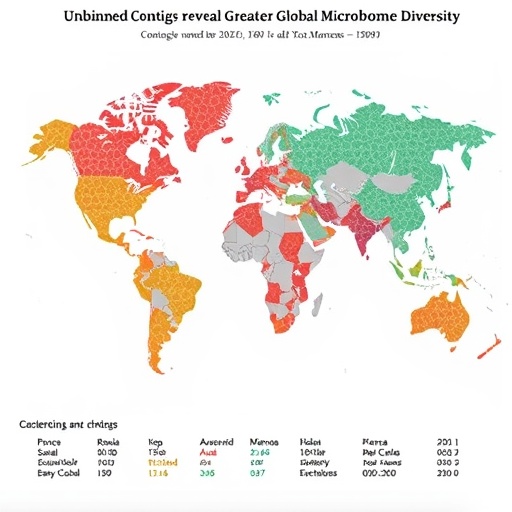
Applying this unbinned contig-centric approach, the researchers analyzed global metagenome datasets comprising hundreds of terabases of sequencing data, gathered from thousands of samples worldwide. Their computational pipeline screened and categorized unbinned sequences systematically, revealing that a substantial fraction of microbial diversity resided outside the established genome bins. This discovery emphasizes the vast hidden microbial “dark matter” yet to be fully characterized, challenging the completeness of existing microbial reference databases such as GTDB and other genome repositories.
The implications extend beyond taxonomy and ecology. By mapping functions encoded in these new microbial sequences, the authors shed light on biochemical pathways and genetic innovations previously inaccessible. For example, enzymes involved in novel metabolic transformations, antibiotic resistance genes, and biosynthetic gene clusters for secondary metabolites were identified, hinting at dynamic evolutionary processes governing microbial adaptation and resilience. Such insights provide valuable resources for synthetic biology and drug discovery, where harnessing microbial ingenuity is a key driver.
Moreover, the study advances our understanding of microbial community dynamics and spatial distributions. By integrating the new sequence data with metadata on sample origin, environmental parameters, and host associations, the researchers unveiled patterns of microbial niche specialization, biogeographical trends, and symbiotic relationships. This information enriches the tapestry of microbial ecology and informs efforts to manipulate microbiomes for environmental remediation and health interventions.
The authors also address potential challenges and limitations inherent in unbinned contig analysis, such as increased noise, incomplete functional annotation, and the risks of contaminant sequences. They outline rigorous validation protocols, including cross-referencing with curated genomic datasets, benchmarking against well-characterized microbial clades, and implementing stringent quality filters. These methodological safeguards ensure the robustness and reproducibility of their findings, setting a new standard for metagenomic data exploration.
Central to this innovation is the harmonization of bioinformatics and computational biology with microbial ecology. Their workflow leverages scalable cloud computing resources, machine learning algorithms for sequence classification, and network-based approaches to reconstruct microbial relationships from fragmented data. This multidimensional toolbox exemplifies the future of microbial research, where data integration and methodological versatility drive discovery at an unparalleled scale.
The research also champions open science principles by making their datasets, analytical tools, and workflows publicly available. Such transparency empowers the global scientific community to build upon these findings, fostering collaborations that transcend disciplinary and geographic boundaries. It also facilitates metagenomic education and training, cultivating a new generation of microbiologists proficient in next-generation data science techniques.
In conclusion, this landmark study fundamentally redefines the boundaries of microbiome research by demonstrating the untapped potential of unbinned contigs to uncover vast hidden biological diversity. It sets a new trajectory for future metagenomic investigations, inspiring innovative approaches to harvest the full spectrum of microbial life on Earth. As microbiome science continues to revolutionize our understanding of life’s complexity and its applications, embracing the unbinned frontier promises to accelerate discoveries that will reshape ecosystems, human health, and technology in the decades to come.
Subject of Research: Expansion of microbial diversity in global microbiomes through analysis of unbinned contigs.
Article Title: Unbinned contigs expand known diversity in the global microbiome.
Article References:
Prasoodanan PK, V., Maistrenko, O.M., Fullam, A. et al. Unbinned contigs expand known diversity in the global microbiome. Nat Microbiol (2026). https://doi.org/10.1038/s41564-026-02314-6
Image Credits: AI Generated
DOI: https://doi.org/10.1038/s41564-026-02314-6
Tags: climate regulation by microbesenvironmental metagenomesglobal microbiome diversityhidden microbial diversitymetagenomic sequencing advancesmicrobial community ecosystemsmicrobial genome binning limitationsNature Microbiology researchnovel metagenomic methodsnutrient cycling microbesunbinned contigs analysisuncultured microbial life