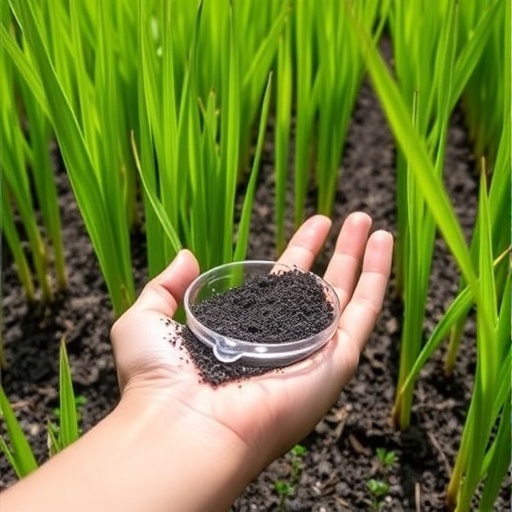
In a groundbreaking advancement for agricultural sustainability and food safety, researchers have developed an innovative magnetic silicon-enriched biochar gel that significantly mitigates the uptake of toxic metalloids arsenic (As) and antimony (Sb) in rice cultivation. These contaminants are notorious for their persistence in polluted paddy soils and pose severe health hazards due to their ability to accumulate in rice grains—a staple food for a large portion of the global population. The novel biochar composite, integrating waste-derived rice husk biochar with iron oxides and graphene, presents a multifaceted solution to this pervasive environmental and agronomic issue.
The newly synthesized FeRBG material, representing a magnetic biochar gel, is engineered to harness the synergistic effects of its constituents. Rice husk biochar acts as a porous matrix offering extensive surface area, while iron oxides impart magnetic properties and chemisorptive sites critical for binding arsenic and antimony. Graphene enhances structural stability and electron mobility within the gel, facilitating electron transfer mechanisms that promote the formation of stable mineral phases. This tri-component configuration establishes a three-dimensional porous network capable of immobilizing mobile toxic metalloids through multiple chemical interactions.
Experimental greenhouse trials conducted with naturally contaminated paddy soils reveal that FeRBG treatment leads to a marked decrease exceeding 20% in the bioavailable fractions of both arsenic and antimony in the soil matrix. The subsequent impact on rice plants is profound: arsenic accumulation in grains diminished by 34.0%, and antimony levels decreased by 16.1%. Notably, the arsenic concentration in rice grains fell below national food safety thresholds post-treatment, underscoring the material’s practical efficacy for ensuring food security in metalloid-polluted regions.
The immobilization mechanisms of FeRBG are complex and multifactorial. Iron oxides within the gel chemically bind arsenic and antimony, transforming their mobile ionic forms into stable, insoluble mineral complexes, thereby reducing their bioavailability. Concurrently, the highly porous biochar framework adsorbs contaminants through physisorption and electrostatic interactions. Graphene’s conductive nature enhances redox reactions and stabilizes the composite structure, preserving its functionality across soil conditions typical of flooded rice paddies. This integrated approach effectively converts toxic metalloids into less bioavailable reservoirs within the soil environment.
Beyond its contaminant sequestration capabilities, FeRBG exhibits notable benefits for rice plant physiology. Treated plants display enhanced root development, evidenced by increased root length, root surface area, and root tip density. These morphological improvements optimize nutrient and water uptake, heightening the plants’ resilience to abiotic stresses commonly exacerbated by metalloid toxicity. Enhanced root architecture supports robust growth, potentially translating into improved agronomic yields while maintaining reduced contaminant transfer to edible tissues.
Microbial community dynamics within treated soils reveal positive shifts linked to FeRBG amendment. The abundance of beneficial bacteria associated with nutrient cycling and stress tolerance increased, contributing to a more diverse and resilient soil microbiome. These microbial changes may play a supporting role in attenuating metal stress and fostering favorable rhizosphere conditions, suggesting that biochar-mediated remediation extends beyond chemical stabilization to modulating biological soil health.
Physiological stress markers in rice plants, including proline content—a known osmoprotectant and stress indicator—decreased with FeRBG treatment, signifying lowered oxidative stress levels. Concurrently, antioxidant enzyme activities were elevated, enabling plants to better counteract oxidative damage induced by arsenic and antimony toxicity. This dual outcome not only improves plant health but also sustains agricultural productivity under contaminated growing conditions.
To elucidate the interconnected effects of FeRBG on soil chemistry, microbial ecology, and plant physiology, researchers applied advanced statistical modeling and integrated geochemical analyses. Results pinpointed arsenic bioavailability in soils as the primary determinant influencing overall plant performance and grain yield. By stabilizing toxic elements and fostering a conducive rhizosphere, FeRBG creates a tailored microenvironment conducive to both crop safety and enhanced food production.
This interdisciplinary study exemplifies a cutting-edge strategy for addressing the persistent global issue of metalloid contamination in agricultural soils. By employing sustainable, waste-derived materials enhanced through nano-engineering and chemical modification, the FeRBG biochar gel approach aligns with circular economy principles while prioritizing human health and environmental protection. It represents a scalable solution with strong potential for deployment in contaminated rice-growing regions worldwide.
While greenhouse findings demonstrate promising performance, the authors advocate for extensive field trials under diverse climatic and soil conditions to validate long-term stability, agronomic impacts, and cost-effectiveness. Further investigation is essential to optimize application methodologies and monitor potential ecological effects, ensuring responsible integration into existing agricultural management frameworks.
In an era where soil contamination increasingly threatens food safety and ecosystem health, technologies like FeRBG harness advanced material science innovations to empower farmers and safeguard consumers. This magnetic silicon-enriched biochar gel exemplifies how multidisciplinary research can deliver tangible, sustainable solutions that enhance soil remediation and secure global food supply chains.
As regulatory pressures and public awareness regarding toxic element accumulation escalate, scalable innovations that mitigate contamination while enhancing crop productivity will be crucial. FeRBG’s dual-function design—capturing hazardous metalloids while promoting plant and microbial health—positions it as a transformative technology for the future of clean, sustainable agriculture worldwide.
Subject of Research: Experimental study on mitigating arsenic and antimony contamination in paddy soil-rice systems using a novel magnetic silicon-enriched biochar gel.
Article Title: Magnetic silicon-enriched biochar for effectively mitigating As and Sb in soil-rice continuum: from integrated geochemical, microbial, and phytophysiological insights
News Publication Date: 10-Mar-2026
Web References:
DOI Link
References:
Gao, Y., Chen, H., Wang, F., et al. Magnetic silicon-enriched biochar for effectively mitigating As and Sb in soil-rice continuum: from integrated geochemical, microbial, and phytophysiological insights. Biochar 8, 74 (2026).
Image Credits: Yurong Gao, Hanbo Chen, Fenglin Wang, Jiayi Li, Zheng Fang, Xiaokai Zhang, Xing Yang, Jin Wang, Juan Liu, Caibin Li & Hailong Wang
Keywords
Biochar, arsenic mitigation, antimony stabilization, soil remediation, rice cultivation, magnetic biochar gel, silicon enrichment, soil microbiome, phytophysiology, environmental contamination, sustainable agriculture, metalloid pollution
Tags: arsenic and antimony pollution mitigationbiochar-based heavy metal adsorptiongraphene stabilized biochar materialsinnovative soil amendment for food safetyiron oxide enhanced biochar compositesmagnetic biochar gel for arsenic removalmultifunctional biochar composites in agriculturereducing arsenic uptake in rice grainsrice husk biochar for soil remediationsilicon-enriched biochar in agriculturesustainable rice cultivation technologiestoxic metalloid immobilization in paddy soils