In a groundbreaking advance for the understanding and treatment of chronic pain, researchers have delineated a novel neural circuit in the brain that specifically governs chronic pain sensations, separate from the pathways responsible for acute pain perception. This discovery not only challenges longstanding assumptions about how pain is processed in the central nervous system but also opens new avenues for targeted therapies capable of alleviating persistent pain without dulling the body’s essential warning mechanisms.
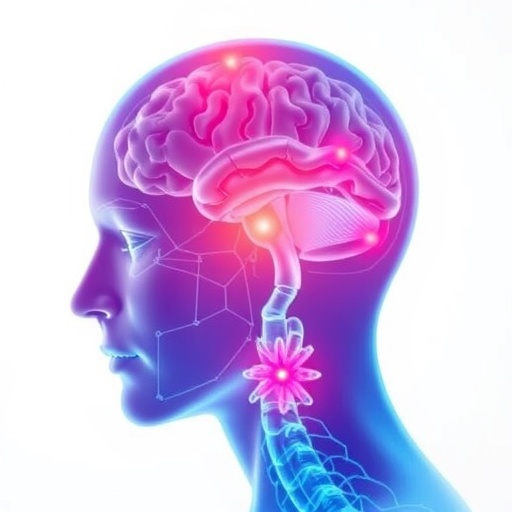
The international team of neuroscientists, led by Xiaoke Chen of Stanford University, employed cutting-edge genetic labeling techniques to illuminate a previously unidentified neural pathway. This circuit originates at the spinal cord, extends into the thalamus, traverses the cortex and brainstem, particularly the rostral ventromedial medulla (RVM), before looping back to the spinal cord. What sets this circuitry apart is its selective activation during chronic pain states, distinctly absent during normal, acute pain.
Chronic pain afflicts approximately 60 million Americans alone, presenting a complex clinical challenge due to its persistent nature even after the initial injury or inflammation has resolved. Unlike acute pain, which serves an adaptive function by signaling immediate tissue damage or threat, chronic pain is often maladaptive, characterized by a heightened sensitivity to stimuli that ordinarily would not provoke discomfort—a phenomenon known as sensitization.
The team’s innovative approach involved tagging neurons within the RVM with fluorescent proteins that glow under specific conditions, thereby exposing the circuit’s architecture and function. Remarkably, when these identified neurons in the circuit were chemically silenced in animal models, the chronic pain behaviors were alleviated while the normal acute pain responses remained fully intact. This precision suggests that the neural substrates of chronic pain can be isolated without compromising protective pain signaling.
Further experiments demonstrated that repeated activation of this identified circuit in otherwise healthy mice induced pain hypersensitivity that persisted for several weeks. This causal role establishes the neural loop as both necessary and sufficient for chronic pain sensitization. These findings signify a paradigm shift: chronic and acute pain rely on distinct and independent neural frameworks rather than a single overlapping system.
Previous scientific models emphasized the role of the periaqueductal gray (PAG) and RVM system in modulating pain, primarily suggesting this pathway as a therapeutic target for reducing pain. However, this newly described circuit appears to operate in an antagonistic fashion—where stimulation heightens pain sensitivity, opposing the analgesic effect mediated by the classical PAG-RVM pathway. This dualistic mechanism elucidates why past interventions have sometimes had limited efficacy or undesirable side effects.
The clinical implications of this discovery are profound. Because chronic pain emerges from a dedicated neuronal ensemble, pharmacological or genetic interventions could be engineered to selectively dampen this circuit’s activity. This targeted manipulation could potentially provide relief for millions of patients burdened by persistent pain without negating their ability to perceive acute pain, which is vital for survival.
Identifying molecular biomarkers and mechanistic triggers that drive the activation of these RVM neurons is an ongoing effort. Deciphering the molecular signature that shifts the circuit into a pain-promoting state might reveal novel drug targets. Such precision medicine strategies could supersede current treatments that lack specificity and frequently bear significant risks, including opioid addiction and cognitive impairment.
Intriguingly, the existence of a dedicated chronic pain circuit raises fundamental questions about the neural logic underlying persistent pain states. Since the brain itself lacks pain-sensing neurons, it presumably relies on internal signaling loops to detect and interpret sustained nociceptive information. Understanding this dedicated circuit could thus illuminate broader principles of how the nervous system encodes internal bodily states and maintains homeostasis.
This discovery also dovetails with parallel investigations exploring genetic variations in humans suffering from chronic pain conditions. By correlating molecular changes in human genetic databases with those observed in the murine models, researchers hope to validate the translational potential of these findings. This cross-species approach strengthens the likelihood of developing effective treatments that are safe and broadly applicable.
Technologically, this study harnessed advanced optogenetics and chemogenetics, enabling selective control and observation of neural populations in vivo. Such tools have revolutionized neuroscience by allowing precise mapping of functional circuits and directly testing their causal roles in behavior and sensation, rather than merely identifying correlative markers.
The decomposition of this spino-brain–spinal cord loop represents a major leap forward in neuroscience, restoring hope for chronic pain sufferers. As therapies targeting this circuit are developed, future clinical approaches may finally offer the elusive combination of efficacy and safety once considered unattainable in pain management.
In summary, the revelation of a distinct brain circuit dedicated to chronic pain sensitization fundamentally reshapes our understanding of pain neurobiology. It also presents a promising horizon for therapeutic innovation, potentially enabling millions to regain quality of life while preserving the indispensable warnings mediated by acute pain.
Subject of Research: Animals
Article Title: Deconstruction of a spino-brain–spinal cord circuit that drives chronic pain
News Publication Date: 1-Apr-2026
Web References:
http://dx.doi.org/10.1038/s41586-026-10296-y
Image Credits: Courtesy Xiaoke Chen/Stanford University
Keywords: Chronic pain, Neuroscience, Cellular neuroscience, Behavioral neuroscience, Clinical neuroscience, Molecular biology, Cell biology
Tags: brain pathways for chronic painchronic pain neural circuitdifferentiation of acute and chronic paingenetic labeling in neuroscienceinnovative chronic pain treatmentsmaladaptive pain sensitivityneural mechanisms of persistent painneuroscience of pain modulationrostral ventromedial medulla pain processingspinal cord pain pathwaystargeted therapies for chronic painthalamus role in pain perception