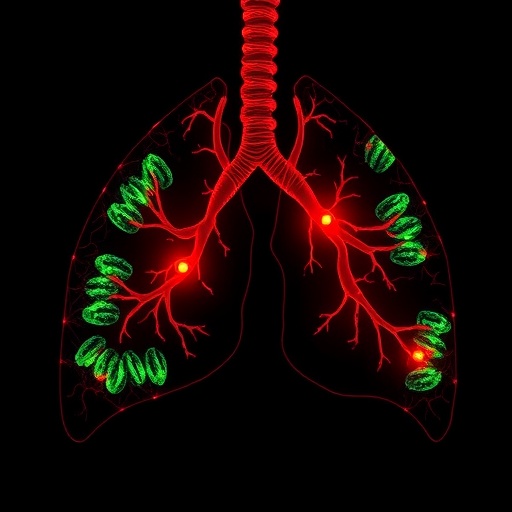
In an era marked by the relentless rise of multidrug-resistant bacterial infections, breakthroughs in antimicrobial therapy are urgently needed—and a recent study highlights a promising new agent that could revolutionize treatment paradigms for chronic lung infections. Researchers have unveiled compelling evidence demonstrating the potent efficacy of Fluorothiazinone (FT), a novel inhibitor targeting the type III secretion system (T3SS) of Burkholderia cenocepacia, a notorious pathogen responsible for chronic lung infections in cystic fibrosis patients. This study, conducted through rigorous in vivo and in vitro models, offers a beacon of hope for combating infections traditionally regarded as intractable.
Burkholderia cenocepacia is a Gram-negative opportunistic pathogen linked with severe pulmonary complications, especially in individuals with cystic fibrosis (CF). This bacterium’s tenacity is underscored by its multidrug resistance and ability to orchestrate chronic infections through intracellular survival mechanisms. The pathogen’s type III secretion system, a molecular syringe used to inject virulence factors into host cells, is instrumental in immune system evasion and persistence. Targeting this secretion system has emerged as a groundbreaking strategy, and Fluorothiazinone, a non-traditional antibacterial agent, stands at the forefront of this approach.
The study meticulously employed a clinically isolated Burkholderia cenocepacia strain obtained from a chronically infected CF patient, ensuring clinical relevance. To simulate both acute and long-term infection dynamics, researchers utilized DBA/2 mice, which were subjected to intranasal inoculation of the pathogen. Through this model, they explored how preventive and therapeutic applications of FT influenced bacterial persistence and host survival.
Acute infection posed a significant mortality threat, with the untreated group experiencing a 50% death rate within five days, underscoring the virulence and rapid progression of disease in this model. Remarkably, mice that received a combined preventive and therapeutic FT regimen achieved 100% survival, a dramatic turnaround that speaks volumes about the compound’s protective capabilities. This outcome not only highlights FT’s antibacterial activity but also implies potential immunomodulatory benefits during the acute infectious phase.
Equally compelling were the findings related to chronic infection. The research demonstrated that FT administration substantially diminished bacterial lung colonization by several orders of magnitude by day five, progressing to complete eradication by day ten. This finding is particularly significant, as chronic lung infections caused by B. cenocepacia are notoriously refractory to antibiotics and often result in substantial tissue damage and respiratory decline. The ability of FT to halt and reverse chronic infection progression suggests it could become a pivotal tool in managing persistent pulmonary diseases.
Histopathological analysis offered a window into the underlying tissue-level impact of the infection and treatment. Lung samples from FT-treated mice showed significantly reduced inflammation, cellular infiltration, and tissue destruction compared to untreated controls. This histological preservation is indicative of FT’s potential to not only suppress bacterial growth but also mitigate the collateral damage mediated by host immune responses, thereby preserving lung function.
Delving into the cellular mechanisms, the researchers assessed FT’s effects on intracellular bacterial survival within RAW264.7 macrophage cell lines. These macrophages are representative of host immune cells that typically engulf and attempt to destroy invading pathogens. Burkholderia cenocepacia’s predilection for intracellular survival complicates treatment, as many antibiotics fail to effectively penetrate or act within host cells. FT, however, exhibited a robust capacity to prevent the survival and intracellular replication of the bacteria in macrophages, substantially impairing a key mechanism by which the pathogen establishes chronic infection.
The implications of these findings extend beyond the immediate antimicrobial effects. By specifically targeting the T3SS, FT disrupts the bacterium’s ability to manipulate host cellular processes and immune signaling, thereby attenuating its virulence without necessarily inducing bacterial death directly. This mode of action reduces selective pressures that often drive antibiotic resistance, positioning FT as a promising candidate in the fight against resistant pathogens.
Moreover, the study’s use of a clinical isolate ensures translational relevance; many preclinical studies rely on lab-adapted strains that may not fully replicate clinical scenarios. This direct evaluation against a multidrug-resistant isolate indicates that FT’s efficacy translates to real-world challenges encountered in treating chronic infections in vulnerable populations.
The preventive aspect of FT treatment is equally noteworthy. By administering the agent in a pre-exposure manner, the study underscores the potential of FT to serve in prophylactic regimens, possibly guarding high-risk patients such as those with cystic fibrosis from initial colonization or infection flare-ups. Such an approach could significantly reduce the burden of chronic infections and improve long-term pulmonary outcomes.
The research team employed a comprehensive methodology, combining animal infection models, histopathology, and cellular assays to characterize FT’s multifaceted effects. This methodological rigor provides confidence in the robustness of the findings and lays the groundwork for subsequent clinical evaluation.
The safety profile of FT in the studied models also appeared favorable, with treated animals showing no apparent adverse effects during the study period. This aspect, while preliminary, is crucial, given that many potent antimicrobial agents encounter limitations due to toxicity concerns. The selective targeting of bacterial virulence pathways rather than essential bacterial survival functions may underpin this tolerability.
Importantly, the study highlights a paradigm shift in infectious disease therapy—from traditional bactericidal or bacteriostatic approaches towards antivirulence strategies that disarm pathogens and enhance host defenses. Fluorothiazinone exemplifies this shift, revealing how molecularly targeted interference in bacterial secretion systems can yield substantial therapeutic benefits.
Future directions envisioned by the researchers include extended evaluations of FT in diverse infection models, detailed pharmacokinetic and pharmacodynamic profiling, and eventual clinical trials to confirm efficacy and safety in human subjects. Combining FT with other antimicrobials could also potentiate treatment efficacy and delay the emergence of resistance.
In summary, the study presents a compelling case for Fluorothiazinone as a next-generation therapeutic capable of curbing acute and chronic lung infections caused by multidrug-resistant Burkholderia cenocepacia. By impeding intracellular survival and replication within macrophages and attenuating pathological lung damage, FT addresses key hurdles that have long hampered effective treatment of chronic pulmonary infections in cystic fibrosis patients. This innovative approach heralds a new chapter in antimicrobial strategy, promising to transform outcomes for patients afflicted by stubborn and life-threatening lung infections.
The advent of Fluorothiazinone holds immense promise and may well mark the beginning of a broader renaissance in infection management that prioritizes precision targeting, resistance mitigation, and host-pathogen interface modulation. As antibiotic resistance continues its relentless advance, the need for such breakthroughs has never been more urgent—and this research lights the way forward with hope and tangible progress.
Subject of Research: Evaluation of Fluorothiazinone, a type III secretion system inhibitor, in suppressing acute and long-term lung infections caused by multidrug-resistant Burkholderia cenocepacia from a cystic fibrosis patient.
Article Title: Long-term lung infection suppression in a mouse model caused via the clinical isolate of Burkholderia cenocepacia using the non-traditional antibacterial agent Fluorothiazinone.
Article References:
Soloveva, A.V., Nelyubina, S.A., Morgunova, E.Y. et al. Long-term lung infection suppression in a mouse model caused via the clinical isolate of Burkholderia cenocepacia using the non-traditional antibacterial agent Fluorothiazinone. J Antibiot (2026). https://doi.org/10.1038/s41429-026-00907-1
Image Credits: AI Generated
DOI: 01 April 2026
Tags: Burkholderia cenocepacia lung infectionBurkholderia cenocepacia pathogenesischronic lung infections in cystic fibrosiscystic fibrosis pulmonary complicationsFluorothiazinone antibiotic therapyin vivo and in vitro infection modelsintracellular bacterial survival mechanismsmultidrug-resistant bacterial infectionsnon-traditional antibacterial treatmentsnovel antimicrobial agents for CFtargeting bacterial virulence factorstype III secretion system inhibitor