


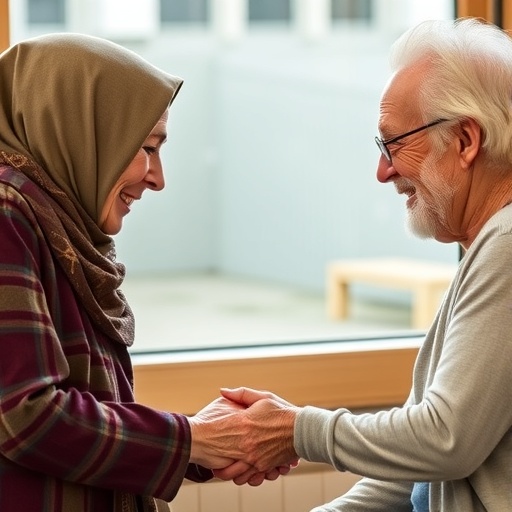
In an era marked by rapid aging populations worldwide, the quest to understand the intricate factors that underpin the health and well-being of older adults has never been more crucial. A groundbreaking study led by Horii, M., Hatta, T., and Imagama, S., recently published in BMC Geriatrics, delves deeply into the complex relationship between health-related quality of life (HRQoL) and the existential construct known as the meaning of life among community-dwelling older adults. This innovative research not only sheds light on how these two dimensions intersect but also challenges prevailing notions of aging, health, and psychological resilience at the twilight of life.
The research team embarked on an ambitious investigation with the core premise that health status alone cannot fully encapsulate an elder’s quality of life without considering subjective existential factors. While traditional geriatrics focuses intensely on physical and mental health markers, this study posits that a holistic perspective intertwining physical wellness and a sense of purpose is indispensable for comprehending the lived experiences of the elderly. The study population comprised community-dwelling older adults, emphasizing those living outside institutional settings, thus providing insight into everyday aging dynamics.
At the heart of the research is the concept of meaning in life, a profoundly philosophical yet measurable construct that reflects an individual’s sense of purpose, coherence, and understanding of their existence. This element can profoundly impact mental health outcomes, social engagement, and even physiological health. The investigators hypothesized that a stronger perception of life’s meaning would correlate positively with enhanced self-rated health-related quality of life metrics, irrespective of physical health limitations or chronic conditions.
Employing robust psychometric instruments, the researchers administered comprehensive evaluations that combined traditional HRQoL scales with validated meaning-in-life questionnaires. This novel methodological integration allowed for a nuanced analysis of the pathways through which meaning influences multiple domains of health-related quality of life, including physical functioning, emotional well-being, and social participation. Crucially, the study crafted a model that adjusts for confounding factors such as age, socioeconomic status, and comorbidities, thus ensuring the associations uncovered are both reliable and generalizable.
The statistical outcomes were revelatory. The data revealed a statistically significant positive association between a pronounced sense of meaning in life and higher HRQoL scores across all measured domains. Older adults who reported stronger existential fulfillment also demonstrated enhanced mental health indices and greater physical resilience. Importantly, the study highlights how meaning acts as a buffer against age-related decline in quality of life, proposing that psychological and philosophical engagement with life’s purpose can mitigate the adverse impact of chronic health challenges.
One of the compelling aspects of this research lies in its interdisciplinary framework that integrates gerontology, psychology, and existential philosophy into a cohesive scientific narrative. This bridging of disciplines provides a richer contextual understanding of aging, where the subjective experience of meaning is not merely ancillary but central to wellbeing. The implications for clinical practice are profound: healthcare providers are encouraged to incorporate assessments of life’s meaning and purpose into routine evaluations, potentially guiding holistic treatment plans that nurture both body and soul.
Additionally, the study addresses the societal dimension of aging by underscoring the importance of community and social connectedness. Meaning in life is often closely tied to relationships and societal engagement, and this work indicates that enhancing community support structures could be a vital lever in boosting both psychological and physical health among elders living independently. Programs fostering volunteerism, cultural participation, or spiritual pursuits may thus have tangible benefits for health-related quality of life beyond the purely medical interventions.
The researchers also discuss the neurobiological underpinnings that might explain the observed links between meaning of life and health outcomes. Emerging evidence suggests that a robust sense of meaning reduces stress-related neuroendocrine activation, which in turn lowers inflammation and improves immune function—biological pathways known to influence aging trajectories. By situating their findings within this biological framework, the study advances a more comprehensive model of healthy aging that transcends traditional biomedical limitations.
Moreover, this work has implications for public health policies aimed at the aging demographic. By identifying meaning of life as a modifiable psychological factor that correlates with better health outcomes, policymakers are presented with novel intervention targets. Community-based programs, mental health services, and even urban planning can incorporate strategies that foster meaningful engagement for older adults, potentially alleviating the economic and societal burdens of aging populations.
Critically, the study eschews simplistic cause-and-effect assumptions, recognizing the bidirectional and dynamic nature of the relationship between meaning in life and health-related quality of life. The authors acknowledge that health status may feedback into one’s sense of meaning just as meaning influences health perceptions, creating a complex interplay that requires longitudinal analyses to fully unravel. Their current cross-sectional design provides a foundational understanding but also serves as a clarion call for further research exploring these temporal dynamics.
The cultural context of the participants also enriches the study’s insights. Conducted primarily in a Japanese setting, where concepts of community, aging, and purpose hold unique sociocultural significance, the findings invite cross-cultural comparisons to ascertain universal versus culture-specific elements of meaning and health. This cultural sensitivity enhances the applicability of the results and encourages global geriatric research to embrace diverse philosophical contexts when addressing aging well.
In conclusion, this seminal study by Horii and colleagues redefines paradigms in geriatric health research by confirming that the quest for meaning is not merely an abstract philosophical endeavor but a tangible element that correlates with and potentially enhances older adults’ health-related quality of life. As societies grapple with the demographic realities of aging populations, integrating existential meanings into health care and community programs may unlock new pathways to fostering vibrant, resilient elderhood—where longevity is paired with richness of psychological and experiential wellbeing.
This research underscores a vital message for the future of aging: meaningful life engagement is a cornerstone of health, deserving equal attention alongside physical and psychological care. The findings compel a shift toward more person-centered, holistic models of elder care that honor the intellectual, emotional, and spiritual dimensions of human experience. Such an integrated approach promises not just longer lives, but lives imbued with dignity, purpose, and joy.
The innovative nature of this study paves the way for continued interdisciplinary explorations that bring together gerontology, neuroscience, psychology, and philosophy. Future investigations may illuminate mechanisms, interventions, and cultural approaches that further enhance meaning and quality of life in aging populations worldwide. As this research gains traction, it could ignite a paradigm shift in public health and clinical geriatrics—centering the meaning of life as an essential metric in measuring successful aging.
For readers and practitioners alike, this research offers both a challenge and an opportunity: to rethink aging beyond deficits and diseases, to recognize the profound power of existential meaning in shaping health outcomes, and to embrace new strategies that nurture this life-affirming dimension in older adults everywhere.
Subject of Research: The relationship between health-related quality of life and the meaning of life in community-dwelling older adults.
Article Title: The association between health-related quality of life and the meaning of life in community-dwelling older adults.
Article References:
Horii, M., Hatta, T., Imagama, S. et al. The association between health-related quality of life and the meaning of life in community-dwelling older adults. BMC Geriatr (2026). https://doi.org/10.1186/s12877-026-07425-7
Image Credits: AI Generated
Tags: aging and life meaning correlationaging population mental and physical healthcommunity-dwelling older adults health studyexistential factors in elderly healthhealth-related quality of life in older adultsholistic health perspectives for seniorsimpact of life purpose on elder healthinterdisciplinary geriatric health researchmeaning of life and elder well-beingpsychological resilience in aging populationsquality of life beyond physical health in seniorssubjective well-being in aging


