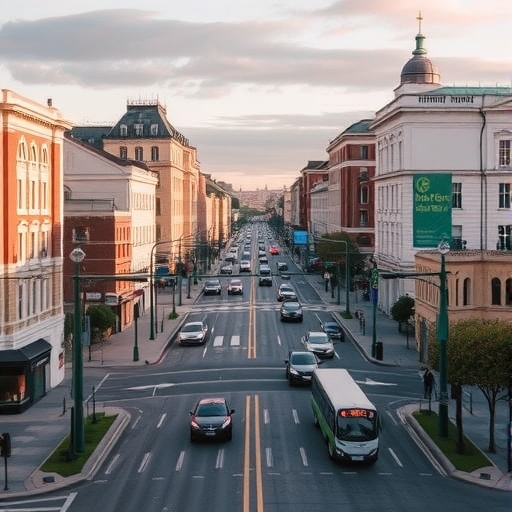
In the ever-expanding landscape of urban environments, the intricate relationship between city growth and traffic dynamics continues to fascinate and challenge researchers across disciplines. A groundbreaking study by Zhang, Hong, Gao, and colleagues, soon to be published in Nature Communications, illuminates the complex, bidirectional yet asymmetric causal links between urban systems and traffic patterns across 30 globally significant metropolitan areas. This pioneering work offers unprecedented insights into how cities evolve and how traffic flows—not merely as dependent phenomena but as systems exerting multifaceted influences on each other.
Cities are notoriously complicated systems, where human activity, infrastructure, and governance intersect dynamically. The researchers set out to unravel the convoluted ways in which urban expansion and traffic dynamics serve as both cause and effect in a continuous feedback loop. By leveraging meticulous data collection from 30 cities across continents, encompassing various urban typologies and scale, the study achieves a holistic overview of urban-traffic interactions that transcends localized case studies prevalent in previous literature.
Central to the investigation is the concept of causality—not just correlation—between urban variables and traffic metrics. Using advanced statistical techniques rooted in nonlinear time series analysis and Granger causality tests adapted for urban complexity, the authors dissect how temporal shifts in one system precipitate changes in the other. This approach clarifies the direction and strength of influence unlike past work that primarily qualified associations, thereby marking a quantum leap in methodological rigor.
One of the study’s most striking revelations is the asymmetric nature of these causal relationships. While urban system characteristics, which include population density, land use patterns, and infrastructural investments, inevitably drive traffic behavior, the feedback from traffic congestion, flow variability, and modal shares back to urban development exhibits a distinctly different magnitude and temporal latency. This asymmetry highlights that urban planning interventions cannot simply assume linear reciprocity but must accommodate varied response mechanisms within city networks.
Across diverse case cities—from sprawling metropolises in Asia to more compact European urban centers—the researchers document how growth spurts alter traffic demand and distribution patterns, fundamentally influencing congestion hotspots and daily commute rhythms. Conversely, persistent traffic burdens influence urban expansion by modifying accessibility perceptions, economic activity localization, and even residential preferences, albeit through more diffuse mechanisms that manifest over longer intervals.
A technical cornerstone of the research is the integration of multi-source data streams, including high-resolution traffic sensor networks, satellite-derived land use classifications, demographic databases, and transportation mode split surveys. By synthesizing geographically heterogeneous data at fine spatial and temporal granularity, the study achieves a comprehensive modeling framework capable of capturing localized phenomena while preserving generalizable patterns across cities.
Embedded within the causality framework are considerations of urban form and infrastructure topology, which modulate how traffic impacts spread and influence urban growth tendencies. Dense, transit-oriented developments reveal different feedback traits compared to car-dependent suburban expansions. This nuance points to the importance of contextual factors in engineering sustainable urban futures and tailors traffic mitigation strategies respectively.
Beyond empirical findings, the authors propose theoretical models suggesting urban systems should be viewed as complex adaptive systems with embedded nonlinearities, thresholds, and path dependencies. Such a perspective reframes urban-traffic relations away from deterministic, one-to-one mappings towards probabilistic, evolving dynamics influenced by policy decisions, technology adoption, and behavioral change over time.
The implications of this work are profound for urban planners, policymakers, and transportation engineers. Recognizing and quantifying these bidirectional yet asymmetric causality pathways enable more predictive and adaptive planning. For instance, investment decisions in public transit infrastructure can now be modeled not just for travel time improvements but considering their ripple effects on urban sprawl and socio-economic segregation patterns.
Importantly, the study’s findings bear urgency in the context of accelerating urbanization globally, as more than two-thirds of the world’s population is expected to reside in cities within a few decades. The pressure on urban systems compounds with climate change challenges, requiring holistic interventions that reconcile mobility needs with sustainability goals. Insights into causality actually empower cities to anticipate unintended consequences of policies and harness positive feedback loops to foster resilient growth.
Traffic dynamics themselves are evolving, with technological transformations such as autonomous vehicles, shared mobility services, and smart traffic signal systems introducing new variables into the equation. Zhang and colleagues point out that integrating such emergent trends into causal frameworks is the natural next step for urban dynamics research, promising even greater fidelity in understanding future city-traffic interplays.
The thoroughness and scope of this study also underscore the necessity for cross-disciplinary collaboration, engaging urban geographers, data scientists, civil engineers, and social scientists. Complexity science methodologies fused with cutting-edge computational tools provide the backbone for this ambitious endeavor, illustrating the power of collaborative innovation in urban research domains.
In conclusion, this novel exploration of bidirectional, asymmetric causality between urban systems and traffic dynamics marks a milestone in urban science literature. Its nuanced elucidation of how cities and their mobility patterns shape each other opens avenues for smarter, more anticipatory urban development. As cities around the world grapple with congestion, pollution, and equity demands, this research offers pathways to balance growth with efficient, sustainable transportation networks—a beacon for building future cities that are both livable and thriving hubs of human activity.
Subject of Research: Urban systems and traffic dynamics causality in 30 cities worldwide.
Article Title: Bidirectional yet asymmetric causality between urban systems and traffic dynamics in 30 cities worldwide.
Article References:
Zhang, Y., Hong, Y., Gao, S. et al. Bidirectional yet asymmetric causality between urban systems and traffic dynamics in 30 cities worldwide.
Nat Commun (2026). https://doi.org/10.1038/s41467-026-71377-0
Image Credits: AI Generated
Tags: asymmetric causality between city growth and trafficbidirectional causal links in urban environmentscomparative study of 30 global citiescomplex urban infrastructure interactionsdynamics of human activity and traffic congestionfeedback loops in city development and trafficglobal metropolitan traffic and urban systemsGranger causality tests for traffic patternsmetropolitan traffic flow and urban expansionmultidisciplinary urban traffic researchnonlinear time series analysis in urban studiesurban systems and traffic dynamics