• HOME
  • NEWS
  • EXPLORE
    • CAREER
      • Companies
      • Jobs
    • EVENTS
    • iGEM
      • News
      • Team
    • PHOTOS
    • VIDEO
    • WIKI
  • BLOG
  • COMMUNITY
    • FACEBOOK
    • INSTAGRAM
    • TWITTER
Sunday, August 16, 2026
BIOENGINEER.ORG
No Result
View All Result
  • Login
  • HOME
  • NEWS
  • EXPLORE
    • CAREER
      • Companies
      • Jobs
        • Lecturer
        • PhD Studentship
        • Postdoc
        • Research Assistant
    • EVENTS
    • iGEM
      • News
      • Team
    • PHOTOS
    • VIDEO
    • WIKI
  • BLOG
  • COMMUNITY
    • FACEBOOK
    • INSTAGRAM
    • TWITTER
  • HOME
  • NEWS
  • EXPLORE
    • CAREER
      • Companies
      • Jobs
        • Lecturer
        • PhD Studentship
        • Postdoc
        • Research Assistant
    • EVENTS
    • iGEM
      • News
      • Team
    • PHOTOS
    • VIDEO
    • WIKI
  • BLOG
  • COMMUNITY
    • FACEBOOK
    • INSTAGRAM
    • TWITTER
No Result
View All Result
Bioengineer.org
No Result
View All Result
Home NEWS Science News

NASA sees Tropical Cyclone Donna blanket Vanuatu

Bioengineer by Bioengineer
May 6, 2017
in Science News
Reading Time: 2 mins read
0
Share on FacebookShare on TwitterShare on LinkedinShare on RedditShare on Telegram
IMAGE

Credit: Credits: NASA

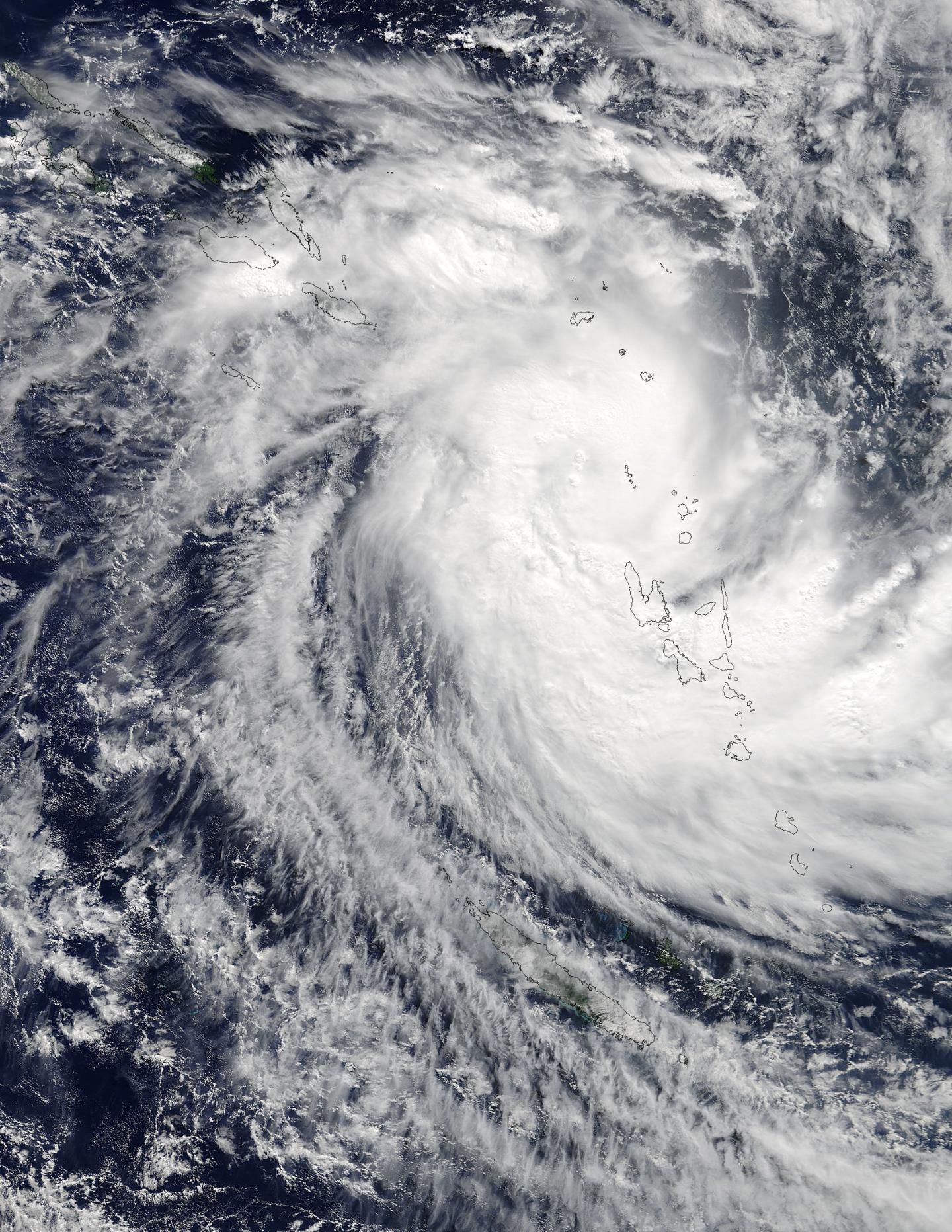
The 80 plus islands that make up the nation of Vanuatu were blanketed by the clouds of Tropical Cyclone Donna when NASA's Terra satellite passed overhead. NASA's Aqua satellite provided an infrared look at Donna that showed strong storms with heavy rain potential.

The Moderate Resolution Imaging Spectroradiometer instrument aboard NASA's Terra satellite captured a visible image of Tropical Cyclone Donna on May 4 at 2330 UTC (7:30 p.m. EDT) as it covered Vanuatu in the South Pacific Ocean. Powerful thunderstorms circled the center of the storm and a large, thick band of thunderstorms wrapped into the center from the south-southwest.

On May 5, warnings were in effect for Vanuatu and New Caledonia. The Vanuatu Meteorology and Geo-Hazards Department issued warnings for Torba, Sanma and Malampa. A Red Alert was in effect for the Torba Province and a Yellow Alert was in effect for the Sanma and Malampa provinces.

The New Caledonia Meteorological and Climatological Department issued a Yellow Strong Wind Alert for the northwestern area of the territory.

An infrared image from the Atmospheric Infrared Sounder instrument aboard NASA's Aqua satellite on May 5 at 02:17 UTC (May 4 at 10:17 p.m. EDT) showed very cold cloud top temperatures in thunderstorms around Donna's center. Coldest cloud tops were as cold as minus 63 degrees Fahrenheit or minus 53 degrees Celsius. Cloud top temperatures that cold have been shown to generate heavy rainfall.

On May 5, 2017 at 1500 UTC (11 a.m. EDT), Tropical Cyclone Donna has maximum sustained winds near 90 knots (103 mph/166.7 kph). Donna was a Category 2 hurricane on the Saffir-Simpson Hurricane Wind Scale. Donna was centered near 13.9 degrees south latitude and 164.8 degrees east longitude, about 302 nautical miles (347.8 miles/ 559.7 km) northwest of Port Vila, Vanuatu. Donna was moving to the west-southwest at 6 knots (7 mph/11 kph).

Donna is expected to peak in intensity on May 7 and 8 at 115 knots. A trough or elongated area of low pressure moving toward the storm from the west is expected to turn the direction of the storm from the southwest to the southeast. After May 8, increasing vertical wind shear and cooling sea surface temperatures will gradually weaken the cyclone. By May 10, the Joint Typhoon Warning Center expects Tropical Cyclone Donna to begin extra-tropical transition.

###

Media Contact

Rob Gutro
[email protected]
@NASAGoddard

http://www.nasa.gov/goddard

############

Story Source: Materials provided by Scienmag
Share12Tweet7Share2ShareShareShare1

Related Posts

KAIST develops semiconductor neuron that harnesses noise to selectively process signals

KAIST develops semiconductor neuron that harnesses noise to selectively process signals

August 16, 2026
Imagining natural and extra robotic thumbs together strengthens kinesthetic sensorimotor networks

Imagining natural and extra robotic thumbs together strengthens kinesthetic sensorimotor networks

August 16, 2026

PARP1 Drives Neuropathic Pain Through GPX4-Dependent Ferroptosis in Injured Mice’s Sensory Neurons

August 15, 2026

Strubbelig–NHL3 Receptor Complex Helps Arabidopsis Respond to Cellulose Deficiency

August 15, 2026
Please login to join discussion

POPULAR NEWS

  • KAIST develops semiconductor neuron that harnesses noise to selectively process signals

    29 shares
    Share 12 Tweet 7
  • Imagining natural and extra robotic thumbs together strengthens kinesthetic sensorimotor networks

    29 shares
    Share 12 Tweet 7
  • PARP1 Drives Neuropathic Pain Through GPX4-Dependent Ferroptosis in Injured Mice’s Sensory Neurons

    29 shares
    Share 12 Tweet 7
  • Strubbelig–NHL3 Receptor Complex Helps Arabidopsis Respond to Cellulose Deficiency

    29 shares
    Share 12 Tweet 7

About

We bring you the latest biotechnology news from best research centers and universities around the world. Check our website.

Follow us

Recent News

KAIST develops semiconductor neuron that harnesses noise to selectively process signals

Imagining natural and extra robotic thumbs together strengthens kinesthetic sensorimotor networks

PARP1 Drives Neuropathic Pain Through GPX4-Dependent Ferroptosis in Injured Mice’s Sensory Neurons

Subscribe to Blog via Email

Success! An email was just sent to confirm your subscription. Please find the email now and click 'Confirm' to start subscribing.

Join 85 other subscribers
  • Contact Us

Bioengineer.org © Copyright 2023 All Rights Reserved.

Welcome Back!

Login to your account below

Forgotten Password?

Retrieve your password

Please enter your username or email address to reset your password.

Log In
No Result
View All Result
  • Homepages
    • Home Page 1
    • Home Page 2
  • News
  • National
  • Business
  • Health
  • Lifestyle
  • Science

Bioengineer.org © Copyright 2023 All Rights Reserved.