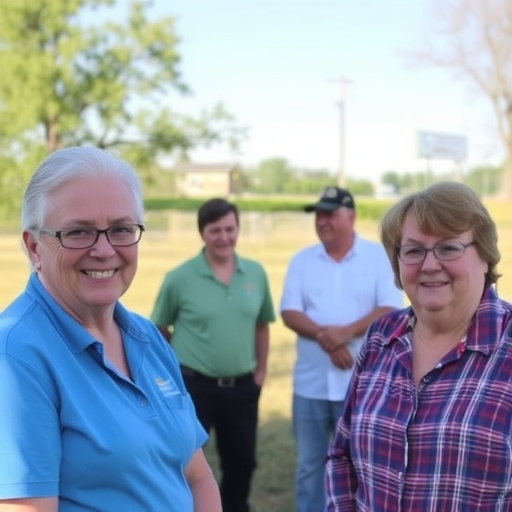
A groundbreaking new study from the Pennington Biomedical Research Center at LSU reveals compelling insights into the health disparities faced by rural populations, focusing initially on Louisiana’s Assumption Parish. The Risks Underlying Rural Areas Longitudinal (RURAL) Heart and Lung Study embarks on a pioneering journey to understand why rural residents endure higher rates of chronic conditions such as heart and lung diseases, diabetes, obesity, and stroke compared to their urban counterparts. This extensive research project, led by Dr. Stephanie Broyles, provides a crucial data resource that lays the groundwork for tailored public health interventions aimed at these underserved communities.
The first dataset from Assumption Parish unveils startling evidence on the socio-epidemiological influences on health outcomes in rural settings. While Assumption and nearby Franklin Parish share similar demographic profiles, significant health outcome differences exist between them. These early findings underscore the complex interplay of environmental, socioeconomic, and educational factors contributing to disease prevalence. One of the most striking revelations from the Assumption data is the disproportionate impact of educational attainment on health status, surpassing even income or age as a predictive determinant of cardiovascular risk.
Dr. Broyles and her team found that adults in Assumption Parish who did not complete high school are more than twice as likely to suffer from hypertension and hypercholesterolemia when compared to those with at least some college education. Such correlations hint at underlying systemic issues including limited health literacy, restricted access to preventive care, and occupational hazards without adequate health insurance coverage. However, the research team prudently emphasizes correlation rather than causation, advocating for further investigation into the causal pathways behind these associations.
The study also paints a vivid epidemiological portrait of Assumption Parish, mapping its public health challenges alongside demographic and socioeconomic indicators. The parish is characterized by a lower population density and a higher median age, factors that intensify healthcare access difficulties. Residents confront a heightened prevalence of obesity, hypertension, and diabetes, conditions exacerbated by modifiable risk factors such as diet and physical inactivity. Coupled with environmental challenges—such as limited access to nutritious food options and a scarcity of primary healthcare providers—these factors weave a complex matrix that perpetuates chronic disease burdens.
Significantly, the study documents that 80% of adults in Assumption Parish are classified as overweight or obese, a figure that eclipses both statewide and national averages. Disaggregating these data reveals stark disparities by educational level: 75% obesity prevalence among those without high school diplomas contrasts sharply with a 48% rate among individuals with some college education. Similarly, high cholesterol and blood pressure afflict more than twice the proportion of less-educated residents. These pronounced disparities spotlight education as a key social determinant of health within rural contexts.
The forthcoming analysis of Franklin Parish data promises to enrich the understanding of health variability among rural parishes with similar demographic frameworks. By juxtaposing high-risk and lower-risk rural communities, the RURAL study endeavors to uncover the micro-level factors that drive health disparities, moving beyond generic rural-urban dichotomies. Dr. Broyles emphasizes that rural populations are heterogeneous; geographic and structural differences within rural Louisiana significantly influence community health profiles and longevity.
The RURAL Heart and Lung Study represents a massive collaborative effort, involving 16 institutions and a $42.5 million funding pool managed by the National Institutes of Health (NIH). The study spans four states—Louisiana, Mississippi, Alabama, and Kentucky—and targets 10 counties designated as rural. This ambitious multistate approach is instrumental in revealing broader patterns and generating generalizable knowledge that could shape policy responses aimed at mitigating rural health inequities nationwide.
At the core of this research project is an innovative mobile examination unit designed to bring advanced clinical assessments directly into rural communities. In 2024, the unit conducted comprehensive health evaluations on 460 adult residents of Assumption Parish. These evaluations included a battery of sophisticated diagnostics such as urine and blood analysis for metabolic markers, echocardiography to assess cardiac function, CT imaging, and pulmonary function tests. This multimodal data collection advances precision in characterizing rural health profiles and captures subclinical abnormalities often overlooked in conventional surveys.
The longitudinal nature of the RURAL study mandates a follow-up evaluation in 2028 for the same cohort, enabling researchers to track health trajectories and disease progression over time. This prospective design will yield critical insights into the evolution of risk factors and the effectiveness of potential interventions. Longitudinal analysis is especially vital in rural research, where healthcare access barriers and social determinants interact dynamically to influence health outcomes.
Pennington Biomedical Research Center stands at the forefront of metabolic and chronic disease research, leveraging a robust infrastructure of 44 clinics and 16 specialized core facilities. Staffed by an interdisciplinary network of scientists, clinicians, and technical specialists, the center is committed to unraveling the biological and environmental triggers of obesity, cardiovascular disease, cancer, and dementia. The RURAL study exemplifies the center’s dedication to translating molecular and clinical insights into actionable community health improvements.
The implications of this study resonate far beyond Assumption Parish or even the state of Louisiana. With millions living in rural America facing similar health disparities, the data serve as an urgent call for targeted public health strategies that integrate social determinants such as education, environmental access, and healthcare infrastructure. The RURAL study articulates a new paradigm for rural health research, combining advanced diagnostics, longitudinal monitoring, and a socioecological lens to inform precision public health and reduce the rural health divide.
As analysis of Franklin Parish results and data from other participating states progresses, the RURAL study will continue to illuminate the nuanced landscape of rural health disparities. Its findings promise to empower policymakers, healthcare providers, and communities alike to develop culturally sensitive, evidence-based programs. Ultimately, the RURAL Heart and Lung Study charts a hopeful pathway toward enhancing the health, longevity, and quality of life for rural populations nationwide, demonstrating how rigorous science can amplify the voices and needs of the often-overlooked rural heartland.
Subject of Research: People
Article Title: [Not Provided]
News Publication Date: [Not Provided]
Web References: https://www.pbrc.edu/pdf/Assumption_RURAL_Data_Book.pdf
References: [Not Provided]
Image Credits: Pennington Biomedical Research Center
Keywords: Rural populations, heart disease, lung disease, diabetes, obesity, education and health, health disparities, longitudinal study, epidemiology, public health, mobile health assessment
Tags: chronic disease prevalence in rural communitiesdiabetes and obesity in rural populationshealth outcomes in Assumption and Franklin Parishheart and lung disease risk factorsimpact of education on cardiovascular risklongitudinal rural health studiesPennington Biomedical Research Center researchpublic health interventions for rural areasrural health disparities in Louisianasocio-epidemiological influences on healthsocioeconomic determinants of healthstroke incidence in Assumption Parish