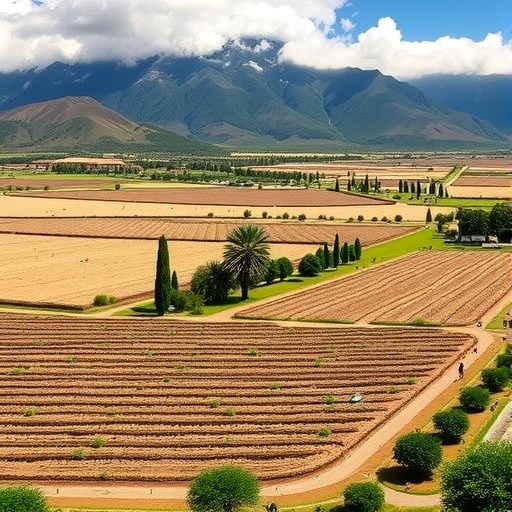
In a groundbreaking study published in Nature, researchers have shed new light on the complex transition from foraging to farming in the Uspallata Valley, a region located at the southern fringe of Andean agriculture. This research, through the analysis of 46 newly sequenced ancient human genomes combined with stable isotope and strontium isotope data, reveals a nuanced picture of local hunter-gatherers adopting agriculture late and undergoing significant social and demographic transformations. This study significantly refines our understanding of how agricultural practices spread in South America and how indigenous populations adapted to socio-environmental challenges.
The transition to agriculture marks one of the most profound turning points in human prehistory, often tied to large-scale demographic, social, and cultural changes. However, the timing and pathways of this transition were far from uniform across different regions. The Uspallata Valley represents a compelling case study where indigenous populations retained a distinct genetic identity despite adopting farming practices. Genetic analyses exposed a unique genetic component in these populations, signifying a long-standing population history characterized by relative continuity rather than replacement.
Ancient DNA sequencing unraveled the genetic continuity between pre-agriculture hunter-gatherer groups and subsequent farming populations, countering the hypothesis of population displacement or replacement by incoming farming groups. This genetic stability suggests that local foragers did not merely get replaced by migrant farmers but rather incorporated agricultural techniques into their subsistence economy, embracing a flexible strategy that balanced foraging with farming.
The researchers employed palaeodietary isotopes, specifically carbon (δ13C) and nitrogen (δ15N), to probe past diets. These isotopes revealed fluctuations in maize consumption over time, consistent with diverse and adaptive foodways where reliance on agriculture was variable rather than constant. This fluctuating maize intake indicates that agriculture was not immediately dominant but integrated into a broader subsistence strategy, challenging simplified models of agricultural transition that presume rapid and total adoption of farming.
Moreover, strontium isotope ratios (87Sr/86Sr) provided insights into mobility and migration patterns in the region. Between approximately 810 and 700 calibrated years before present (cal BP), the arrival of migrants from nearby regions was detected, hinting at movements of people shortly before the Inka expansion. Notably, these migrants shared the same regional genetic pool as the locals, suggesting movement within a metapopulation rather than large-scale invasions or foreign incursions.
The genomic and isotopic evidence combined points to the migrants possibly moving in matrilineally organized family groups, an inference drawn from genetic kinship patterns and the distribution of isotopic signatures. This social organization would have implications for understanding social resilience mechanisms during times of crisis, highlighting how kin networks may have facilitated coping strategies in response to increasingly harsh conditions.
Crucially, the immigrants bore physical stress markers, including signs of malnutrition and evidence of diseases such as tuberculosis. Genomic analyses confirmed the presence of tuberculosis pathogens in ancient remains, revealing that health challenges played a significant role in shaping demographic trends. These health burdens, combined with environmental and social stresses, likely contributed to a long-term demographic decline observed in these populations.
These findings suggest a multi-dimensional crisis during this period in the Southern Andes, where environmental pressures, disease, and social upheaval intersected. The adoption of agriculture can therefore be seen not just as a technological shift but as part of a broader adaptive strategy that included social reorganization and migration to cope with these adversities.
By illuminating these complex dynamics, the study challenges simplistic narratives of agricultural emergence as a straightforward progression and instead portrays it as a fluid, context-dependent process interwoven with demographic continuity, cultural resilience, and networked mobility. This nuanced understanding is essential for reconstructing accurate prehistoric models of human-environment interaction in South America.
Furthermore, the intersection of archaeogenetics with isotope geochemistry showcased in this research exemplifies the power of interdisciplinary approaches. The integration of genomic data with bioarchaeological markers opens new frontiers for tracing both biological and cultural histories and for understanding how ancient human groups navigated crises.
The documented case of flexible maize farming, migration of kin groups, and the persistence of genetically distinct populations exemplifies the adaptive capacity of indigenous societies facing climatic, social, and epidemiological challenges. These adaptability strategies underscore the complexity of human resilience, especially in frontier regions where cultural innovation and biological continuity coexist.
Ultimately, this study reframes our understanding of the Southern Andes as a dynamic crossroads of genetic heritage, shifting subsistence economies, and social strategies. It reminds us that transitions like the move to agriculture are rarely linear or uniform but are shaped by multifaceted interactions between people, environment, and disease.
As the Uspallata Valley case demonstrates, human history is deeply textured, involving waves of movement, persistence of identity, and continual adaptation. These insights not only enrich our knowledge of the past but also provide valuable lessons on resilience in the face of crisis applicable to ongoing global challenges.
This research paves the way for future studies to explore how late agricultural transitions and responses to crisis shaped other marginalized or peripheral regions worldwide, enriching the broader narrative of human prehistory with new perspectives on coexistence, adaptation, and survival.
Subject of Research:
Late adoption of agriculture by local hunter-gatherers in the Uspallata Valley and the associated demographic, social, and health impacts during periods of crisis and migration in the Southern Andes.
Article Title:
Local agricultural transition, crisis and migration in the Southern Andes.
Article References:
Barberena, R., Luisi, P., Novellino, P. et al. Local agricultural transition, crisis and migration in the Southern Andes. Nature (2026). https://doi.org/10.1038/s41586-026-10233-z
Image Credits:
AI Generated
DOI:
https://doi.org/10.1038/s41586-026-10233-z
Tags: ancient DNA in archaeologyAndean agriculture transitioncultural transformations in ancient South Americademographic changes in prehistoryhunter-gatherer to farming shiftindigenous genetic continuitylate adoption of agriculturesocio-environmental adaptation in AndesSouth American agricultural historystable isotope analysis in migrationstrontium isotope migration studiesUspallata Valley ancient genomes