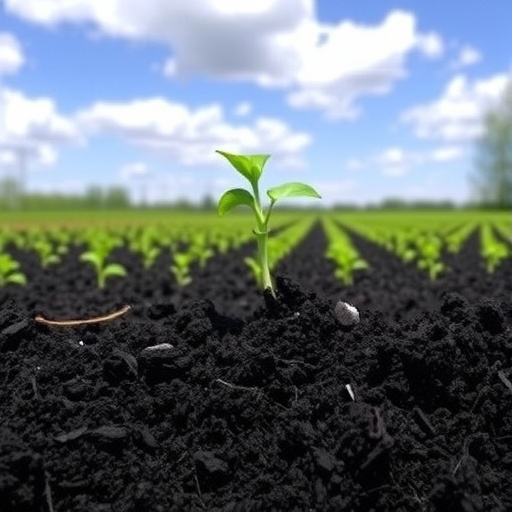
In a groundbreaking investigation spanning over a decade, scientists have elucidated how biochar—an innovative, carbon-dense material derived from agricultural residues—can profoundly bolster the soil’s capacity to sequester carbon. This revelation carries immense implications for climate change mitigation and sustainable land management, though the benefits are neither universal nor uniform. The nuanced effectiveness of biochar hinges critically on the interplay between soil type, land use, and the underlying microbial community dynamics.
The longitudinal study meticulously assessed the effects of recurrent straw-derived biochar amendments on soil organic carbon (SOC) across contrasting agricultural landscapes. By systematically comparing waterlogged paddy fields with non-flooded upland soils under closely controlled conditions, the research team successfully isolated the variables influencing carbon storage outcomes. Their data revealed that biochar applications induced substantial increases in overall soil carbon stocks, yet the magnitude of these gains varied dramatically based on environmental context.
One of the most striking discoveries was the striking disparity in carbon sequestration efficiencies between paddy and upland soils. In flooded paddy soils, biochar-enhanced sequestration soared by an extraordinary 66 to 300 percent compared to upland counterparts with identical parent materials. These results highlight water saturation as a pivotal factor, likely moderating microbial respiration rates and decelerating the decomposition of organic compounds, thereby promoting longer-term carbon retention.
Beyond mere quantity, biochar reshaped the quality and stability of soil organic matter. Soils treated with biochar accrued higher concentrations of chemically resilient carbon fractions, known for their reduced bioavailability and prolonged persistence in the soil matrix. Concurrently, there was a notable decline in more labile, easily degraded carbon compounds, suggesting a transformative shift towards more recalcitrant carbon pools conducive to enduring climate benefits.
At the heart of these transformations lie the intricate microbial communities that mediate soil carbon cycling. The biochar amendments altered the relative abundance of key microbial taxa, including both bacteria and fungi, triggering shifts in metabolic pathways and carbon processing dynamics. In paddy systems, microbial assemblages favored processes that stabilize carbon, whereas upland soils exhibited microbial signatures indicative of accelerated carbon turnover and release.
The researchers emphasized the crucial role of microbial necromass—the residual biomass of dead microorganisms—which contributes substantially to the stable organic carbon pool. Their findings demonstrated that soils originating from clay-rich and alluvial parent materials not only stabilized greater quantities of carbon but also revealed enhanced accumulation of microbial necromass, underscoring the significance of soil mineralogy and texture in maximizing biochar’s efficacy.
Interestingly, while biochar introduction augmented the absolute levels of microbial-derived carbon, its proportional contribution to the total soil carbon pool paradoxically diminished. This observation suggests that biochar supplementation introduces additional, inherently stable carbon forms that coexist and interact with naturally occurring soil organic matter, ultimately modifying the natural carbon cycling process.
The investigation further unveiled that the soil’s initial physicochemical properties—pH, texture, and mineral content—mediate how biochar influences microbial community function and, consequentially, the trajectory of soil carbon sequestration. These insights challenge the pervasive assumption of biochar as a one-size-fits-all solution and stress the necessity of tailoring biochar application strategies to specific environmental settings.
This research bridges a critical knowledge gap, providing empirical evidence that the synergistic effects of soil type, land management, and microbial ecology dictate biochar’s long-term impact on soil carbon dynamics. The emerging paradigm reframes biochar not solely as a soil amendment but as a complex biogeochemical modifier with environment-specific mechanisms.
Climate scientists and agronomists alike stand to benefit from these findings, which carve a clearer path toward integrating biochar into holistic climate action plans. By optimizing biochar utilization according to local soil matrices and agricultural practices, stakeholders can leverage its carbon sequestration potential while simultaneously enhancing soil health and crop productivity.
As the global community intensifies efforts to curb atmospheric CO2 concentrations, understanding and harnessing soil carbon sequestration becomes paramount. This study’s revelations act as a beacon, guiding precision interventions in soil management that align ecological sustainability with agricultural innovation, ultimately reinforcing soils as resilient carbon sinks for future generations.
Subject of Research: Soil organic carbon sequestration in biochar-amended soils and the microbial processes driving carbon stabilization.
Article Title: Contrasting microbial carbon transformation pathways drive differential SOC sequestration in long-term biochar-amended paddy and upland soils.
News Publication Date: February 5, 2026.
Web References: http://dx.doi.org/10.1007/s42773-025-00559-8
References: Yang, X., Xu, L. & Zhao, X. Contrasting microbial carbon transformation pathways drive differential SOC sequestration in long-term biochar-amended paddy and upland soils. Biochar 8, 41 (2026).
Image Credits: Xin Yang, Lingying Xu & Xu Zhao.
Keywords
biochar, soil organic carbon, carbon sequestration, microbial community, paddy soil, upland soil, soil carbon stabilization, microbial necromass, climate mitigation, soil amendment, biogeochemical cycles, soil chemistry
Tags: biochar effects on soil organic carbonbiochar from agricultural residuesbiochar impact on upland soilsbiochar in flooded paddy soilscarbon storage in agricultural soilsclimate change mitigation through soil carbonlong-term biochar applicationmicrobial community dynamics in soilmicrobial processes in biochar-amended soilssoil carbon sequestrationsustainable land management with biocharwaterlogged vs upland soil carbon storage