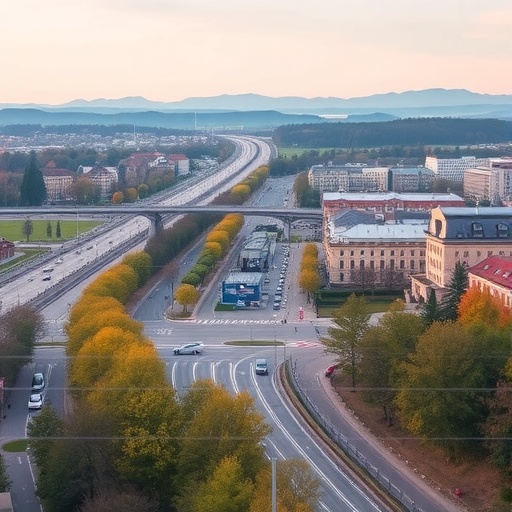
In an era where urban living is increasingly entwined with daily life, the sensory environment plays a crucial role in shaping public health outcomes. Recent research conducted in Zurich, Switzerland, sheds light on an often overlooked yet pervasive urban stressor: road traffic noise. This study rigorously explores how ambient traffic sounds influence psychological experiences during walks in both urban-built settings and urban forests, revealing nuanced effects that challenge existing perceptions about nature’s restorative potential.
Noise pollution, particularly from road traffic, has long been established as a detriment to human health, linked with cardiovascular diseases, sleep disturbances, and increased stress levels. However, understanding its effects in specific contexts, such as during outdoor leisure activities, remains underexplored. This randomized controlled trial uniquely investigates the impact of road traffic noise on immediate subjective experiences during walks, focusing on annoyance levels, repetitive negative thinking, and individuals’ connectedness with non-human nature.
Set against the backdrop of Zurich’s urban green spaces and city environments, this field study employed a comprehensive methodological approach. Participants were exposed to walks in two distinct settings: densely built urban areas characterized by high vehicular traffic noise and adjacent urban forests where natural sounds predominate but may still be permeated by distant traffic noise. Assessments took place before and after the walks, offering a rigorous within-subject analysis that isolates the influence of environmental noise on psychological outcomes.
The findings unambiguously demonstrate that road traffic noise significantly increases annoyance during both urban forest walks and walks through built environments. This highlights noise as a potent acute stressor capable of dampening the perceived restorative value of natural settings. Interestingly, despite the heightened annoyance, the noise did not appear to exacerbate repetitive negative thinking, a cognitive pattern commonly linked with depression and anxiety disorders, suggesting that annoyance and cognitive rumination may be mediated by different psychological mechanisms.
Moreover, the study reveals that road traffic noise does not significantly diminish individuals’ sense of connectedness with non-human nature. This is a critical insight, as connectedness to nature is often credited with bolstering mental health and well-being. The finding suggests that while ambient noise disrupts comfort and increases irritability, it does not necessarily erode fundamental emotional bonds with the environment, opening avenues for further research into how sensory inputs shape multifaceted components of human-nature relationships.
The implications of these results are far-reaching. Urban planners and public health officials must weigh the psychological costs of noise pollution when designing and managing urban green spaces. Although urban forests serve as vital sanctuaries for city dwellers, their benefits might be partially negated if persistent road noise intrudes. This insight underscores the necessity for noise mitigation strategies, such as strategically located barriers, vegetation buffers, and traffic management policies, to enhance the health-promoting potential of green spaces.
Methodologically, the trial’s randomized controlled design enhances the robustness of its conclusions, setting it apart from correlational studies that dominate much of environmental health research. Future studies could build upon this work by incorporating physiological stress markers or longitudinal mental health assessments to elucidate the chronic effects of urban noise exposure during recreational activities.
The study was spearheaded by scientists from Switzerland and The Netherlands, funded by prestigious grants from the Swiss National Science Foundation, reinforcing the importance of this research within the European scientific agenda. Their interdisciplinary team bridges environmental psychology and urban health sciences, reflecting the complex interplay between human cognition, exposure to environmental stressors, and health outcomes.
This research also contributes significantly to ongoing debates about the intrinsic value of urban green spaces. While green environments have demonstrable benefits on mood and cognitive functioning, this study cautions against idealizing these spaces without acknowledging environmental stressors that may undermine their restorative effects. Considering the global trend of urbanization, understanding these dynamics becomes essential to promoting mental health equity in cities.
By revealing that road traffic noise is a critical health-related stressor even within natural urban settings, this study calls for a reevaluation of urban design paradigms. It challenges stakeholders to innovate beyond mere green infrastructure provision to holistic environmental quality enhancement, integrating soundscape management as a core element of healthy city planning.
In conclusion, the Zurich study offers valuable, nuanced perspectives on how road traffic noise impinges on psychological well-being during urban walks. It underscores the necessity of mitigating acoustic pollution to preserve the mental health benefits associated with urban nature exposure. As urban populations grow, such research is indispensable for informing evidence-based interventions that reconcile urban mobility, environmental quality, and public health.
For city dwellers seeking respite in urban forests, the subtle interruptions of traffic noise may seem trivial but carry greater implications for annoyance and stress. This research empowers policymakers to prioritize acoustic comfort alongside visual greenery, emphasizing a multisensory approach to urban health promotion.
As the dialogue around urban sustainability evolves, integrating soundscape considerations emerges as a frontier for enhancing human experiences in the built and natural environments. The Zurich trial stands as a pioneering example, reminding us that to foster genuinely salutogenic urban spaces, city planning must respect the intricate relationships between noise, nature, and the human psyche.
Subject of Research: The influence of road traffic noise on psychological responses during walks in urban built environments and urban forests.
Article Title: Road traffic noise affects annoyance during urban built and forest walks, but not repetitive negative thinking or connectedness with non-human nature: A randomized controlled trial
News Publication Date: 18-Mar-2026
Web References: http://dx.doi.org/10.1371/journal.pone.0342906
Image Credits: Julia Schaupp / WSL, CC-BY 4.0
Keywords
Urban noise pollution, road traffic noise, urban forests, environmental psychology, restorative environments, mental health, annoyance, repetitive negative thinking, nature connectedness, randomized controlled trial, urban planning, acoustic ecology
Tags: ambient noise effects on public healthnature connectedness in urban environmentsnoise annoyance during outdoor activitiesnoise pollution and cardiovascular diseasepsychological effects of noise pollutionrandomized controlled trials on noise pollutionrepetitive negative thinking and noise exposuresensory environment and urban health outcomesurban forest walking stress reductionurban green space mental health benefitsurban noise pollution and sleep disturbanceurban road traffic noise health impact