In a groundbreaking advancement poised to transform personal healthcare and continuous health monitoring, researchers have unveiled microneedle-integrated sensors capable of extracting dermal interstitial fluid for real-time analysis. This innovative technology, meticulously detailed in a recent study published in the Journal of Pharmaceutical Investigation, represents a major leap toward non-invasive, pain-free biosensing that could redefine how clinicians and individuals monitor health biomarkers. The implications of this development extend far beyond mere convenience, potentially offering earlier disease detection, more precise drug delivery, and comprehensive physiological insight that traditional methods have struggled to provide.
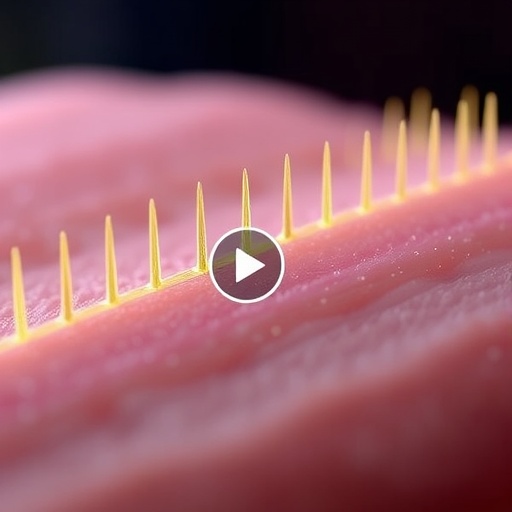
At the core of this technology lie microneedle arrays—ultra-small, minimally invasive needles that pierce the skin’s outer barrier just enough to access the dermal interstitial fluid (ISF) beneath without causing pain or bleeding. Unlike conventional blood draws which are invasive and inconvenient, these microneedles serve as a gateway to a rich source of physiological information. The ISF carries a wealth of biochemical markers including glucose, electrolytes, hormones, and metabolites, making it an ideal medium for real-time health assessment. By integrating biosensors directly onto these microneedles, the system facilitates continuous monitoring with unprecedented accuracy and immediacy.
The design of these microneedle-integrated sensors is a feat of engineering brilliance. Fabricated using biocompatible polymers and coated with selective sensing materials, the microneedles are capable of rapid fluid sampling and molecular recognition. The study highlights how microfabrication techniques allow for customization of needle length, density, and sensor integration, enabling the devices to be tailored for various physiological conditions and targeted analytes. This personalization enhances their clinical applicability across diverse patient populations, including those with chronic illnesses requiring vigilant monitoring.
One of the transformational aspects outlined by the researchers is the system’s real-time data transmission capability. The sensors embedded in the microneedles are coupled with miniaturized electronics that convert biochemical signals into digital data streams. These data can be wirelessly transmitted to smartphones or healthcare cloud platforms, enabling remote monitoring by healthcare professionals and immediate alerts to patients. This seamless integration of bioelectronics with microneedle technology empowers continuous oversight, reducing the need for hospital visits and improving patient compliance.
The study further delves into the biochemical interactions within the ISF and how the sensors are designed to selectively detect specific biomarkers amid a complex biological milieu. Advanced surface chemistry modifications on the sensor electrodes ensure high sensitivity and specificity, mitigating cross-reactivity and environmental noise. For example, glucose oxidase immobilization on the sensor surface facilitates direct enzymatic detection of glucose levels, critical for diabetic patient management. Such highly targeted sensing strategies are essential to deliver clinically relevant data that can inform treatment decisions in real time.
Importantly, the microneedle sensor platform is designed with patient comfort and safety as paramount considerations. The microneedles penetrate only the epidermal and superficial dermal layers, avoiding nerve endings and blood vessels, thus eliminating pain and risk of infection. Biodegradable materials and antimicrobial surface treatments further enhance their safety profile. The study underscores extensive biocompatibility and toxicology tests confirming minimal skin irritation and immune responses, setting a new standard for wearable biosensing devices.
Clinically, the applications for this technology are vast and multifaceted. For diabetics, continuous glucose monitoring via microneedle sensors could revolutionize glycemic control by providing instantaneous feedback on blood sugar fluctuations, enabling precise insulin dosing. Beyond diabetes, monitoring electrolyte balance, lactate levels, or cortisol could provide insights into hydration status, physical exertion, and stress respectively. The versatility of the platform may even extend to early disease diagnostics, drug pharmacokinetics, and personalized medicine, tailoring treatments based on dynamic biochemical feedback.
Moreover, integrating microneedles with sensor technology in a wearable format paves the way for unobtrusive, around-the-clock monitoring in everyday settings. Unlike bulky medical devices, these sensors are lightweight, discreet, and can be embedded into patches or smartwatches, offering continuous health surveillance without disrupting users’ lifestyles. Such ubiquity could generate vast streams of individualized health data, fostering the rise of precision health paradigms and enabling proactive healthcare interventions before significant symptoms emerge.
The technological challenges addressed in this study also spotlight the materials science and microelectronics synergy required to bring these devices to life. Ensuring sensor stability over prolonged field use demands robust sensing layers resistant to biofouling and degradation. Achieving efficient fluid extraction through microneedles involves optimizing needle geometry and fluid dynamics within skin interstices. The researchers detail how iterative engineering and biomaterial innovations overcame these hurdles to maintain sensor performance and user comfort simultaneously.
From an engineering perspective, the integration of sensing elements into microneedle arrays exemplifies the cutting edge of miniaturization and multifunctionality in biomedical devices. The sensors operate reliably within a small form factor, powered by integrated microbatteries or energy harvesting components. Wireless communication protocols employed are optimized for low power consumption and secure data transmission, vital for mobile health applications. This convergence of microsystems engineering and biomedical insight is creating tools once considered futuristic.
Looking ahead, the commercialization potential of microneedle-integrated sensors is immense. With the global demand for minimally invasive diagnostics rising, these devices could become staples in home health kits, sports medicine, occupational health, and chronic disease management. The study also emphasizes scalable manufacturing approaches using micromolding, inkjet printing, and roll-to-roll fabrication, paving routes for mass production. Regulatory pathways and clinical trial designs are envisaged to establish efficacy and safety for wide clinical adoption.
Ethical and data privacy considerations are also integral to the deployment of continuous monitoring technologies. The researchers advocate for stringent protocols to safeguard patient privacy, ensure data integrity, and empower patient control over their health information. Balancing technological capabilities with user trust will be vital for public acceptance and long-term success. This study sets the foundation for responsible innovation in digital health tools.
In summation, the microneedle-integrated sensor system represents a paradigm shift in health monitoring—merging painless interstitial fluid access with high-fidelity biosensing and wireless data capabilities. By transcending limitations of traditional blood draws and intermittent monitoring, this technology heralds an era of real-time, personalized health intelligence accessible anytime and anywhere. It aligns perfectly with the evolving landscape of precision medicine, population health management, and patient-centered care.
The study by Baek, Ud Din, and Jin stands as a testament to interdisciplinary innovation—where materials science, bioengineering, electronics, and clinical insight coalesce to create a transformative health technology platform. As development continues and early clinical validations emerge, these microneedle sensors could soon find their way into the hands of millions, empowering individuals to take control of their health with a simple patch on their skin. The future of continuous, painless, and accurate health monitoring is indeed at our doorstep.
Subject of Research: Microneedle-integrated sensors for dermal interstitial fluid extraction and real-time health monitoring.
Article Title: Microneedle-integrated sensors for dermal interstitial fluid extraction and real-time health monitoring.
Article References:
Baek, K., Ud Din, F. & Jin, S.G. Microneedle-integrated sensors for dermal interstitial fluid extraction and real-time health monitoring. J. Pharm. Investig. (2026). https://doi.org/10.1007/s40005-026-00808-3
Image Credits: AI Generated
DOI: https://doi.org/10.1007/s40005-026-00808-3
Tags: advanced drug delivery systemsbiocompatible polymer microneedlescontinuous physiological monitoringdermal interstitial fluid analysisearly disease detection methodsglucose and hormone monitoring through skinmicroneedle arrays for biomarker detectionmicroneedle-integrated sensorsnon-invasive biosensing technologypain-free health diagnosticsreal-time skin health monitoringwearable health sensor technology