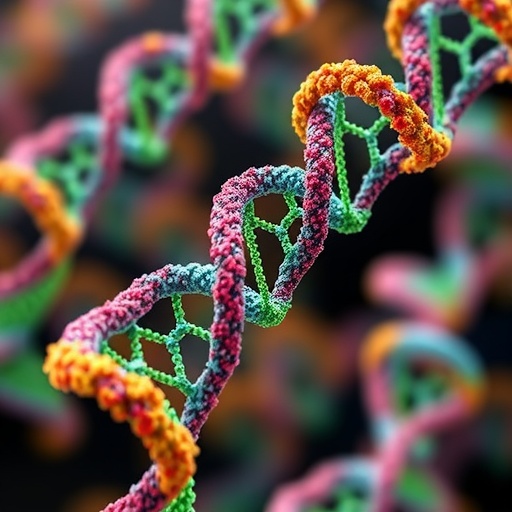
In a groundbreaking leap at the nexus of biotechnology and artificial intelligence, researchers have unveiled a transformative approach for synthesizing DNA sequences on an unprecedented scale. This revolutionary method, detailed in a recent publication in Nature Biotechnology, redefines how generative models can be harnessed not just in silico but materially, at petascale volumes. Bridging computational design and physical manufacturing, the technique embodies a synthesis of machine learning algorithms with innovative biochemical processes—ushering in a new era where designed DNA sequences are produced en masse with precise control and remarkable efficiency.
At its core, the newly introduced approach addresses a longstanding bottleneck in synthetic biology. While generative modeling of DNA, RNA, and protein sequences has advanced immensely, the physical realization of these designs remained prohibitively costly and logistically challenging. Traditional DNA synthesis methods, constrained by their linear, deterministic nature, struggle to scale without astronomical financial and time investments. This breakthrough circumvents these limitations by embedding generative sampling mechanisms directly into wet lab procedures. In doing so, the researchers effectively transpose the stochastic sampling processes of computational models into the biochemical realm through controlled chemical reactions.
Central to the approach is the concept of manufacturing-aware generative modeling. Unlike conventional generative models that operate purely within computational frameworks, these models are cognizant of synthesis constraints and capabilities from the outset. This fusion ensures that the sequences produced not only meet biological criteria for functionality and diversity but are also optimized for manufacturability. By marrying algorithmic sampling with parallelized DNA oligosynthesis, the method realizes magnitudes of throughput—approaching a staggering 10^16 unique DNA sequences synthesized in a single operational timeframe.
The practical validation of this approach was demonstrated through its application to human antibody engineering. Antibodies, with their immense therapeutic potential and structural complexity, represent an ideal proving ground. Generating an expansive library of single-chain variable fragment antibodies (scFvs), the team synthesized variants exhibiting diversity and biological realism equivalent to the outputs of state-of-the-art protein language models. This parity underscores the method’s robustness in maintaining the intricate balance of sequences necessary for functional antibody expression.
Verification of the designed DNA libraries employed high-throughput sequencing techniques, ensuring fidelity between intended generative outputs and empirical realizations. Importantly, the researchers extended their approach beyond synthetic validation. They transfected human cell lines with the synthesized scFv libraries, achieving translation and functional expression. This critical step confirmed that the physical DNA not only faithfully replicated computational designs but also retained biological activity—a testament to the meticulous integration of design and manufacturing parameters.
Perhaps most striking is the subsequent application of these expressed antibodies in multiplexed screens against human leukocyte antigen (HLA)-presented intracellular proteins. This high-throughput screening strategy unveiled potential leads for chimeric antigen receptors (CARs), offering transformative possibilities for immunotherapy. By streamlining the design-to-expression-to-screening pipeline at an industrial scale, the researchers lay the groundwork for accelerated therapeutic discovery and development, shortening timelines that historically span years.
The versatility of the method was further corroborated through its application to other biological targets. Generative models of Taq polymerase and the HLA-presented peptidome were physically instantiated, again achieving petascale DNA synthesis with comparable efficacy. This breadth of applicability indicates that manufacturing-aware generative synthesis is not confined to specific protein classes but can generalize across diverse biomolecular families, signaling broad implications for synthetic biology, diagnostics, and beyond.
Underpinning this revolution is a sophisticated interplay between computational and chemical engineering disciplines. The generative model’s stochastic sampling algorithms are emulated in the lab by precisely tuned chemical reactions during oligonucleotide synthesis. Instead of sequential, deterministic DNA strand construction, this methodology introduces controlled stochasticity that mirrors the probabilistic nature of computational models. This innovation enables parallelized synthesis pathways that dramatically accelerate throughput while maintaining sequence diversity and design fidelity.
Such a paradigm shift has profound implications for the future of biomolecular design. By physically embodying generative models, researchers no longer remain confined to digital sequence libraries but can access vast, tangible molecular libraries for experimental interrogation. This capability transforms exploratory biology, permitting rapid hypothesis testing and iterative optimization in physical systems, which is critical for discovering novel therapeutics and understanding complex biomolecular interactions.
Moreover, this approach aligns seamlessly with advancements in high-throughput sequencing and screening technologies, forming an integrated ecosystem for synthetic biology. Large-scale sequencing validates the integrity of vast DNA libraries while multiplexed protein binding assays and functional screens elucidate biological relevance. This interconnected pipeline accelerates the transition from computational models to real-world applications, enhancing reproducibility and expanding the design space for synthetic biomolecules.
From a commercial perspective, manufacturing-aware generative DNA synthesis promises to reduce costs, timeframes, and resource burdens traditionally associated with large-scale DNA library production. Companies engaged in antibody discovery, vaccine development, and enzyme engineering stand to benefit immensely from this innovation. By enabling massive sequence diversities within a single synthesis batch, the method facilitates the rapid identification of lead candidates, expediting drug development cycles and personalized medicine initiatives.
The futuristic vision encapsulated by this technology also hints at potential integration with automated laboratory workflows and robotic synthesis platforms. Such synergies could lead to fully autonomous design-build-test cycles for biomolecules, ushering in a new paradigm of synthetic biology research empowered by artificial intelligence and molecular manufacturing capabilities.
Despite these dramatic advances, the method acknowledges inherent complexities in translating in silico models to biochemical reality. Ensuring synthesis fidelity, managing stochastic variability, and optimizing reaction conditions require tightly coupled interdisciplinary expertise. Continuous refinements in oligosynthesis chemistry, error correction protocols, and model calibration will be essential to fully realize the potential of manufacturing-aware generative synthesis on an even grander scale.
Looking forward, the field stands poised at the confluence of computational creativity and synthetic feasibility. By physically embedding machine learning models within chemical manufacturing pipelines, researchers have not only amplified the scale of DNA design synthesis but have also redefined the ethos of bioengineering. This pioneering work heralds a future where petascale libraries of designed biomolecules are routinely generated, validated, and harnessed for scientific and therapeutic breakthroughs, fundamentally reshaping our approach to biomolecular innovation.
In sum, this landmark study exemplifies the power of synthesis-aware generative modeling, vindicating a vision where complex biomolecular landscapes are not merely imagined but physically instantiated at scales previously thought unattainable. The amalgamation of AI-driven design and precision biochemical synthesis sets a new standard, transforming conceptual possibility into experimental reality and accelerating the pace at which biology can be engineered for humanity’s benefit.
Subject of Research: Generative modeling and large-scale DNA synthesis integrating machine learning with biochemical manufacturing.
Article Title: Manufacturing-aware generative models enable petascale synthesis of designed DNA.
Article References:
Weinstein, E.N., Gollub, M.G., Slabodkin, A. et al. Manufacturing-aware generative models enable petascale synthesis of designed DNA. Nat Biotechnol (2026). https://doi.org/10.1038/s41587-026-03020-8
Image Credits: AI Generated
DOI: https://doi.org/10.1038/s41587-026-03020-8
Tags: AI-driven gene synthesis methodsbiochemical process innovationcomputational design in synthetic biologygenerative models for DNA synthesishigh-throughput DNA manufacturingintegration of AI and wet lab techniquesmachine learning in biotechnologymanufacturing-aware generative modelingpetascale DNA synthesis technologyscalable DNA sequence productionstochastic sampling in biochemistrysynthetic biology advancements