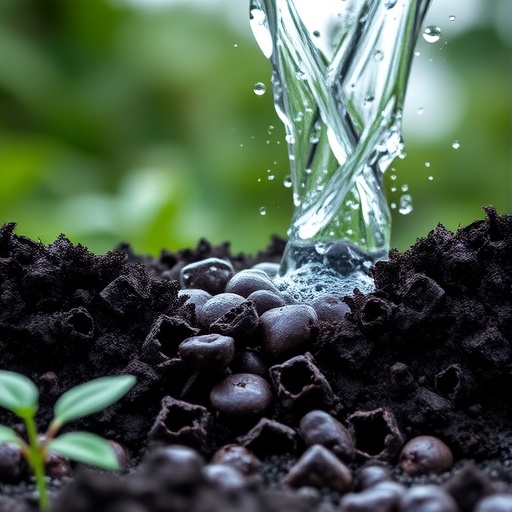
A groundbreaking study has unveiled a transformative approach to converting agricultural and industrial waste into advanced porous carbon materials, known as morph-genetic porous carbon, with remarkable implications for soil and water conservation. Published in the esteemed journal Biochar, this pioneering research combines the realms of materials science and game theory, offering a novel systematic framework for identifying and prioritizing high-performance biochar variants tailored for environmental sustainability.
As global industrialization and urban expansion accelerate, the generation of agricultural and industrial residues has surged exponentially, presenting immense waste management challenges. Concurrently, soil degradation and erosion threaten agricultural productivity and water security worldwide. Against this backdrop, the valorization of waste into functional biochar products emerges as a compelling strategy to mitigate environmental degradation while enhancing resource utilization.
The innovative research undertook comprehensive experimentation using eight diverse biomass waste feedstocks: rice straw, vineyard pruning residues, palm pruning residues, sawdust, vinasse derived from sugarcane processing, poultry slaughterhouse waste, paper mill byproducts, and tissue paper manufacturing waste. Through controlled pyrolysis in oxygen-limited environments, these raw materials were thermally decomposed to generate biochar, which subsequently underwent activation procedures at elevated temperatures to develop highly porous carbon structures.
Distinctively, the biochars produced demonstrated a highly engineered pore architecture coupled with extensive specific surface areas, characteristics central to enhanced adsorptive capacity. These engineered features enable morph-genetic porous carbon to more effectively retain water molecules, nutrients, and adsorb harmful pollutants compared to conventional biochar materials. Such properties position these materials as potent candidates for improving soil matrix structure and facilitating water conservation under diverse agro-environmental conditions.
To rigorously assess performance, the research team synthesized a comprehensive library of 64 porous carbon samples, deploying Brunauer–Emmett–Teller (BET) surface area analysis to quantify surface attributes critical for adsorptive behavior. The results revealed significant variability rooted in the distinct feedstocks and activation regimes, underscoring the complex interplay between raw material composition and processing parameters in governing final material characteristics.
Breaking new ground, the team incorporated a decision-making paradigm grounded in game theory, specifically utilizing the Condorcet algorithm, which conducts pairwise comparisons across multiple performance parameters. This sophisticated analytic approach weighed twelve pivotal physical metrics, including pore volume, surface area, and pore size distribution, enabling an objective and systematic hierarchy of material efficacy beyond traditional iterative experimental methods.
The integration of game-theoretic decision-making marks a paradigm shift in material selection by offering a multi-criteria optimization framework that accounts for competing performance attributes simultaneously. This approach eliminates subjective bias and facilitates the identification of top-performing morph-genetic porous carbons optimized to fulfill multifunctional environmental roles, a crucial advancement for scalable biochar deployment.
Among the evaluated candidates, five morph-genetic porous carbon samples emerged as superior performers, prominently derived from rice straw, sawdust, palm pruning residues, vineyard pruning residues, and tissue paper factory waste. These materials distinguished themselves via exceptional surface areas and pore morphology conducive to maximized adsorption, hydration retention, and pollutant sequestration, aligning perfectly with environmental remediation goals.
From an agronomic perspective, the enhanced pore networks and surface chemistries of these carbons provide expanded reservoirs for soil moisture and vital nutrients, directly influencing soil aggregation, permeability, and resilience against erosion processes. The resultant improvements in soil physicochemical properties promise to bolster crop productivity and water use efficiency, especially in arid and degraded terrains vulnerable to desertification.
Beyond soil amelioration, the research underscores the broader ecological benefits of adopting advanced biochar materials derived from waste streams. By diverting biomass residues from incineration or landfill disposal, the approach effectively reduces greenhouse gas emissions and circumvents environmental pollution, contributing significantly to circular economy principles and sustainable resource management.
The authors advocate for the utilization of their comprehensive framework—merging high-resolution material characterization with rational decision algorithms—as a blueprint for future biochar innovations. This methodology not only accelerates discovery and application but also optimizes resource allocation by prioritizing materials with the highest environmental impact potential, thereby catalyzing advances in climate-smart agriculture and pollution mitigation technologies.
In summation, this study exemplifies the convergence of cutting-edge materials engineering and decision sciences to unlock the immense potential of waste-derived porous carbons. By converting agricultural and industrial byproducts into environmental allies, the research presents a compelling vision for sustainable soil and water stewardship in a rapidly changing ecological landscape, heralding a new era of biochar-based solutions that address multiple global challenges simultaneously.
Subject of Research: Environmental applications of morph-genetic porous carbon derived from agricultural and industrial waste for soil and water conservation.
Article Title: Introducing priority morph-genetic porous carbon for potential applications in soil and water conservation through game theory.
News Publication Date: 2-Mar-2026.
Web References: http://dx.doi.org/10.1007/s42773-025-00505-8
References: Sadeghi, S.H., Zare, S., Gharehmahmudli, S. et al. Introducing priority morph-genetic porous carbon for potential applications in soil and water conservation through game theory. Biochar 8, 35 (2026).
Image Credits: Seyed Hamidreza Sadeghi, Somayeh Zare, Sudabeh Gharehmahmudli, Habibollah Younesi, Fengbao Zhang, Mahboubeh Mirzahosseini, Padideh Sadat Sadeghi, Mehdi Homaee, Yahya Parvizi, Shen Nan & Yao Li.
Keywords
Refuse derived fuels, Civil engineering, Porous materials, Applied sciences and engineering, Environmental remediation
Tags: advanced porous carbon materialsagricultural waste biochar productionbiochar activation techniquesbiochar for soil conservationbiomass waste feedstock utilizationenvironmental sustainability in agriculturehigh-performance biochar variantsindustrial waste valorizationmorph-genetic porous carbonpyrolysis of biomass wastesustainable soil and water managementwaste-to-resource conversion