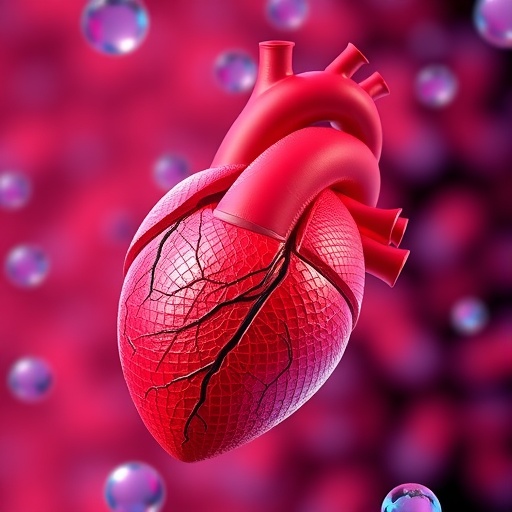
In a groundbreaking advancement poised to redefine cardiac care, researchers at Columbia University have unveiled a novel RNA-based therapy capable of stimulating the heart’s intrinsic ability to heal itself following myocardial infarction. Traditional interventions for heart attacks primarily focus on restoring blood flow to the damaged myocardium; however, they fail to replace the lost cardiac muscle cells, leaving patients vulnerable to chronic heart failure. The newly developed treatment employs self-amplifying RNA to instruct skeletal muscle cells to produce a precursor protein that circulates throughout the body and is selectively activated in the heart to promote regeneration and repair.
The human heart notoriously exhibits a negligible capacity for regeneration, particularly in adults, rendering recovery from cardiac injuries exceedingly limited. Ke Cheng, the Alan L. Kaganov Professor of Biomedical Engineering at Columbia, emphasizes, “The spontaneous regeneration power is very, very limited.” This limitation has driven the pursuit of innovative therapies that go beyond symptomatic treatment to address actual tissue repair. In their recent work published in the journal Science, Cheng and his collaborators have harnessed an elegant biological strategy: mimicking the regenerative mechanisms naturally present in newborn mammals.
During the neonatal period, mammalian hearts possess a remarkable capacity to recover from injury, a phenomenon attributed in part to elevated expression of the gene encoding atrial natriuretic peptide (ANP). ANP modulates multiple pathways crucial to repair processes such as angiogenesis, inflammation resolution, and fibrosis suppression. In adult hearts, however, ANP levels surge to a significantly lesser extent following injury, correlating with diminished regenerative outcomes. The Columbia team experimentally demonstrated that blocking the Nppa gene, which encodes pro-ANP, in neonatal mice abrogated their hearts’ ability to heal, thereby affirming this pathway’s central role.
The therapeutic challenge, historically, has been the delivery and stability of ANP in vivo. ANP and its precursors degrade rapidly in circulation, precluding effective pharmacological application using traditional approaches. Existing cardiac drug delivery systems frequently necessitate invasive procedures, including direct myocardial or pericardial injections and intracoronary infusions, which are not only risky but also limit widespread clinical adoption. Addressing these challenges, the Columbia researchers conceptualized an innovative approach that transforms skeletal muscle into a bioreactor for pro-ANP production, exploiting natural enzymatic mechanisms localized to the heart.
The cornerstone of this approach involves the use of RNA-lipid nanoparticles engineered to encode the Nppa gene. Upon intramuscular injection into peripheral muscles such as the thigh or arm, these nanoparticles transfect muscle cells, prompting them to manufacture pro-ANP, an inactive precursor that is stable within the bloodstream. Circulating pro-ANP is then selectively activated in the myocardium by the enzyme Corin, which is highly enriched in cardiac tissue relative to other organs. This enzymatic specificity ensures targeted delivery of active ANP to the heart without the need for invasive cardiac interventions.
One of the most remarkable features of this RNA therapeutic is its self-amplifying property. The self-amplifying RNA (saRNA) construct can replicate within transfected muscle cells, markedly extending the duration of therapeutic protein production after a single injection. Experimental models demonstrated that pro-ANP synthesis persisted for at least four weeks post-dose, a duration that could translate into monthly administrations for patients. This sustained effect contrasts with conventional drugs that require frequent dosing due to rapid metabolism or clearance.
Preclinical evaluation of this methodology encompassed a robust series of experiments involving multiple animal models, including large mammals and mice with complex comorbidities such as atherosclerosis and type 2 diabetes. This comprehensive testing framework underscored the therapy’s efficacy across diverse pathological states and age groups, significantly enhancing its translational potential. Of particular clinical relevance, delayed administration—given one week post-infarction when myocardial damage is already established—still conferred substantial cardiac repair, expanding the window of opportunity for treatment.
The implications of this technology extend beyond myocardial infarction. By tailoring saRNA constructs to encode different therapeutic proteins, the platform holds promise for other debilitating conditions characterized by organ damage, including chronic kidney disease, hypertension, and pregnancy-related disorders such as preeclampsia. This paradigm, wherein peripheral skeletal muscle generates a systemically circulating prodrug activated selectively at the disease site, represents a versatile and minimally invasive approach to organ-targeted therapy.
Clinicians, including co-author Torsten Vahl of Columbia University Irving Medical Center, recognize the transformative potential of a therapy that can be administered via simple injection, obviating the need for catheter-based interventions. The possibility of reducing post-infarction scarring and preserving cardiac function through such a straightforward delivery route could revolutionize standard care and improve outcomes for millions of patients worldwide.
Looking forward, the team aims to leverage Columbia’s advanced cell engineering facilities to produce clinical-grade RNA therapeutics and initiate phase-one safety trials at the adjacent medical center. The integrated research and clinical infrastructure uniquely position Columbia University to expedite the translation of this promising research into tangible clinical benefit.
This innovative RNA delivery strategy not only provides a new avenue for cardiac regeneration but also exemplifies how molecular engineering and an understanding of developmental biology can converge to architect next-generation therapies. The future of medicine may increasingly rely on empowering the body’s own cells to synthesize and regulate therapeutic molecules with unprecedented precision and durability, heralding a new era in regenerative medicine and targeted gene therapy.
Subject of Research: Cardiac regeneration and RNA-based therapy for myocardial infarction
Article Title: Single intramuscular injection of self-amplifying RNA of Nppa to treat myocardial infarction
News Publication Date: 5-Mar-2026
Web References: https://www.science.org/doi/10.1126/science.adu9394
Image Credits: Cheng Lab / Columbia University
Keywords: Cardiology, RNA, Regenerative medicine, Gene therapy, Cardiovascular disease, Targeted drug delivery, Biomedical engineering
Tags: biomedical engineering in cardiologyColumbia University cardiac studiesheart regeneration after myocardial infarctionheart tissue regeneration researchinnovative myocardial infarction treatmentsintrinsic heart repair mechanismsneonatal heart regeneration modelsregenerative medicine for heart failureRNA therapy for heart muscle repairRNA-based cardiac therapyself-amplifying RNA treatmentskeletal muscle cell protein production