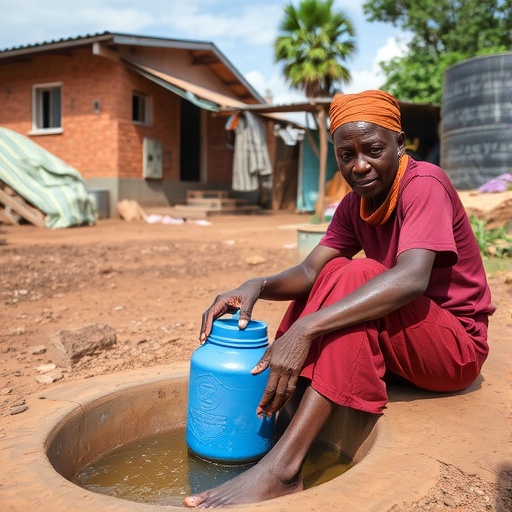
In an era marked by escalating concerns over water scarcity and sustainable resource management, the intricate dynamics that govern household water use have emerged as a critical frontier for scientific inquiry. A groundbreaking study conducted by Oyelami, Ogunbode, and Owoeye offers unprecedented insights into the determinants influencing water consumption behaviors in the Oyo Zone of Oyo State, Nigeria. This research, recently published in Scientific Reports, elucidates the multifaceted factors shaping water use patterns at the household level, shedding light on socio-economic, infrastructural, and environmental variables that have far-reaching implications for regional and global water sustainability.
Household water use constitutes a significant portion of total water consumption in many developing regions, and understanding its underlying drivers is crucial for effective water management policies. The Oyo Zone presents a compelling case study due to its heterogeneous demographic composition and varying degrees of urbanization across its Local Government Areas (LGAs). By deploying a comprehensive mixed-methods approach, the researchers meticulously analyzed water use determinants, capturing a nuanced depiction of everyday water utilization amid diverse living conditions.
Integral to the study was the identification of socio-economic factors that decisively influence water consumption rates. Income levels, educational attainment, and household size emerged as pivotal variables. Households with higher income generally demonstrated increased water use, attributable to the availability of modern appliances and sanitation facilities. Conversely, lower-income homes resorted to rationing strategies, reflecting constraints in both access and affordability. The correlation between education and water use further underscored cognitive and behavioral dimensions that mediate consumption patterns, emphasizing the role of awareness in conservation efforts.
Infrastructure availability and quality constitute another core determinant explored in this research. The study detected stark disparities in water supply systems both within and between LGAs. Urbanized areas benefited from relatively reliable pipe-borne water supplies, while rural communities depended heavily on boreholes, wells, or communal water points. The physical state and reliability of these infrastructures directly influenced consumption behaviors, with intermittent supply prompting households to adopt water storage practices or alternative sources, often at increased economic and health costs.
Environmental factors were also rigorously examined, revealing that climatic variability and seasonal fluctuations in rainfall notably affect water availability and use. The Oyo Zone experiences distinct wet and dry seasons, driving cyclic changes in water demand and access. During dry spells, reliance on less sustainable or contaminated sources tends to surge, exacerbating health risks and resource depletion. The interplay between environmental stressors and socio-economic conditions thus frames a complex adaptive landscape for household water management.
Policy implications derived from the study are profound. By mapping water use determinants at granular local levels, the research equips policymakers with data-driven avenues to tailor interventions that address specific community needs. Prioritizing infrastructural upgrades in underserved areas, promoting water-saving technologies, and enhancing public education campaigns emerge as actionable strategies. Moreover, integrating climate resilience into water governance policies could safeguard against the negative effects of environmental variability on household water security.
Beyond local relevance, the findings resonate with global efforts toward Sustainable Development Goal 6, which advocates for universal access to clean water and sanitation. The nuanced understanding of household dynamics presented in the Oyo State study serves as a model for other regions grappling with parallel challenges. By advancing empirical knowledge on consumption determinants, the research underpins the global discourse on equitable and efficient water resource management.
Significantly, the methodology employed by Oyelami and colleagues advances the frontier of interdisciplinary research, combining quantitative surveys, spatial analysis, and qualitative interviews. This holistic approach allows for a multidimensional perspective that transcends traditional water use studies confined to technical metrics alone. By integrating human behavioral insights with infrastructural and ecological data, the research captures the complexity inherent in water use decision-making processes.
The study also highlights the emerging role of digital technologies in monitoring and managing household water consumption. While the Oyo Zone is in the early stages of adopting smart water meters and data analytics, the research anticipates these tools as transformative in enhancing predictive capabilities and consumption feedback mechanisms. Future research trajectories may focus on leveraging Internet of Things (IoT) devices to optimize water distribution and incentivize conservation through real-time user engagement.
Health outcomes linked to water use patterns constitute another critical dimension explored. The research underscores the vulnerability of communities dependent on unimproved water sources to waterborne diseases. By delineating the factors contributing to inadequate water provision, the study advocates for integrated health and water policies that prioritize safe, sustainable access as a fundamental public health measure. This aligns with global commitments to reduce morbidity and mortality from water-related illnesses.
Furthermore, gender dynamics emerged tacitly within the research, recognizing that women often bear primary responsibility for water collection and use. Though not explicitly detailed, these social roles influence water use timing, quantity, and efficiency. Gender-sensitive approaches to water management could therefore amplify the effectiveness of intervention programs by addressing differential impacts and empowering marginalized groups within households.
Economic analyses beyond income levels were hinted at, with cost-benefit considerations of water sources influencing household choices. The trade-offs between water quality, accessibility, and expenditure suggest that financial mechanisms such as subsidies or tariffs can shape user behaviors. Strategically designed incentive schemes could encourage sustainable consumption without compromising affordability, especially for vulnerable populations.
Environmental sustainability also weaves through the study’s undercurrents, recognizing that household water use is both influenced by and contributory to broader ecosystem health. Groundwater depletion, surface water pollution, and biodiversity loss linked to water extraction represent systemic risks. This research adds to the growing evidence advocating for integrated water resource management frameworks that balance human needs with ecological preservation.
Community engagement and participatory governance were implicitly valorized as essential for successful water management policies. The researchers noted that local knowledge and social capital significantly impact water use practices and acceptance of technocratic solutions. Embedding community voices into planning and decision-making may foster more resilient and contextually appropriate water governance models.
In sum, the study authored by Oyelami, Ogunbode, and Owoeye transcends traditional water use research by providing a comprehensive, data-rich exploration of household water use determinants within a dynamically changing socio-environmental setting. It offers a blueprint for multidisciplinary inquiry and policy innovation, articulating the imperative for sustainable, equitable water access as foundational to human well-being and environmental stewardship. As global water challenges intensify, such localized, detailed analyses are indispensable to crafting solutions that are both effective and inclusive.
Subject of Research: Dynamics of household water use determinants in selected Local Government Areas in Oyo Zone of Oyo State, Nigeria.
Article Title: Dynamics of household water use determinants in selected Local Government Areas in Oyo Zone of Oyo State Nigeria.
Article References:
Oyelami, A.A., Ogunbode, T.O. & Owoeye, M.O. Dynamics of household water use determinants in selected Local Government Areas in Oyo Zone of Oyo State Nigeria. Sci Rep (2026). https://doi.org/10.1038/s41598-025-33339-2
Image Credits: AI Generated
Tags: demographic factors in water useenvironmental influences on water consumptionhousehold water demand determinantshousehold water use driversinfrastructure and water use patternsmixed-methods water use studysocio-economic factors affecting water usesustainable water management in Oyo Zoneurbanization impact on water consumptionwater consumption behavior in Nigeriawater scarcity in developing regionswater sustainability policies Nigeria