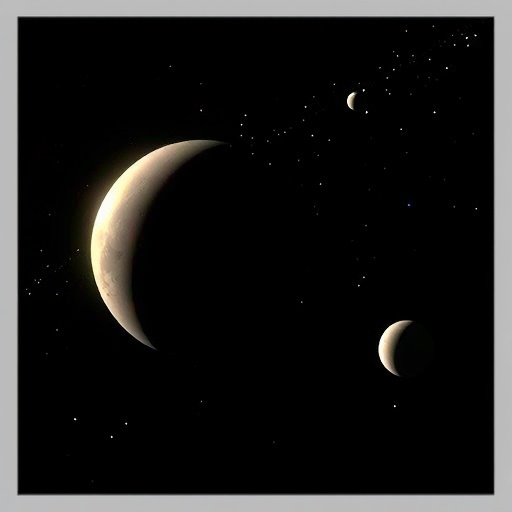
In a groundbreaking development that challenges traditional notions about the prerequisites for life, researchers from the Excellence Cluster ORIGINS at LMU and the Max Planck Institute for Extraterrestrial Physics (MPE) have unveiled compelling evidence suggesting that exomoons orbiting free-floating planets may sustain habitable environments far removed from any stellar illumination. These distant moons could preserve liquid water oceans for periods extending up to 4.3 billion years, predominantly through dense hydrogen atmospheres coupled with tidal heating mechanisms. This revelation not only extends the temporal window nearly equivalent to Earth’s own evolutionary history but also broadens the realm of potentially life-supporting environments to the cold, starless expanses of interstellar space.
The genesis of free-floating planets (FFPs), sometimes referred to as ‘rogue’ or ‘nomadic’ planets, arises from the turbulent dynamics during planetary system formation. Gravitational perturbations within nascent star systems frequently compel planets into trajectories that eject them into the galactic void, severing them from their parent stars. Contrary to earlier assumptions that moons might be lost during such violent expulsions, recent theoretical studies led by LMU physicist Dr. Giulia Roccetti reveal a resilience among moons to remain gravitationally bound to their host planets despite these cataclysmic events. The survival of these satellite worlds maintains the possibility of environments where life could persist independently of stellar warmth.
Crucially, the orbits of these retained moons are highly eccentric as a consequence of the destabilizing ejection event. Such elongated elliptical orbits instigate cyclical variations in distance between the moon and its planet, giving rise to substantial tidal forces. These gravitational interactions cyclically deform and compress the lunar interior, generating frictional heat through tidal flexing. This process, known as tidal heating, has been evidenced within our solar system—most notably on moons like Io and Europa—and is hypothesized to be sufficient to maintain subsurface or surface liquid water reservoirs on exomoons even in the absence of solar radiation, thus challenging the paradigm that a star’s energy is an absolute necessity for liquid water.
The retention of heat generated by tidal forces is intricately tied to atmospheric properties. On Earth, carbon dioxide acts as a potent greenhouse gas, trapping infrared radiation and regulating surface temperatures conducive to life. However, in the frigid conditions characteristic of space-drifting planetary systems, carbon dioxide is prone to condensing and precipitating out of the atmosphere, diminishing its greenhouse capacity and enabling thermal energy to escape into space. This limitation necessitates alternative atmospheric compositions capable of sustaining surface warmth on these moons over geological timescales.
Investigations into hydrogen-dominated atmospheres present a compelling alternative. Although molecular hydrogen (H2) is largely transparent to infrared radiation under standard conditions, unique physical phenomena emerge at high pressures. Notably, collision-induced absorption (CIA) occurs when hydrogen molecules transiently collide and form temporary complexes, which can absorb infrared radiation significantly. This mechanism confers hydrogen atmospheres with an unexpected capacity to trap heat, creating stable, insulating blankets that prevent thermal energy loss despite the absence of a proximate star. Moreover, hydrogen’s chemical stability at extremely low temperatures sustains the integrity of the atmosphere, ensuring prolonged habitable conditions.
The implications of this research extend beyond exomoon habitability to broader astrobiological discourse, particularly in relation to early Earth’s environment and the origin of life. Collaborations with Professor Dieter Braun’s team highlighted a fascinating parallel: Earth’s primordial environment may have experienced similarly high hydrogen concentrations, potentially introduced via asteroid impacts. These conditions possibly fostered prebiotic chemical pathways that paved the way for life’s emergence. In this light, free-floating exomoons encapsulate natural laboratories where analogous physicochemical processes might unfold, independent of stellar contributions.
Moreover, the cyclic tidal deformation of these moons easily generates local wet-dry cycles due to periodic stresses and heat flux variations. Such cycles are regarded as critical in the synthesis of complex organic molecules, promoting the congregation and rearrangement of chemical constituents essential for life’s chemistry. The evaporation and re-condensation cycles engendered by tidal forces could facilitate polymerization and other chemical reactions that drive complexity, placing these exomoons as promising candidates for environments conducive to the genesis of life.
Extensive modeling within this new framework suggests that the habitable phase on these moons can span up to 4.3 billion years, a duration long enough not only for simple life to survive but also for the potential evolution of complex biological systems. This longevity dramatically outpaces previous estimates focused on carbon dioxide-dominated atmospheres, where habitability was limited to around 1.6 billion years due to atmospheric condensation and resultant cooling.
The possibility that free-floating planets and their moons are prevalent in the Milky Way further amplifies the significance of these findings. Current astronomical surveys estimate the number of such rogue planets to be on par with, or even exceeding, the number of stars in our galaxy. This places a vast population of potential habitable environments scattered through the interstellar medium, invisible to traditional methods that focus on suns and their proximity zones.
This paradigm-shifting study compels the scientific community to reconsider the breadth of the habitable zone, traditionally defined by the distance from a host star where liquid water can persist on a planet’s surface. Instead, it propels a new paradigm where habitability is understood as a product of a complex interplay between internal planetary and satellite processes, atmospheric chemistry, and environmental dynamics, independent of stellar irradiation. Such insights drive home the profound notion that life might emerge and sustain itself under conditions hitherto considered inhospitable.
In essence, these findings illuminate the vast and varied nature of potential life-supporting niches in the cosmos. By elucidating the role of hydrogen atmospheres and tidal heating in sustaining liquid water on exomoons orbiting free-floating planets, the research significantly broadens the cosmic landscape hospitable to life. It also encourages the search for biosignatures beyond conventional habitable zones, encompassing the darkest and coldest recesses of our galaxy.
As the field of exoplanetary science advances, the potential discovery of biosignatures or prebiotic chemistry on such moons could revolutionize our understanding of life’s ubiquity and resilience. Upcoming observational platforms and missions may one day detect atmospheric compositions or tidal heating signatures indicative of habitability on free-floating planet-exomoon systems, ushering in a new era of astrobiological exploration.
The continued interdisciplinary collaboration between astrophysicists, biophysicists, and astrochemists underscores the importance of integrating physical, chemical, and biological perspectives to unravel the complex conditions underlying habitability. This research, published in the Monthly Notices of the Royal Astronomical Society, stands as a testament to the innovative approaches redefining our cosmic boundaries and invites profound questions about life’s potential habitats throughout the Milky Way and beyond.
Subject of Research:
Habitability conditions of exomoons orbiting free-floating planets supported by tidal heating and hydrogen-dominated atmospheres.
Article Title:
Habitability of Tidally Heated H2-Dominated Exomoons around Free-Floating Planets
News Publication Date:
24-Feb-2026
Web References:
http://dx.doi.org/10.1093/mnras/stag243
Keywords
Exomoons, Free-floating planets, Tidal heating, Hydrogen atmosphere, Habitability, Interstellar space, Liquid water, Collision-induced absorption, Astrobiology, Origin of life, Prebiotic chemistry, Rogue planets
Tags: dense hydrogen atmospheresexomoon evolutionary historyexomoons habitable conditionsfree-floating planets habitabilitygravitational perturbations in planetary systemsinterstellar space life potentiallife-supporting environments beyond starsliquid water oceans on exomoonsmoons orbiting nomadic planetsplanetary system formation dynamicsrogue planet satellite survivaltidal heating on moons