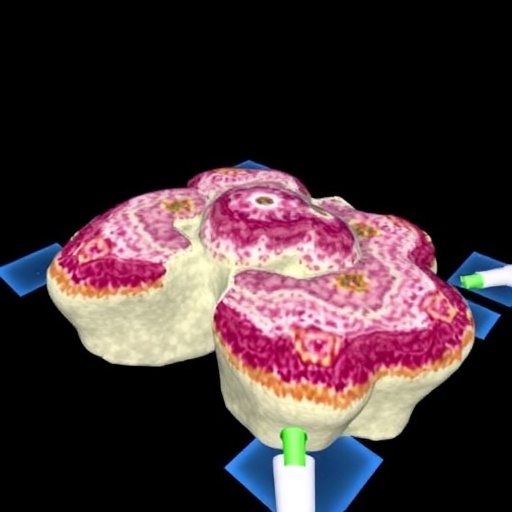
In the rapidly evolving field of biomedical imaging, a groundbreaking approach has emerged that promises to revolutionize how researchers interact with complex histological data. The recent study by Liimatainen, Latonen, and Ruusuvuori introduces SparStVR, a novel platform designed for exploring sparse three-dimensional (3D) histology datasets within an immersive virtual reality (VR) environment. This innovative technology leverages the synergy between advanced imaging techniques and immersive visualization, offering unprecedented opportunities to decipher the intricate microarchitecture of biological tissues.
Histology, the microscopic study of tissue architecture, has traditionally relied on two-dimensional (2D) slide analysis. While this approach has yielded invaluable insights, it inherently obscures the three-dimensional spatial relationships vital to understanding biological systems at a cellular level. The advent of 3D histology seeks to overcome these limitations but often grapples with challenges such as voluminous data, sparse sampling, and computational complexity. SparStVR directly addresses these issues by integrating data sparsity with immersive analytics, enabling researchers to navigate and interpret complex tissue structures that have previously been difficult to visualize comprehensively.
What sets SparStVR apart is its core emphasis on sparse data representation. Unlike dense volumetric datasets that require extensive imaging and storage capacity, sparse data acquisition allows for the capture of critical histological features with significantly reduced sampling. However, sparse datasets traditionally pose challenges for conventional visualization due to incomplete data points and potential information loss. SparStVR employs sophisticated interpolation algorithms and machine learning-driven reconstruction techniques to fill in the gaps, effectively synthesizing a coherent 3D tissue model that maintains the biological fidelity necessary for accurate analysis.
The virtual reality component of SparStVR ushers in a new paradigm of scientific exploration. By donning VR headsets, researchers can immerse themselves within the reconstructed tissue environment, manipulating and examining microscopic structures with intuitive gestures and natural spatial interactions. This immersion transcends the confines of flat-screen visualization, providing a more instinctive understanding of complex anatomical features such as cellular layering, vascular networks, and pathological abnormalities, which are often lost or misinterpreted in 2D projections.
Fundamentally, SparStVR integrates cutting-edge computer vision and graphics processing capabilities. Real-time rendering within the VR platform ensures smooth navigation even with large-scale histological datasets, capitalizing on GPU acceleration to maintain frame rates that minimize user discomfort and sea sickness — common challenges in VR applications. Moreover, the platform offers configurable visualization parameters, enabling users to tailor contrast, color mapping, and transparency settings to highlight specific tissue components such as nuclei, membranes, or extracellular matrix compositions.
One noteworthy aspect of this platform is its potential impact on pathological diagnostics and translational medicine. Conventional histological examinations require extensive manual labor and sometimes subjective interpretation by trained pathologists. SparStVR’s immersive environment facilitates collaborative analysis, where multiple experts can simultaneously inspect volumetric data, discuss observations in situ, and annotate regions of interest in real-time. This collaborative potential not only speeds up data interpretation but also fosters consensus-building and cross-disciplinary communication.
In addition to clinical applications, SparStVR has profound implications for basic biomedical research. Tissue morphogenesis, cancer metastasis, and neuroanatomy studies stand to benefit immensely from the ability to probe spatial dynamics in an interactive 3D framework. The platform’s sparse data advantage further reduces barriers regarding data acquisition times and computational loads, making high-resolution 3D histological studies more accessible to laboratories lacking extensive imaging infrastructures.
The developers of SparStVR have also prioritized interoperability and scalability. The system supports standard histological data formats and can integrate datasets from various imaging modalities, including confocal microscopy, optical coherence tomography, and micro-CT scans. This flexibility ensures that SparStVR can evolve alongside imaging technology innovations, maintaining relevance and compatibility as new methodologies emerge.
Importantly, SparStVR incorporates a user-friendly interface designed to accommodate both seasoned histologists and newcomers to VR technologies. Carefully designed workflows guide users through data loading, preprocessing, interaction, and analysis phases, minimizing the learning curve inherent in adopting new software tools. This inclusivity broadens the potential user base, spanning academic institutions, industry laboratories, and clinical settings.
The implications of this technology extend beyond visualization; it offers a new dimension in data exploration that can expedite hypothesis generation and experimental design. By interactively examining tissue architecture, researchers can detect subtle patterns and anomalies that may not be apparent through automated algorithms or static images. This qualitative insight complements quantitative metrics, enriching the analytical repertoire available to the biomedical community.
SparStVR’s potential for educational applications is equally compelling. Virtual dissection of tissue volumes allows students to experience histological structures in their authentic spatial context, fostering deeper understanding and retention. This immersive education can bridge gaps between textbook knowledge and real-world biological complexity, enhancing training for future generations of biomedical scientists and clinicians.
From a technical perspective, the development of SparStVR required overcoming significant challenges in data integration, real-time rendering, and user interface design. The team leveraged state-of-the-art volumetric compression techniques to handle sparse data efficiently without compromising spatial accuracy. Furthermore, they implemented adaptive sampling strategies that prioritize critical structural regions, optimizing computational resources during visualization.
In terms of future directions, the authors envision expanding SparStVR’s capabilities to include automated feature recognition powered by artificial intelligence. Such integration would enable the system to highlight pathological markers or morphological deviations autonomously, providing decision-support tools for researchers and healthcare providers alike. Additionally, there is potential for remote collaborative environments, allowing geographically dispersed teams to co-analyze data within shared virtual spaces.
The publication of SparStVR in Communications Engineering signifies a milestone in visiting sparse histology data, accentuating the intersection of engineering, computer science, and biology. As biomedical datasets grow in complexity and scale, tools like SparStVR will increasingly become indispensable for unlocking the secrets embedded within biological tissues.
In summary, SparStVR embodies a leap forward in histological visualization by bridging the gap between sparse 3D data acquisition and immersive virtual reality exploration. Its capacity to transform how scientists view, interpret, and interact with tissue microstructures sets a new standard for the integration of cutting-edge technology into biological research. As this platform gains adoption, it promises to accelerate discoveries and enhance understanding in diverse fields such as pathology, oncology, developmental biology, and neuroscience.
With this pioneering work, Liimatainen, Latonen, and Ruusuvuori have not only provided a powerful tool but have also charted a visionary course for future technological advancements that combine data sparsity, immersive visualization, and intelligent analysis to unravel biological complexity.
Subject of Research:
Exploration and visualization of sparse 3D histology data using virtual reality technologies to enhance biomedical imaging analysis.
Article Title:
SparStVR – exploring sparse 3D histology data in virtual reality
Article References:
Liimatainen, K., Latonen, L. & Ruusuvuori, P. SparStVR – exploring sparse 3D histology data in virtual reality. Commun Eng (2026). https://doi.org/10.1038/s44172-026-00634-3
Image Credits: AI Generated
Tags: 3D tissue microarchitecture analysisadvanced biomedical imaging techniquescomputational challenges in 3D histologyimmersive analytics for histological dataimmersive virtual reality histologyinteractive 3D histology explorationnovel platforms for tissue architecture studysparse 3D histology visualizationsparse data representation in histologysparse volumetric data visualizationvirtual reality for biomedical imagingvirtual reality for sparse sampling data