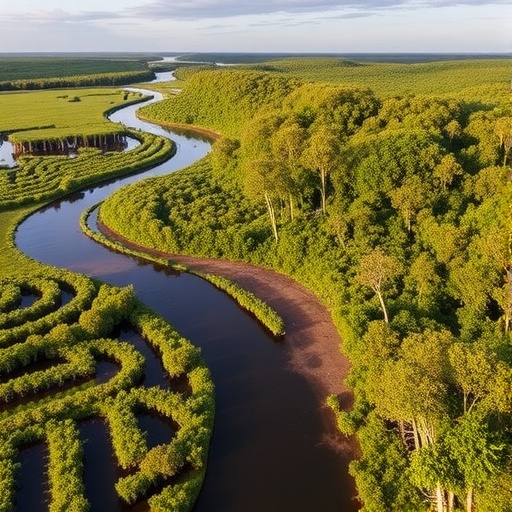
Beneath the sprawling greenery of the Amazon rainforest lies an often-overlooked reservoir of carbon, not within towering trees or deep jungle soils, but in the grassy savannas of Brazil’s vast Cerrado biome. Contrary to popular belief that tropical forests dominate carbon storage, recent groundbreaking research has revealed that the wetlands of the Cerrado — particularly the groundwater-fed veredas and campos úmidos — harbor immense quantities of organic carbon within their peaty soils. This revelation challenges long-held assumptions and highlights a crucial, yet neglected, ecosystem in the global carbon cycle.
The recent comprehensive study, spearheaded by Larissa Verona, a technician at the Cary Institute of Ecosystem Studies and former researcher at Universidade Estadual de Campinas (UNICAMP), offers the first meticulous appraisal of carbon stocks in these unique Cerrado wetlands. These wetlands are characterized by their saturated, oxygen-poor peat soils where plant material decomposes slowly, allowing carbon accumulation over millennia. Using deep soil coring techniques extending to four meters, Verona and her team quantified an extraordinary average of 1,200 metric tons of carbon per hectare in these soils. This value eclipses typical carbon densities in Amazonian biomass by nearly sixfold and points to the Cerrado’s significant yet under-recognized role in carbon sequestration.
Compounding the importance of this discovery, the team employed advanced remote sensing technologies and machine learning algorithms to map the extensive distribution of these peat-rich wetlands across the Cerrado. The modeling revealed a considerable expanse covering approximately 16.7 million hectares, which is about six times larger than previous estimates. This area represents roughly 8% of the Cerrado biome and 2% of the national territory of Brazil, suggesting that these wetlands potentially store carbon equivalent to 20% of that found in Amazonian vegetation. Such a vast, fragmented yet carbon-dense landscape underscores the challenges and opportunities for conservation and climate change mitigation.
What makes the carbon stored in the Cerrado particularly remarkable is its age and persistence. Radiocarbon dating conducted by collaborators from the Max Planck Institute for Biogeochemistry in Germany showed that the organic carbon accumulated in these wetlands averages over 11,000 years old, with some carbon deposits dating beyond 20,000 years. This ancient carbon stock illuminates the slow, continuous build-up over thousands of years, and its vulnerability in the face of modern threats is severe. Unlike forest carbon that can be rapidly replenished through regrowth, the loss of this millennia-old peat carbon represents a potentially irreversible source of atmospheric greenhouse gases.
The study’s insights extend to the dynamic carbon fluxes occurring in these wetlands, particularly in the context of seasonal changes. Using a LI-COR Trace Gas Analyzer to measure greenhouse gas emissions, Verona documented how carbon dioxide and methane fluxes vary across wet, dry, and transitional seasons. The findings revealed that approximately 70% of annual soil emissions occur during the dry season when water levels fall and aerobic conditions prevail. This transition accelerates organic matter decomposition, releasing stored carbon back into the atmosphere. Such seasonally-driven emissions pose serious concerns under future climate scenarios where warming and drying trends could exacerbate carbon leakage from these peatlands.
The ecological and hydrological significance of the Cerrado stretches far beyond carbon storage. As home to over 4,000 native plant species and iconic wildlife such as maned wolves and giant anteaters, it holds unparalleled biodiversity. Moreover, it functions as a critical hydrological hub, feeding the headwaters of two-thirds of Brazil’s major waterways, including tributaries of the Amazon River. The waterlogged peat soils play a pivotal role in regulating water flow, storing carbon, and sustaining ecosystems downstream. Disruption to the Cerrado wetlands threatens both carbon stability and water security on a continental scale.
Yet, this invaluable biome faces mounting pressures from anthropogenic activities and climate change. Agricultural expansion, driven by Brazil’s commodity crop production, increasingly encroaches on wetlands, often involving drainage and water extraction, which destabilizes the hydrology essential for peat formation and conservation. These practices reduce soil moisture, promote oxidation of organic matter, and lead to elevated greenhouse gas emissions. Furthermore, increasing frequency and intensity of wildfires, fueled by hotter and drier conditions under climate change, can release vast amounts of stored carbon, converting a natural carbon sink into a potent carbon source.
Verona aptly describes the Cerrado as a “sacrifice biome” — one that suffers collateral damage because Brazil’s conservation priorities have favored protecting the Amazon rainforest while permitting large-scale agricultural conversion within the savanna. This approach overlooks the interconnectedness of Brazilian ecosystems, as degradation of the Cerrado not only compromises its own biodiversity but also jeopardizes the Amazon via altered water cycles. Recognizing the Cerrado’s integral ecological role is crucial for a holistic, sustainable strategy to safeguard South America’s natural heritage and climate resilience.
The urgency of the situation calls for expanded protection and targeted conservation of these wetlands. Although Brazilian regulations afford some legal protections to groundwater-fed wetlands, enforcement and awareness remain inadequate. The team advocates for enhanced mapping, monitoring, and public education to elevate the profile of Cerrado wetlands within climate policy frameworks. Integrating these peatlands into global carbon accounting and nature-based climate solutions could significantly improve conservation outcomes while supporting livelihoods and biodiversity.
This study illustrates the power of interdisciplinary approaches combining ecology, geochemistry, remote sensing, and machine learning to uncover hidden natural assets with profound implications for climate science and environmental management. It also serves as a timely reminder that effective climate mitigation requires diverse ecosystem stewardship, including often-overlooked systems outside traditional forest-centric paradigms. As the world contends with accelerating climate change and ecosystem loss, the Cerrado peatlands emerge as critical battlegrounds in the quest to preserve carbon stores, maintain water cycles, and sustain life.
Larissa Verona and her colleagues’ work shines a spotlight on an ecosystem rich in history, complexity, and potential. The Cerrado’s peatlands represent not only a vast natural archive of carbon and biodiversity but also a fragile frontier demanding urgent scientific attention and conservation action. Protecting these wetlands is essential not only for Brazil but for global climate stability, underscoring the profound interconnectedness of ecosystems in sustaining planetary health.
Subject of Research: Carbon storage, dynamics, and stability in peat and organic soils of Brazil’s Cerrado wetlands.
Article Title: Vast, overlooked peat and organic soils in Brazil’s Cerrado: carbon storage, dynamics, and stability
News Publication Date: 12-Mar-2026
Web References:
New Phytologist Article
Cary Institute of Ecosystem Studies
Image Credits: Photo by Juliana Di Beo, depicting Larissa Verona measuring greenhouse gas emissions from the soil using the LI-COR instrument.
Keywords
Tropical ecosystems, Wetlands, Peat, Carbon cycle, Carbon sinks, Climate change mitigation, Soil carbon
Tags: Brazil Cerrado wetlands carbon storagecarbon density in Cerrado wetlandsCerrado biome carbon sequestrationdeep soil coring carbon measurementecosystem carbon reservoirs Brazilgroundwater-fed wetlands carbonLarissa Verona carbon researchneglected tropical carbon sinksorganic carbon in peat soilspeat soil carbon accumulationtropical savanna peatlandsveredas and campos úmidos carbon stocks