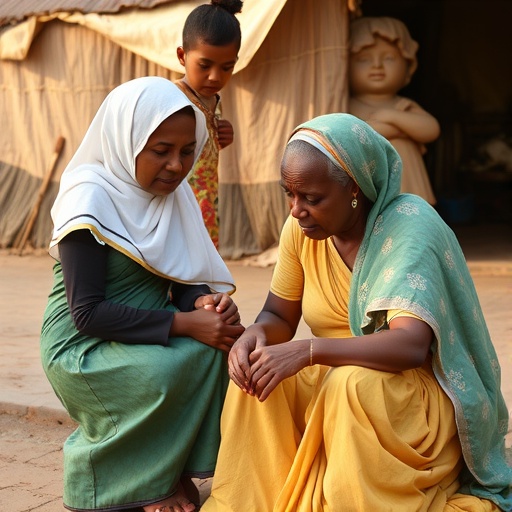
In a groundbreaking study that promises to reshape global public health and social policy, researchers have demonstrated that an intensive, community-wide intervention can reduce the prevalence of child marriage by a staggering 80%. This landmark result emerges from a paired cluster-randomized trial conducted across 18 communities in northern Nigeria, where child marriage rates are notoriously high, with up to 80% of girls marrying before the age of 18. Given the well-documented adverse effects of early marriage—including curtailed educational opportunities, increased health risks, and socio-economic marginalization—this research offers a powerful proof of concept that deeply entrenched social norms can be shifted through carefully designed and locally tailored strategies.
The study centers on Pathways to Choice, a multifaceted “big-push” intervention targeting adolescent girls and their communities. Unlike narrow programs that focus solely on improving educational enrollment or economic incentives, Pathways integrates various elements into a cohesive, community-wide effort aimed not only at girls but also at families, local leaders, and social networks. This holistic approach seeks to dismantle systemic barriers and social expectations that perpetuate early marriage, which has historically been considered an immutable norm in northern Nigeria. The intervention’s broad scope is critical to its effectiveness, enabling sustained attitudinal and behavioral change by reducing the social backlash that often undermines smaller-scale initiatives.
Results from the trial reveal a dramatic reduction in child marriage rates among intervention communities, plummeting from 86% in control groups to just 21% where Pathways was implemented. This remarkable 80% decrease is unprecedented in the literature, where typical anti-child marriage programs yield far more modest gains—often only single-digit percentage reductions. Of particular importance is the finding that while a significant increase in girls’ re-enrollment into school accompanies the intervention’s success, education alone cannot fully explain the steep decline in child marriage. Instead, it is the community-level transformation induced by the intervention that plays a crucial role, creating an environment where delaying marriage becomes not only feasible but socially supported.
The implications of these findings extend beyond northern Nigeria, offering invaluable insights for regions grappling with child marriage worldwide. Early marriage is a global concern, with an estimated 12 million girls marrying before 18 each year, primarily in low- and middle-income countries. The associated risks are extensive, ranging from higher maternal mortality and morbidity to curtailed educational and employment opportunities that suppress women’s economic empowerment. By demonstrating that a comprehensive, culturally sensitive intervention can alter these entrenched behaviors, the study paves the way for scalable, sustainable approaches to ending child marriage globally.
At a technical level, the randomized design of the study ensures a robust evaluation of Pathways to Choice’s efficacy, guarding against confounding factors that often plague observational studies in social behavior. By pairing similar clusters and randomly assigning them to intervention or control conditions, the researchers could isolate the true effect of the community intervention on marriage rates. This rigor adds significant weight to the claim that the intervention itself, rather than extraneous socioeconomic or cultural variables, accounts for the observed outcomes, thereby setting a new standard in intervention research methodology targeting social norms.
The Pathways program itself is a synthesis of evidence-based tactics adapted to the cultural, economic, and social realities of the target communities. It leverages education incentives, health awareness campaigns, community dialogues, empowerment sessions for girls, and engagement with male and female community leaders. Crucially, it addresses the normative environment by altering expectations about appropriate marriageable age, thereby harnessing social influence in favor of postponing marriage. The research suggests that modifying social networks and normative beliefs is key to achieving lasting behavioral change, as resistance and backlash are minimized when whole communities move in a new direction together.
Furthermore, the study underscores the importance of maintaining girls’ educational trajectories as part of delaying marriage. School re-enrollment and retention provide girls with the skills, knowledge, and social capital necessary to assert autonomy over their life choices. Education acts as a protective factor against early marriage by broadening girls’ horizons and creating aspirations beyond early childbearing and domestic roles. However, the research clearly indicates that educational gains must be embedded within larger social change processes to achieve the full impact seen in this trial.
From a public health perspective, reducing child marriage has profound downstream effects on maternal and child health outcomes. Early marriage is linked with early pregnancy, which carries increased risks of complications, maternal mortality, and low birthweight infants. Intervening at the community level to delay marriage effectively decreases these health risks, signaling a potential reduction in the burden on health systems and improvements in population well-being. The intervention’s success in northern Nigeria highlights a viable avenue for health policy integration where education, social norm change, and reproductive health initiatives converge.
This research also challenges some traditional assumptions about the limits of social norm interventions. The magnitude of the effect suggests that with sufficient “push” and comprehensive engagement, even deeply rooted cultural practices mandating early marriage can be substantially modified within a relatively short timeframe. Such transformative change calls for rethinking program funding, design, and implementation strategies toward integrated, community-wide interventions, rather than isolated programs. Moreover, it invites further inquiries into the mechanisms underlying normative shifts and the conditions that accelerate or sustain them over time.
While the immediate outcomes are encouraging, the study’s authors emphasize the necessity of long-term follow-up to assess whether the reductions in child marriage rates persist. Longitudinal data will be essential to evaluate the durability of attitudinal changes and whether subsequent cohorts of girls benefit similarly. There is also interest in exploring whether such reductions lead to measurable improvements in women’s socio-economic status, fertility patterns, and empowerment down the line. This study sets a research agenda that expands beyond impact evaluation to a holistic understanding of social transformation processes.
Despite its strengths, the study notes that replicating Pathways at scale in diverse settings presents challenges. Each community’s cultural landscape requires tailored interventions, suggesting the importance of local stakeholder involvement in program design and adaptation. Furthermore, considerations around funding, government partnerships, and capacity building are critical for sustainable scale-up. Researchers advocate for collaborations between governments, NGOs, and international agencies to leverage resources and expertise needed to broaden Pathways’ reach while maintaining fidelity to its core elements.
In conclusion, this cutting-edge research delivers compelling evidence that an integrated big-push approach can drastically reduce child marriage rates in high-prevalence settings. By tackling the social norm ecosystem holistically and empowering girls educationally and socially, Pathways to Choice charts a path forward for global efforts to protect children’s rights and promote gender equality. The intervention’s success serves as an inspiring model for policymakers, practitioners, and researchers aiming to break cycles of early marriage and unlock opportunities for millions of girls worldwide.
Subject of Research: Child marriage reduction via a comprehensive community intervention in northern Nigeria.
Article Title: “A big-push community intervention reduced rates of child marriage by 80%.”
Article References:
Cohen, I., Abubakar, M. & Perlman, D. A big-push community intervention reduced rates of child marriage by 80%. Nature (2026). https://doi.org/10.1038/s41586-026-10206-2
Image Credits: AI Generated
DOI: https://doi.org/10.1038/s41586-026-10206-2
Tags: adolescent girls empowerment initiativeschild marriage prevention programscluster-randomized trials in public healthcommunity engagement for social changecommunity-wide intervention strategieshealth risks of early marriageholistic approaches to ending child marriageimpacts of child marriage on educationPathways to Choice program evaluationreducing early marriage in Nigeriasocial norm change in child marriagesocio-economic effects of child marriage