In a groundbreaking study published in Nature Neuroscience, researchers have unveiled the profound role that competitive interactions play in shaping the dynamics and computational functions of mammalian brain networks. This research heralds a new understanding of how complex neural systems govern cognitive processes, emphasizing the interplay of competition within the brain’s intricate communication web. The findings challenge existing paradigms and provide a fresh perspective on the neural mechanisms underlying intelligence, adaptability, and potentially various neuropathologies.
The brain, as a highly interconnected network, relies on an exquisite balance of cooperative and competitive interactions among neuronal populations. While synergy among neurons has traditionally been emphasized, this study highlights how rivalry between competing neural circuits is crucial for maintaining dynamic stability and functional complexity. By dissecting these competitive interactions, the scientists demonstrate how such mechanisms contribute not only to the robustness of neural networks but also to their computational capabilities.
At the core of this research is the application of advanced computational modeling combined with empirical data from mammalian brain networks. The authors employ sophisticated network analysis techniques to quantify the relationship between competitive dynamics and network behavior. Their models showcase that when competition is introduced between specific nodes or modules, it distinctly affects the brain’s capacity to process information, adapt to stimuli, and transition between cognitive states.
The study reveals that competitive interactions foster a dynamic modular structure within neuronal networks, enabling the brain to balance integration and segregation optimally. Integration allows different brain regions to work collectively on tasks, while segregation ensures specialized, localized processing. Competitive dynamics appear to fine-tune this delicate balance, facilitating flexible cognitive functions such as attention, working memory, and decision-making.
Importantly, the researchers identify that these competitive interplays are not merely passive but actively shape the trajectory of brain state transitions. As the brain shifts from one cognitive or behavioral state to another, competition among circuits helps streamline these transitions, preventing errant signaling and enhancing the efficiency of neural computations. This improved switching ability likely underpins the brain’s remarkable capacity for adaptability and learning.
Moreover, the study delves into the implications of competitive interactions for the brain’s computational repertoire. By optimizing neural resource allocation, competition enhances specificity in signal processing, thereby reducing noise and improving clarity of neural codes. This mechanism mirrors principles observed in artificial intelligence systems where competitive algorithms boost performance by enforcing selective activation patterns.
The implications extend beyond basic neuroscience. Understanding competitive dynamics in brain networks could provide critical insights into neurological disorders characterized by dysregulated network connectivity, such as schizophrenia, epilepsy, and autism spectrum disorders. Aberrant competitive interactions might result in impaired neural communication and dysfunctional cognitive processing, suggesting new avenues for therapeutic intervention targeting these network dynamics.
From a theoretical standpoint, this work contributes to the evolving framework of network neuroscience by integrating concepts from nonlinear dynamics and game theory into brain modeling. The competitive aspect introduces a layer of complexity that traditional static connectivity maps fail to capture, underscoring the necessity of dynamic network analysis to truly comprehend brain function.
Furthermore, the experimental paradigm employed incorporates state-of-the-art neural recording technologies and multimodal imaging, allowing the researchers to validate their computational predictions against observed mammalian brain activity patterns. This synergy between modeling and empirical data fortifies the study’s conclusions and exemplifies the power of integrative neuroscience approaches.
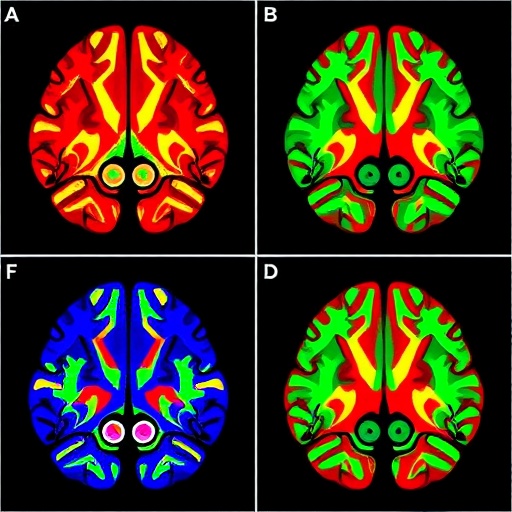
The figure accompanying the publication illustrates the spatial arrangement of neural networks involved in competitive interactions, highlighting core regions where competitive dynamics exert significant influence. Such visualization aids in identifying potential hubs and bottlenecks within the brain that govern these critical competitive processes.
Crucially, the findings also invite a reconsideration of how cognitive tasks are parsed and distributed across the brain. The competitive framework suggests that brain regions vie for dominance dependent on task demands, thus enabling the flexible recruitment of neural ensembles according to situational needs. This sheds light on the neural basis of attentional shifts and prioritization.
Intriguingly, this study opens the door for translational research avenues where artificial neural networks inspired by biological competition might be developed. By embedding competitive modules into machine learning architectures, future computational models could achieve higher degrees of efficiency and adaptability, paralleling the mammalian brain’s prowess in complex problem-solving.
As the field progresses, these insights set a new bar for investigating how neural systems self-organize and maintain homeostasis in the face of constant environmental challenges. Understanding the interplay between competitive and cooperative forces within the brain not only enriches our scientific comprehension but also enhances how we conceptualize human cognition and its disorders.
In conclusion, this landmark research emphasizes the indispensable role of competitive interactions in the architecture and function of mammalian brain networks. It transcends simplistic connectivity analyses, providing a dynamic, nuanced perspective that integrates competition as a fundamental driver of brain complexity and computation, with far-reaching implications spanning neuroscience, medicine, and artificial intelligence.
Subject of Research: Mammalian brain network dynamics and computation shaped by competitive interactions.
Article Title: Competitive interactions shape mammalian brain network dynamics and computation.
Article References:
Luppi, A.I., Sanz Perl, Y., Vohryzek, J. et al. Competitive interactions shape mammalian brain network dynamics and computation. Nat Neurosci (2026). https://doi.org/10.1038/s41593-026-02205-3
Image Credits: AI Generated
DOI: https://doi.org/10.1038/s41593-026-02205-3
Tags: brain network computational capabilitiesbrain network dynamics and competitioncompetitive interactions and neuropathologiescompetitive neural interactions in mammalian brainscomputational modeling of neural circuitsdynamic stability in brain networksinterplay of cooperation and competition in neuronsmammalian brain network behaviornetwork analysis in neuroscienceneural competition and cognitive processesneural mechanisms of intelligencerivalry among neuronal populations