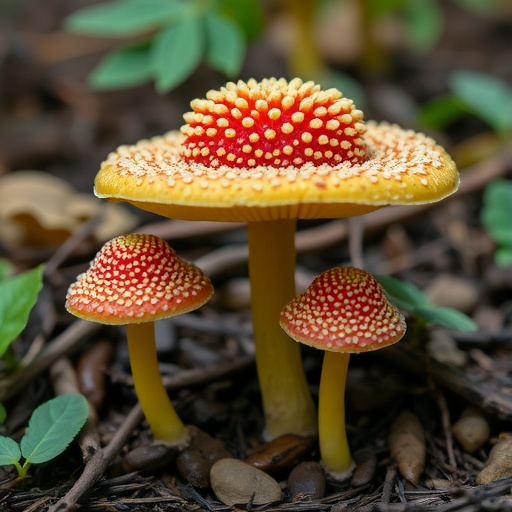
A groundbreaking discovery in mycology has shed new light on the evolutionary trajectory of one of the most widely cultivated and studied psychedelic fungi, Psilocybe cubensis. Researchers from southern Africa and the United States have identified a novel species within the Psilocybe genus—Psilocybe ochraceocentrata—native to the cattle dung-rich grasslands of South Africa and Zimbabwe. This newly described species not only enriches our understanding of fungal biodiversity but also challenges long-held assumptions about the geographic and evolutionary origins of P. cubensis.
For decades, the origin of Psilocybe cubensis has been a topic of intense debate in scientific circles. Traditionally, it was believed that P. cubensis was introduced into the Americas during the Columbian Exchange in the 1500s, hitchhiking with imported cattle from Africa and Europe. This hypothesis was supported by the mushroom’s first formal description in Cuba in the early 20th century. However, the recent identification of P. ochraceocentrata drastically revises this narrative by presenting evidence that these two species diverged approximately 1.5 million years ago, well before historic human-mediated cattle movement.
Psilocybe ochraceocentrata distinguishes itself through a unique ochre-yellow pigmentation concentrated at the center of its mushroom cap, a trait that inspired the species epithet. Despite their morphological similarities to P. cubensis, the two species exhibit distinct genetic profiles, ecological niches, and chemical characteristics. Such differentiation underscores the complex evolutionary dynamics that can result in convergent morphological traits while obscuring deeper genetic divergence, a phenomenon frequently encountered in fungal taxonomy.
The research consortium, composed of mycologists and chemical engineers from institutions including Stellenbosch University, Clark University, University of Utah Health, Duke University, and the Natural History Museum of Zimbabwe, employed an integrative methodological framework. This included multi-locus phylogenetic analyses, molecular clock dating, and ecological niche modeling, facilitated by DNA extracted from both modern collections and historical type specimens. Such a comprehensive approach allowed the team to resolve the phylogenetic relationships with unprecedented precision and to infer temporal divergence events crucial to understanding speciation.
One of the study’s most compelling insights involves the ecological contexts that may have driven the speciation of these fungi. Around 1.5 million years ago, intensifying grassland diversification in South America, coupled with the expansion of grazing herbivores migrating from Africa into Eurasia, created a suite of novel ecological niches. These environmental shifts likely fostered the evolutionary separation of P. cubensis and P. ochraceocentrata, each adapting to the availability of substrates provided by herbivore dung in geographically distinct regions.
This discovery also draws attention to the remarkable fungal diversity in Africa, a continent that remains significantly under-sampled in mycological research. The first specimens of P. ochraceocentrata were collected as early as 2013 in Zimbabwe, yet it took nearly a decade of rigorous genetic and morphological analysis to ascertain the species’ status. This highlights not only the intricacies of fungal systematics but also the urgent need for comprehensive biogeographical surveys to uncover cryptic species and to better understand the global distribution of psychoactive fungi.
Interestingly, P. ochraceocentrata has been unknowingly cultivated worldwide under common strain names like “NSS” (Natal Super Strength) and “Transkei,” prized among cultivators for its potent psychoactive properties and ease of cultivation. This unrecognized domestic presence indicates not only the species’ significance in both natural and anthropogenic settings but also its potential to serve as a genetic resource for psychedelic research and biotechnology.
From a biochemical perspective, the divergence between P. cubensis and P. ochraceocentrata extends to their secondary metabolite profiles. While both species produce psilocybin—a tryptamine compound responsible for psychedelic effects—their differing chemical compositions, potentially including relative concentrations of psilocybin and related alkaloids, may translate into distinct psychoactive experiences or therapeutic potentials. These nuances open new avenues for pharmacological research aimed at harnessing psychedelics for mental health treatment.
The identification of P. ochraceocentrata also challenges the concept of domestication in psychedelic fungi. Unlike many cultivated organisms, “domesticated” P. cubensis is a species with a wild lineage sharing a relatively ancient divergence from its African counterpart. This reframes the domestication process as not merely human-mediated propagation but also as an outcome of deep evolutionary histories that predate human influence, emphasizing the importance of evolutionary biology in understanding cultivated species.
The scientific article presenting these findings was published in the journal Proceedings B of the Royal Society, a leading platform for groundbreaking biological research. The collaborative nature of the study, spanning continents and disciplinary expertise, serves as a model for future integrative research in mycology and evolutionary biology. The implications for biodiversity conservation are profound, advocating for enhanced sampling efforts, especially in underexplored ecosystems like African grasslands.
In conclusion, the discovery of Psilocybe ochraceocentrata not only resolves a long-standing mystery about the origin of widely used psychedelic mushrooms but also underscores the complex interplay between ecology, evolution, and human culture. As research on psychedelics advances in clinical and scientific domains, understanding the full spectrum of genetic and ecological diversity within Psilocybe species will be crucial for safe, sustainable, and efficacious applications. This landmark achievement highlights the untapped potential of fungal biodiversity to reshape scientific paradigms and to inform responsible management of psychoactive organisms.
Subject of Research: The evolutionary origin and phylogenetic distinction of Psilocybe ochraceocentrata as the closest free-living relative of the domesticated psychedelic mushroom Psilocybe cubensis.
Article Title: Discovery of the closest free-living relative of the domesticated ‘magic mushroom’ Psilocybe cubensis in Africa
News Publication Date: 11-Mar-2026
Web References: 10.1098/rspb.2025.2270
Image Credits: Talan Moult
Keywords: Psilocybe ochraceocentrata, Psilocybe cubensis, magic mushrooms, psychedelic fungi, evolutionary biology, mycology, phylogenetics, molecular clock dating, African grasslands, fungal biodiversity, secondary metabolites, psychedelic research
Tags: African grassland fungiAfrican psychedelic fungi speciescattle dung mushroom habitatevolutionary origins of magic mushroomsfungal biodiversity in Africahistorical biogeography of fungimagic mushroom species divergencemycology research South Africaorigin of Psilocybe cubensisPsilocybe cubensis evolutionPsilocybe ochraceocentrata discoverypsychedelic mushroom genetics