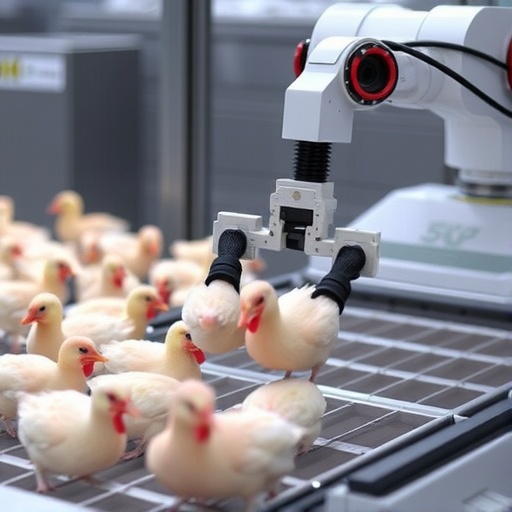
In the realm of agricultural engineering and robotics, a groundbreaking innovation is emerging from the University of Arkansas that promises to revolutionize poultry processing. Amidst the labor shortages exacerbated by the COVID-19 pandemic, a team of engineers and scientists has developed ChicGrasp, an advanced robotic gripping system designed to automate the complex task of handling chicken carcasses. This innovation not only addresses labor challenges but also pushes the boundaries of robotics through the integration of imitation learning and state-of-the-art AI techniques.
ChicGrasp stands apart from traditional robotic grippers by utilizing a dual-jaw configuration with specialized pinchers optimized to grasp chicken legs delicately yet firmly. The system is engineered to lift the carcasses and accurately place them onto shackle conveyors for subsequent processing stages. What makes this advancement particularly extraordinary is the underlying control methodology—an advanced imitation learning algorithm informed directly by human movement trajectories captured via high-fidelity camera systems. This approach mimics human dexterity and adaptability, enabling the robot to interact with the inherently variable and slippery conditions of poultry processing lines.
The core challenge addressed by this technology lies in the unpredictable environment of poultry handling. Unlike rigid, uniform industrial parts, chicken carcasses present a biological complexity with variations in size, leg positioning, and orientation. Conventional robotic solutions, often reliant on scripted motions or mechanical suction, falter under such variability. ChicGrasp’s design philosophy breaks from this mold by integrating a learning-based framework that treats perception, control, and manipulation as interconnected components—enabling dynamic adaptation to real-time scenarios rather than pre-programmed paths.
Central to the robotics control in ChicGrasp is the adoption of a novel imitation learning algorithm known as diffusion policy. Introduced in 2023 by an interdisciplinary team spanning Columbia University, the Toyota Research Institute, and MIT, diffusion policy formulates robotic control as a conditional denoising process. In practical terms, this means the robot incrementally refines its movement predictions based on noisy input data, emulating human-like decision-making under uncertain conditions. This method significantly elevates the robot’s ability to generalize from training demonstrations, thereby enhancing performance in a diverse range of operational contexts.
Amirreza Davar, a graduate student specializing in mechanical and biological engineering at the University of Arkansas, played a pivotal role in both the design of the gripper hardware and the adaptation of the imitation learning paradigm for this application. Under the mentorship of Dongyi Wang, an assistant professor leading the project, Davar tailored the learning processes to interface seamlessly with the robotic arm system, converting complex visual inputs into coordinated joint control commands. His efforts underpin the tangible leap in robotic grasping success seen in the poultry domain.
Imitation learning deviates from classical reinforcement learning by leveraging human-generated trajectory data as a baseline or “ground truth,” thereby enabling the robot to bypass extensive trial-and-error autonomously. With this knowledge-seeding paradigm, ChicGrasp initiates operation with immediate functional competency, which is then continuously refined. The approach brings a critical efficiency advantage especially important in delicate agricultural settings where failures can be costly and product damage must be minimized.
Despite achieving a notable success rate nearing 81%, current efforts grapple with the challenge of processing speed. The human benchmark of three seconds per carcass remains an aspirational target, while the robotic cycle presently spans approximately 38 seconds. Addressing this temporal disparity demands innovations at both the algorithmic optimization level and through advancements in the mechanical actuation and control velocity. Researchers anticipate that future iterations will incorporate more aggressive velocity parameters and reduce idle motion intervals to approach industrial viability.
From a cost perspective, the prototypical incarnation of ChicGrasp demonstrates economic feasibility, estimated at roughly $59,000. This figure encompasses off-the-shelf robotic arms combined with custom 3D-printed components for the gripping apparatus. Such accessibility of materials and detailed open-source sharing of design files, control code, and datasets encourage replication and iterative enhancement across academic and industrial spheres.
Open-sourcing the entirety of ChicGrasp’s hardware and software resources positions the project uniquely as a reproducible benchmark within agricultural robotics—a sector historically challenged by fragmented and proprietary technological approaches. This transparency fosters a collaborative ecosystem in which the engineering community can push forward the integration of adaptive robotics in complex biological product handling, potentially extending well beyond poultry.
Coordinated research efforts contributing to ChicGrasp extend across disciplinary boundaries involving expertise from biological and agricultural engineering, food science, mechanical engineering, and industrial engineering. Such multidisciplinarity exemplifies the complexity and scope required to realize functional AI-driven robotics capable of reliable operation in dynamic food production lines.
This innovative work has received generous funding from a $1 million grant jointly administered by the U.S. Department of Agriculture’s National Institute of Food and Agriculture alongside the National Science Foundation’s National Robotics Initiative 3.0. This support underscores the strategic importance placed on automating agriculture through cutting-edge, intelligent robotic systems designed to increase efficiency, reliability, and safety in food supply chains.
The conceptual leap offered by ChicGrasp—merging embodied AI with imitation-based adaptive control—illustrates an inspiring future where robotics no longer merely execute static commands but learn, predict, and fluidly respond to ever-changing environments. As this technology matures, it heralds the potential for broad-scale transformations in how delicate, irregular biological materials are manipulated, extending beyond poultry processing to other complex agricultural and food processing challenges.
Subject of Research:
Article Title:
News Publication Date: February 5, 2026
Web References:
– https://aaes.uada.edu/news/wang-robotics-grant/
– https://doi.org/10.1002/adrr.202500149
– https://diffusion-policy.cs.columbia.edu/
Image Credits: UADA photo by Paden Johnson
Keywords:
Agricultural robotics, Imitation learning, Diffusion policy, Robotic gripper, Poultry processing automation, Embodied AI, Adaptive robot control, Dual-jaw gripper, Machine learning in agriculture, Robotic manipulation, Food processing technology, Open-source robotics
Tags: adaptive robotics for slippery surfacesadvanced robotic control algorithmsAI-based agricultural engineeringautomation in food processingdual-jaw robotic gripperhigh-fidelity camera systems in roboticsimitation learning in roboticslabor shortage solutions in agriculturepoultry carcass handling technologypoultry processing automationrobotic gripping system for chickenUniversity of Arkansas poultry robotics research