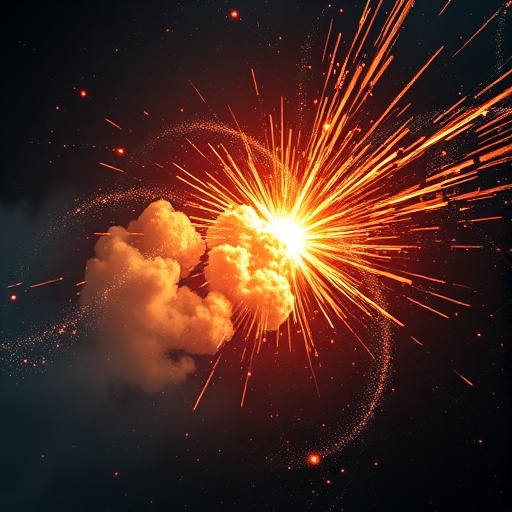
In an extraordinary cosmic event that sheds new light on the origins of the universe’s heaviest elements, an international team of astronomers led by researchers at Penn State University has localized a powerful short gamma-ray burst to a faint galaxy amidst a grand galactic merger. The event, designated GRB 230906A, is believed to have originated from the cataclysmic collision of two neutron stars approximately 8.5 billion light-years away, igniting an intense burst of gamma rays that briefly outshone entire galaxies. This discovery not only provides insight into the astrophysical processes driving such bursts but also highlights the significant role these neutron star mergers play in the cosmic synthesis of precious metals like gold and platinum.
Short gamma-ray bursts (GRBs) are among the most energetic and enigmatic phenomena observed in the universe. Unlike their long-duration counterparts, these bursts last mere seconds and are theorized to arise from the merger of compact stellar remnants—neutron stars—that spiral together under intense gravitational forces. When fused, these stars unleash immense energy and produce kilonovae: explosive events that shine brightly in multiple wavelengths and act as cosmic forges for heavy elements beyond iron. The detection of GRB 230906A was first reported by NASA’s Fermi Gamma-ray Space Telescope in September 2023, spotlighting its peculiar short burst nature and prompting follow-up observations using NASA’s Chandra X-ray Observatory and the Hubble Space Telescope.
Leveraging the high-resolution imaging capabilities of Chandra and the optical prowess of Hubble, the research team triangulated the source of the burst to a faint galaxy embedded in a larger assembly undergoing an active galactic merger. This environment is characterized by complex gravitational interactions that distort the member galaxies’ shapes, drawing out streams of stars, gas, and dust into extended tidal tails. These tidal features are not mere cosmic curiosities but dynamic laboratories where new stars are birthed amidst stirred-up gas clouds. The presence of GRB 230906A within such a debris field underscores a compelling link between these violent galactic encounters and the genesis of neutron star binaries responsible for such high-energy phenomena.
The tidal interaction between colliding galaxies appears to act as a catalyst for successive waves of star formation. This is crucial since the neutron stars involved in the observed gamma-ray burst likely evolved from massive stars born during a surge triggered by the merger approximately 700 million years prior to the merger event. As Dr. Simone Dichiara of Penn State elucidates, the dynamical forces at play within tidal tails compress gas clouds, igniting star formation that later leads to the creation of binary neutron star systems. Over hundreds of millions of years, the orbital dance of these compact remnants tightens until their final violent coalescence unleashes the observed gamma radiation and heavy element production.
Furthermore, the team’s observations highlight the significant role compact binary mergers play in enriching the cosmic environment with heavy elements. The violent fusion produces kilonova emissions—transient light halos arising from radioactive decay of freshly synthesized elements. These emissions serve as beacons, signposting cosmic sites where precious metals such as gold, platinum, and other r-process elements are forged in abundance. This discovery lends robust observational support to longstanding theoretical predictions that compact object mergers fundamentally shape the chemical evolution of galaxies and the interstellar medium.
Co-author and professor Jane Charlton emphasizes the profound cosmic implications of these results, noting that the heavy elements essential to Earth’s composition—and ultimately, to human biology—originate from explosions of this kind. Iron, for example, which constitutes a critical component of our blood and planetary core, has roots tracing back to countless dying stars over billions of years. Observing such bursts within dynamically rich environments strengthens the understanding that galactic collisions do far more than rearrange stellar populations; they effectively drive the elemental enrichment necessary for planetary systems and life to emerge.
A pivotal aspect of this research was the utilization of high-precision X-ray imaging afforded by the Chandra Observatory. Due to the faintness of the host galaxy and its embedding in a complex galactic tail, the pinpoint accuracy of Chandra was essential to linking the gamma-ray burst to its precise cosmic address. Without such instrumentation, the burst’s host could have easily eluded detection, obscuring key evidence about the environmental conditions influencing neutron star mergers and element synthesis.
While the current data position the GRB host at approximately 8.5 billion light-years, its exact distance remains an open question. Should future observations with next-generation telescopes confirm a greater remoteness, GRB 230906A may rank among the most distant short GRBs ever recorded, pushing the boundaries of our observational reach and giving fresh insight into early universe star formation and merger rates. Such measurements will refine models of cosmic history and elemental abundance distributions across space and time.
The study offers a glimpse into astrophysical processes that are not just relics of the distant past but are also ongoing. Our own Milky Way galaxy, hosting Earth and humanity, is destined to collide with its neighbor, the Andromeda galaxy, in about four to five billion years—a cosmic dance that will likewise generate tidal tails and trigger starburst activity. This future scenario suggests that the mechanisms unveiled by this research are fundamental and recurring themes in the evolution of galaxies, stellar populations, and cosmic chemistry.
Contributions to this discovery arose from a globally distributed team of scientists, including collaborators from Italy’s University of Rome-Tor Vergata, Carnegie Mellon University, The Open University of Israel, George Washington University, Mexico’s Universidad Nacional Autónoma de México, and Japan’s Aoyama Gakuin University. The convergence of expertise from multiple institutions underscores the collaborative nature of frontier astrophysics, where multifaceted observations and theoretical models coalesce to unravel the universe’s deepest mysteries.
This research was made possible through funding and support from NASA, the Smithsonian Astrophysical Observatory, the European Research Council, the U.S. National Science Foundation, the U.K. Science and Technology Facilities Council, and the Royal Society. Such sustained investment in space science and observatory infrastructure is vital for pushing the envelope of astronomical discovery and understanding the fundamental workings of our cosmos.
In summary, the identification of GRB 230906A within a peculiar galactic merger environment exemplifies how cosmic destruction acts as a catalyst for creation. The violent merging of galaxies initiates star-forming episodes that ultimately spawn neutron star pairs, whose dramatic collisions seed the universe with the building blocks of planets and life. As we continue to probe these distant and fleeting cosmic fireworks, we deepen our grasp of the origins of the elements that constitute the very fabric of our existence.
Subject of Research: Not applicable
Article Title: A Merger within a Merger: Chandra Pinpoints the Short GRB 230906A in a Peculiar Environment
News Publication Date: March 10, 2026
Web References: http://doi.org/10.3847/2041-8213/ae2a2f
References: The Astrophysical Journal Letters
Image Credits: Illustration by Maria Cristina Fortuna/NASA/Chandra X-ray Center
Keywords
Cosmic rays, gamma-ray burst, neutron star merger, kilonova, element synthesis, galactic merger, tidal tail, star formation, astrophysics, Chandra X-ray Observatory, Hubble Space Telescope, cosmic evolution
Tags: astrophysical processes of gamma-ray burstscosmic neutron star collisionformation of gold and platinum in universegalactic mergers and cosmic eventsgamma-ray bursts from compact objectsGRB 230906A discoveryheavy element synthesis in spacekilonova explosions and heavy metalsmultiwavelength kilonova observationsneutron star merger astrophysicsPenn State astronomy researchshort gamma-ray burst origins